
 Today the Canadian Journal of Psychiatry published an article that the media has picked up upon that states that depression is more prevalent in obese patients.
The Montreal Gazette states, "Obesity-depression link is confirmed", CanWest News Service states, "Obesity, depression have same root causes, study suggests".
So what did the study state? It stated that 19% of obese Canadians were depressed compared with "only" 15% of the general population.
To me that sure doesn't seem like a slam-dunk difference.
There are many co-morbdities associated for obesity that apparently were not controlled that almost certainly could contribute to the development of depression. Things like pain from increased incidences of osteoarthritis, worry from cardiovascular disease and diabetes, bias and discrimination in the workplace, frustration with weight loss difficulties.
As well, the majority of medications used in the treatment of depression themselves directly lead to weight gain and while the medication induced weight gain is not always dramatic, it can be.
Bottom line for me is that there are a lot of realities commonly associated with obesity that are in and of themselves depressing and there are a lot of realities associated with the treatment of depression that are in and of themselves obesogenic.
Thursday, April 20, 2006
The very shaky "link" between obesity and depression


Wednesday, April 19, 2006
The American Board of Bariatric Medicine

Did you know that the only medical body in North America that offers any form of certification in Obesity Medicine is the American Board of Bariatric Medicine?
I find it astounding that despite weight and diet related illness being the second most preventable cause of death in North America, contributing billions of dollars in health care costs and dramatically affecting patients' qualities of life, that there is only one organization specifically designed to certify and educate physicians in the whys and wherefores of weight management.
Having gone to medical school in the 1990s, I can tell you first hand that weight management was certainly not something discussed in more than an, "eat less, exercise more" manner.
While at the end of the day of course that's what weight loss comes down to, weight is complicated. It's a complex interplay involving genetics, learned behaviour, co-existing medical problems, medication, and lifestyle and there's no question that the average family doctor probably was not taught enough to properly address it.
I can only hope that over the course of the coming years, medical schools and residency programs start taking obesity seriously and help educate future physicians not only in weight management, but also helps teach them how to compassionately address this sensitive and complicated issue.
Monday, April 10, 2006
The Nutricate Receipt - Great idea!
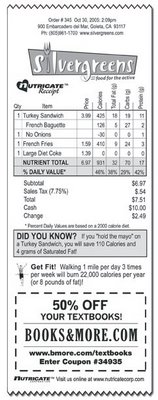 The Nutricate Corporation based out of Santa Barbara, California has come up with a brilliant new receipt for restaurants - the Nutricate Receipt which provides nutritional information regarding the meal you've just paid for.
I love this idea, but it would be better if at the bottom of the receipt it would give a breakdown of how long you'd have to exercise to burn off those calories. For instance in their demo receipt some poor soul had 931 calories for lunch. In order to burn that off he/she'd have to walk at 3.5mph for 3.5 HOURs or cycle at 10mph for 2.2 HOURs.
So was that turkey sandwich and fries really worth it?
Tuesday, March 21, 2006
Skinny? Have I got a hotel for you!

Norden, Germany. Juergen Heckrodt the owner of Hotel Ostfriesland has an interesting policy. He charges half a euro per kilogram for his rooms with a maximum cost of 39 Euros.
While this policy may not impact on global obesity rates, it's certainly unique!
Tuesday, March 14, 2006
Do play the McGame!
 Find out if you have what it takes to run a ruthless multinational corporation! Play the Mcvideogame and you can play like the big boys - exploiting underdeveloped countries and low-wage workers, feeding cattle hormones and antibiotics to boost growth and improve your bottom line.
Friday, February 24, 2006
Don't drink the McWater
 Enter Jasmine Roberts, a 15 year old high school student in Tampa, Florida. Clearly an inquisitive young woman, she hypothesized that the ice machines in fast food restaurants would be great homes for bacteria.
So what she did was collect ice from 5 different fast food restaurants and plated the melted liquid on agar (bacteria food).
Here's where you get to smile. For a comparison group, she used toilet water from those same restaurants.
The results?
In Jasmine's words, "I never thought the toilet water would be cleaner"
Don't drink the McWater...or at the very least, don't have the McIce.
Wednesday, February 22, 2006
Cafeteria Big Brother

Parents in Houston now have a new tool in their battle against childhood obesity - Cybersoft Primero ParentOnline (warning PDF) allows parents to restrict the choices their children make in the school cafeteria. If you don't want little Billy to have dessert, simply don't allow it in his profile. As well, parents will be able to track their child's choices.
While this indeed may be helpful, it does seem a bit overlordish to me.
At the end of the day, the best way to treat your children is to focus on yourselves. If you take the time to make healthier dietary choices, control your own portions, limit desserts, and make exercise a part of your daily lives, guess what, your children will learn from you. If instead exercise consists of picking up the remote control, food is hurried, dessert is frequent, that's going to be what your children learn.
Monday, February 20, 2006
Gatorade vs. Pedialyte - Who ya got?
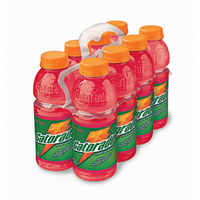
Good news for parents with kids with vomiting and diarrhea. As we all know products like Pedialyte are very expensive and actually have expiry dates that make us feel guilty if we have them on hand. A study done in India randomly divided 61 kids into either getting Gatorade or a commercial pediatric electrolyte solution. The results? No differences.
I'd be recommending 3/4 strength gatorade any way you can get it into your kid. Remember, chugging may well lead to vomiting so a tablespoon every 5 minutes or in the form of a popsicle are probably the better ways to go.
Thursday, January 12, 2006
Actually some good news for obesity...unless you live in Italy

A survey of 1900 Americans yesterday reported somewhat shocking results. The percentage of Americans who viewed overweight people as less attractive dropped from 55% back in 1986 to 24% today. Given the rapid rise in overweight and obesity rates, that's actually fairly good news - especially considering that obesity certainly is still considered by many to be an acceptable target for scorn.
Of course, that's an American survey. Results were also released yesterday regarding a survey conducted in Italy that showed that Italians viewed obesity as "worse than adultery" in the hierarchy of deadly sins.
Thursday, January 05, 2006
TV vs. BOB - Who Ya Got?

As many people know, TV viewing increases the risk of childhood obesity. In fact, it has been shown that the risk of obesity in pre-school children increases by 6% for every hour of television he or she watches per day and if there's a TV in their bedroom, their risk rises by 31%
Enter BOB. BOB helps parents manage their child's TV time. It utilizes a personal PIN number and allows parents to set the number of hours a child is allowed to watch television per week and also provides individual user reports for each PIN.
So TV vs. BOB....who ya got?
Monday, January 02, 2006
If you're trying to lose weight, stop reading this!

Dr. Angelo Tremblay and researchers out of Quebec did a fascinating study. They took 15 University students and randomized them into two groups. One group sat and rested for 45 minutes. The other group had to read a document and write a 450 word summary of it. They were then all led to an all-you-can-eat buffet.
Guess what, the people who spent time thinking ate considerably more than those who rested.
Are you still reading? For heaven's sake stop already, you're going to get hungry!
Thursday, December 22, 2005
Why newspapers are bad sources of medical information

I'm not even going to bother doing the work here. The anaethetist blogger I mentioned before did a great job of deconstructing news reports that suggest that based on a recent study, getting a chest XRay to rule out cancer is a good idea.
Bottom line - quite often, mass media is an atrocious place to look to for medical information....unfortunately that probably also includes blogs (but not this one or bookofjoe :-) ).
Always ask yourself, who's the source and what's their motivation. In the case of the media, the motivation may simply be sales. An article entitled, "Chest XRay screening doesn't help to prevent lung cancer" will sell less articles than the one that says, "Get a chest XRay - it may save your life!"
That being said, there are some excellent medical journalists out there - you just need to learn who you can trust.
Cool scanner

Sorry that it's been so long since I posted. I got derailed by a bachelor party in Las Vegas.
Glad I didn't have this scanner there to tell me that I was not living in a healthy manner.
To my eyes it looks like it rivals MRIs in quality. Hopefully the $1,800,000 price tag will come down given that the technology, if CT scanner based ought to be a heck of a lot cheaper.
Wednesday, December 14, 2005
Fibre - not a miracle, but still great

So a very solid report came out today in the Journal of the American Medical Association that looked at studies that pooled over 725,628 men and women for up to 20 years to determine whether or not diets high in fibre reduced the risk of colon cancer.
The facts are straightforward, people eating diets higher in fibre do have a lower risk of colon cancer BUT it's probably not because of the fibre. It's probably because people who have diets high in fibre often live healthier and make healthier choices overall.
The fact is that dietary fibre DOES help reduce cholesterol levels, it DOES help keep calories under control, it DOES help reduce the body's resistance to insulin and overall is still a great idea to include in a healthy life.
Monday, December 12, 2005
3DPS vs. Measuring tape

Talk about overkill.
A report on the news about a 3-dimensional photonic image scanner which uses 4 lasers to measure over 2 million points on the body.
What's it for?
It's to measure the incidence of abdominal obesity, otherwise known as apple-shaped. Not a bad thing to measure given that there is greater risk with abdominal obesity.
Want to know what I use in my office?
A tape measure.
Measure at roughly the umbilicus. More than 35 inches in women and more than 40 inches in men is said to confer greater risk.
Saturday, December 10, 2005
How many calories a day do you burn?

So if you want to lose weight, one of the most important things you need to know is how many calories a day you actually burn.
Over the years there have been many methods and equations used to make this determination. The picture in this post is an old standard called a, "Douglas Bag". Basically it allows docs to figure out how much oxygen you've burned and extrapolate from there how many calories you've burned.
Newer methods include such things as indirect calorimeters and some even fancier devices.
While there are some places that have indirect calorimeters (like us at the Bariatric Medical Institute), at least 90% of the time the equations are pretty accurate.
The best equations I've found are located here.
Once you know how many calories you burn then if you simply keep track of calories using a food diary or an online service, so long as you eat less than you burn, you'll lose weight.
The trick is, you've got to like the way you're living - that's where keeping track of calories is so helpful. By having an idea of how many calories you burn and keeping track of how many calories you have it allows you to answer a very easy question, "Is it worth the calories" when you're considering having something to eat. The other thing to remember of course is that sometimes, it ABSOLUTELY is worth the calories. Food plays a role in comfort, celebration and just like that decisions. If you lose the ability to choose less than perfectly from time to time, well then you're on a diet, and guess what, diets fail over 98% of the time.
Thursday, December 08, 2005
DARE to exercise - it could save your life!

Dr. Ron Sigal, from my hometown Ottawa, recently presented the largest study ever of its kind looking at the effect of exercise on type II diabetes (formerly known as adult onset diabetes until children as young as 8 began developing it due to our toxic food environment)at the Canadian Society for Exercise Physiology conference.
To summarize, Dr. Sigal's work proved that after 22 weeks of close to 200 minutes per week of exercise, that aerobic plus resistance strength training were as good as taking a medication for diabetes.
While this doesn't mean go off your drugs and go and exercise, you may well be able to reduce your diabetic medications by getting in shape.
If you want more reasons to exercise - Ron's work demonstrated that exercise translated for many patients into a 15-20% reduction in the risk of heart disease and up to a 30% reduction in the risk of diabetic complications such as blindness and kidney failure.
Exercise need not be brutal - you don't need the sweat bursting out of your brow for it to count. Start with a great pedometer and set the simplest of goals - more steps than yesterday.
You may just save your own life.
Tuesday, December 06, 2005
DUH

The Institute of Medicine released a report today that stated that targeting children with advertisements for high calorie foods and beverages likely contributes to rates of childhood obesity.
Of course they do.
The fact is that children under the age of 11 cannot differentiate truth from advertisement.
Just as it is now a crime to target children with advertisements for smoking, so too should it be for crappy foods.
Call your local member of parliament, congressman or senator and tell them it should be criminal...in some countries it already is!
Unless your doc runs a weight loss program, don't let them give you weight loss drugs

Just a quick post. A study published recently in the New England Journal of Medicine, confirmed something anyone involved in medical weight loss already knows - the drugs aren't so great all by themselves.
If your family doc prescribes you Meridia, Xenical or Phentermine but does not offer you guidance or support in lifestyle change, you're probably wasting a great deal of money. On the other hand, using these drugs in conjunction with a behavioural weight loss program can be quite beneficial.
If it were as simple as, "Here take this pill", over 65% of North America wouldn't be overweight. If it sounds too good to be true, of course it probably is.
Monday, December 05, 2005
Does Drinking Make you Skinny?

A friend just sent me an article stating that drinking moderately is associated with a lower risk of obesity.
The newsfeeds are of course all over it, even so far as to suggest that if you need to lose weight, you should consider NOT giving up alcohol.
That's just news-spin hogwash.
If you actually take the time to read the article you'll see that the "moderate" drinkers are also better educated, rate themselves as healthier and have higher incomes than the non or heavy drinkers. That probably means that they've got better access to health care, take better care of themselves and as my friend pointed out, if they are able to moderately consume alcohol, they can probably also moderately consume foods.

