
 Cover your ears medical organizations, low-fat is not the magic bullet for weight management. The low fat movement, born out of the simple fact that there are more calories per gram of fat than there are per gram of carbohydrate or protein, is dying a slow, painful death. Medical professionals and governments around the globe have latched onto the low fat approach as not only the healthiest way to live, but also as the only way to lose weight. It seems that finally, that tide is turning.
Two days ago the American Heart Association released their 2006 dietary recommendations and for the first time in over two decades, they focused on the currency of weight - calories, rather than just a blanket statement about the reduction of dietary fat (for full text visit the journal Circulation and read the 16 page scientific report of the AHA).
Another blow to the low-fat proponents came from this months issue of the journal Obesity where Rena Wing and Jim Hill have continued their exemplary reporting on what it takes to not only successfully lose weight, but more importantly keep it off. In 1994 Drs. Wing and Hill established the National Weight Control Registry in order to study people who had lost at least 30lbs and kept it off for at least 1 year (actually the average results are even better with the average registrant having lost 67lbs and kept it off for 5 or more years). What they found originally was that those folks who were successful did so with low-fat approaches. Of course the late 80s and early 90s were the low-fat diet years so it is not altogether surprising that the folks who enrolled in the registry had tried low-fat approaches. What had always frustrated me was that people often used the data from the registry to suggest that therefore low-fat was the only way to go. Well guess what, they're wrong - the registry is changing. In the article in Obesity, it turns out that those folks entering the registry in the late 90s and early 2000s in fact were much less likely to be on a low-fat diet.
Bottom line of course is it doesn't matter if it's low fat, high fat, low carb or high carb, if you're happy and it's less calories, it's good.
Wednesday, June 21, 2006
Low fat? Low carb? Who cares?


Tuesday, June 20, 2006
Television with Sole
 Gillian Swan, a design student in England, has designed yet another soldier in the fight against inactivity. Dubbed "Square Eyes" her unique shoe soles contain an electronic pressure sensor and a computer chip to record how many steps their wearer takes in a daytime. An embedded wireless transmitter then passes that information off to a receiver attached to the wearers television which decides based on the wearer's steps and exertion how much television they've earned that day. 100 steps = 1 minute of television.
Readers of my blog will know that I feel activity to be the smaller part of the equation with weight, but certainly any intervention that can help encourage (in this case perhaps force) children to be more active certainly cannot hurt.
Monday, May 29, 2006
A Healthy Search Engine
 The internet is a scary place to research your medical information. Anybody and his brother can make a very credible looking website to provide medical "information" and unfortunately much of the time, that information is woefully inaccurate. At times it may even be dangerous.
Thankfully, the folks who brought us Quackwatch have put together their own peer-reviewed medical search engine - The Internet Health Pilot. It searches only through evidence-based medical information and therefore provides only safe, reliable and informative results.
Tuesday, May 23, 2006
Don't Sit Too Close to the Candy Bowl!
 As anyone who's ever tried to lose weight before knows, proximity matters. Some foods simply can't be allowed into the house.
Now, thanks to Dr. Brian Wansink, we have proof that sitting too close to the candy bowl is probably a bad idea.
Dr. Wansink is the John S. Dyson Professor of Marketing at Cornell University and is the director of Cornell's Food and Brand Lab whose mandate it is to study "Why, What, When, and How Much We Eat".
In this months issue of the International Journal of Obesity Dr. Wansink details a study involving Hershey's Kisses.
The study was conducted over "Secretaries Week" where 40 secretatries from six different departments at the University of Illinois were given bowls of Hershey's Kisses. Each day each bowl was filled with 30 kisses. There were 20 clear bowls and 20 opaque bowls and there were four different study designs: Clear bowl right in front of you, opaque bowl right in front of you, clear bowl 6 feet away, opaque bowl 6 feet away. Every day researchers would swing by and count how many kisses were left in the bowl.
The results revealed that when the kisses were 6 feet away in an opaque bowl the average number of candies consumed per day was 3.1. 6 feet away in a clear bowl, 5.6, opaque bowl right in front of them, 4.6 and when in a clear bowl right in front of them, 7.7.
So not surprisingly, both visibility and proximity increase consumption. What was interesting was that proximity had a somewhat unexpected finding. When the food was more accessible people underestimated how many kisses they had vs. overestimating when further away.
A few bottom line messages. First, leave foods you want to eat more of in more visible and accessible locations. Don't banish your fresh fruits and vegetables to opaque crispers, leave them right out in the open on your fridge shelves and your countertops. Secondly, the bad stuff, don't necessarily throw it out but hide it behind other foods and banish it to the furthest reaches of your cupboard spaces. Lastly, if you ever get the chance to see Brian Wansinck give a lecture, jump at it - he's one of the best speakers I've had the pleasure of seeing.
Thursday, May 18, 2006
Self-hate Weight
 In this week's edition of the journal Obesity, there's a very sad article that quantifies just how pervasive the anti-fat bias in America really is.
It has long been established that obese people are stigmatized in education, employment and heath care. As well, it seems that the negative attitudes and stereotypes associated with obesity are acceptable in society given that we still regularly see them as the butt of jokes on television and in Hollywood.
It may surprise some readers here to learn that even obese people discriminate against the obese. In this study 37% of obese respondents reported that they preferred thin people, 27% of obese respondents said that thin people were more motivated and 27% of obese respondents said fat people were lazier.
This study also looked at "Personal trade-off items", meaning what would you be willing to give up or do in order to not be obese.
Of healthy weight individuals, 18% would rather give up 10 years of their lives than be obese, 36% would rather be divorced than be obese, 27% would rather be infertile than be obese, 21% would rather be severely depressed than be obese, 20% would rather be an alcoholic than be obese, 7% would rather lose a limb than be obese and 5% would rather be blind than be obese.
Now while those numbers are in and of themselves shocking, they become more shocking when you consider how the authors got their data. This study was funding and publicized by the Rudd Institute, an organization whose mission it is to address stigmatization and discrimination of obese individuals. The over 4000 respondents likely heard of the study either from the Rudd Institute's website, attending a presentation on weight sitigma given by one of the authors, or reading a news article on stigma that made reference to the website where the study's data were collected. Therefore the people who responded with such negative attitudes and stereotypes towards obesity were actually the people in society who might be expected to have the least amount of anti-fat bias.
Like the Rudd Institute says, "See the person, not the pounds". Clearly as a society, we still have a long way to go.
Tuesday, May 09, 2006
Track Calories with your Keychain!
 I always recommend tracking calories to patients trying to lose weight. The simplest analogy is money, and the currency of weight in our bodies is calories. Before you buy anything, you need to know how much it costs.
Calorie counting can be difficult and while there are many free online services that can help track calories (www.sparkpeople.com, www.fitday.com) they still require hunting for calories.
No more. Enter Training Peak's Calorie Scanner which conveniently fits on your keychain and then scans the barcodes of the foods that you're eating. Couple that with Training Peak's online/desktop calorie software and all of a sudden those barcodes translate into calories and nutritional information.
Only problem I can see is that my from scratch spaghetti sauce doesn't come with a barcode.
Cost is a bit steep as well - $216.30 for a scanner with a one year subscription.
Monday, May 08, 2006
It's Depressing to Stop Exercising
 This month the journal Psychosomatic Medicine published a very interesting paper on the effects of stopping exercise on mood.
Their study involved taking 40 regular exercisers (>30mins per time, >3times/week) who were not taking or receiving any psychological or psychiatric treatment, and simply asking 20 of them to stop exercising for two weeks. They then compared symptoms and mood between those who continued exercising versus those who stopped.
Within one week of stopping exercise, compared with folks still exercising the study subjects reported more fatigue and depressive symptoms which then worsened in week number two.
While we probably didn't need a study to prove this (anyone who exercises regularly and has to stop knows this to be true already), here is now proof of yet another reason not to stop exercising!
Friday, May 05, 2006
The HP Photosmart R927 Super Incredible Diet Plan
 Perhaps in response to our growing waistlines HP has come up with a Super-Incredible-Diet-Plan - don't lose weight and use their cameras with their "slimming" feature and presto-chango you've lost weight.
The picture here shows the subtle changes the camera produces using Hurley from Lost fame.
If this isn't a sad statement about where we've come as a society, I don't know what is.
Thursday, May 04, 2006
Today is Project ACES Day - Another misguided effort in the war on obesity.

I can't tell you how frustrated I get when events such as Project ACES are touted as soldiers in the fight against obesity.
Started by Len Saunders, a New Jersey schoolteacher in 1989 Project ACES (All Children Exercise Simultaneously) involves trying to get children across the world exercising for 15 minutes simultaneously.
Going to the Project ACES website it promotes itself as making, "fitness fun for kids", "promoting health and nutrition", "promoting sport and exercise", and "supporting physical education", and there is no doubt in my mind that all of those are worthy, wonderful and achievable goals for the Project.
You know what's not an achievable goal? Having 15 minutes of exercise a day put a dent in childhood obesity rates. Yet the AP describes Project ACES this way, "Students in all 50 states and at least 50 other countries were urged to exercise en masse for 15 minutes Wednesday, all to curb alarming rates of childhood obesity."
So why is it not reasonable to report Project ACES as an obesity intervention? Quite simply, exercise does not burn that many calories.
In fact I would argue that were the Canadian and American governments successful at getting every last citizen to exercise 30 minutes a day it would actually lead to North Americans growing even larger because then everyone would feel justified in rewarding their exercise with food. They would feel justified because our governments and countless allied health organizations constantly present the misguided notion that exercise alone is enough to lead to weight loss or prevent weight gain.
Fact is 30 minutes per day of exercise probably burns no more than 250 calories. Reward exercise with food 3 times a week and kiss 30 minutes of even daily exercise goodbye. It takes well over an hour of vigourous exercise to work off one Big Mac or a bag of potato chips.
If we are to succeed in preventing the rise of obesity in our countries, the focus has to be on food and more specifically on calories.
I can't tell you how many patients I've seen who've said to me, "I shouldn't be this weight because I exercise a lot", or, "It doesn't make sense because I only eat healthy food."
Obesity prevention, fitness and healthy eating are all extremely important determinants of health. To lump them all together as one effort takes away from the importance of each in our health and discourages those who "eat healthy" and "exercise" but don't lose weight, from ever trying.
Thursday, April 20, 2006
The very shaky "link" between obesity and depression
 Today the Canadian Journal of Psychiatry published an article that the media has picked up upon that states that depression is more prevalent in obese patients.
The Montreal Gazette states, "Obesity-depression link is confirmed", CanWest News Service states, "Obesity, depression have same root causes, study suggests".
So what did the study state? It stated that 19% of obese Canadians were depressed compared with "only" 15% of the general population.
To me that sure doesn't seem like a slam-dunk difference.
There are many co-morbdities associated for obesity that apparently were not controlled that almost certainly could contribute to the development of depression. Things like pain from increased incidences of osteoarthritis, worry from cardiovascular disease and diabetes, bias and discrimination in the workplace, frustration with weight loss difficulties.
As well, the majority of medications used in the treatment of depression themselves directly lead to weight gain and while the medication induced weight gain is not always dramatic, it can be.
Bottom line for me is that there are a lot of realities commonly associated with obesity that are in and of themselves depressing and there are a lot of realities associated with the treatment of depression that are in and of themselves obesogenic.
Wednesday, April 19, 2006
The American Board of Bariatric Medicine

Did you know that the only medical body in North America that offers any form of certification in Obesity Medicine is the American Board of Bariatric Medicine?
I find it astounding that despite weight and diet related illness being the second most preventable cause of death in North America, contributing billions of dollars in health care costs and dramatically affecting patients' qualities of life, that there is only one organization specifically designed to certify and educate physicians in the whys and wherefores of weight management.
Having gone to medical school in the 1990s, I can tell you first hand that weight management was certainly not something discussed in more than an, "eat less, exercise more" manner.
While at the end of the day of course that's what weight loss comes down to, weight is complicated. It's a complex interplay involving genetics, learned behaviour, co-existing medical problems, medication, and lifestyle and there's no question that the average family doctor probably was not taught enough to properly address it.
I can only hope that over the course of the coming years, medical schools and residency programs start taking obesity seriously and help educate future physicians not only in weight management, but also helps teach them how to compassionately address this sensitive and complicated issue.
Monday, April 10, 2006
The Nutricate Receipt - Great idea!
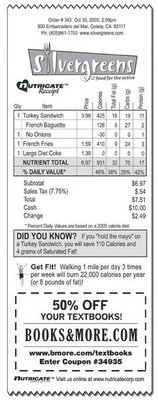 The Nutricate Corporation based out of Santa Barbara, California has come up with a brilliant new receipt for restaurants - the Nutricate Receipt which provides nutritional information regarding the meal you've just paid for.
I love this idea, but it would be better if at the bottom of the receipt it would give a breakdown of how long you'd have to exercise to burn off those calories. For instance in their demo receipt some poor soul had 931 calories for lunch. In order to burn that off he/she'd have to walk at 3.5mph for 3.5 HOURs or cycle at 10mph for 2.2 HOURs.
So was that turkey sandwich and fries really worth it?
Tuesday, March 21, 2006
Skinny? Have I got a hotel for you!

Norden, Germany. Juergen Heckrodt the owner of Hotel Ostfriesland has an interesting policy. He charges half a euro per kilogram for his rooms with a maximum cost of 39 Euros.
While this policy may not impact on global obesity rates, it's certainly unique!
Tuesday, March 14, 2006
Do play the McGame!
 Find out if you have what it takes to run a ruthless multinational corporation! Play the Mcvideogame and you can play like the big boys - exploiting underdeveloped countries and low-wage workers, feeding cattle hormones and antibiotics to boost growth and improve your bottom line.
Friday, February 24, 2006
Don't drink the McWater
 Enter Jasmine Roberts, a 15 year old high school student in Tampa, Florida. Clearly an inquisitive young woman, she hypothesized that the ice machines in fast food restaurants would be great homes for bacteria.
So what she did was collect ice from 5 different fast food restaurants and plated the melted liquid on agar (bacteria food).
Here's where you get to smile. For a comparison group, she used toilet water from those same restaurants.
The results?
In Jasmine's words, "I never thought the toilet water would be cleaner"
Don't drink the McWater...or at the very least, don't have the McIce.
Wednesday, February 22, 2006
Cafeteria Big Brother
Parents in Houston now have a new tool in their battle against childhood obesity - Cybersoft Primero ParentOnline (warning PDF) allows parents to restrict the choices their children make in the school cafeteria. If you don't want little Billy to have dessert, simply don't allow it in his profile. As well, parents will be able to track their child's choices.
While this indeed may be helpful, it does seem a bit overlordish to me.
At the end of the day, the best way to treat your children is to focus on yourselves. If you take the time to make healthier dietary choices, control your own portions, limit desserts, and make exercise a part of your daily lives, guess what, your children will learn from you. If instead exercise consists of picking up the remote control, food is hurried, dessert is frequent, that's going to be what your children learn.
Monday, February 20, 2006
Gatorade vs. Pedialyte - Who ya got?
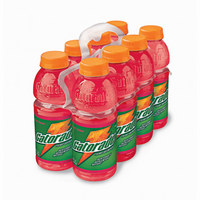
Good news for parents with kids with vomiting and diarrhea. As we all know products like Pedialyte are very expensive and actually have expiry dates that make us feel guilty if we have them on hand. A study done in India randomly divided 61 kids into either getting Gatorade or a commercial pediatric electrolyte solution. The results? No differences.
I'd be recommending 3/4 strength gatorade any way you can get it into your kid. Remember, chugging may well lead to vomiting so a tablespoon every 5 minutes or in the form of a popsicle are probably the better ways to go.
Thursday, January 12, 2006
Actually some good news for obesity...unless you live in Italy

A survey of 1900 Americans yesterday reported somewhat shocking results. The percentage of Americans who viewed overweight people as less attractive dropped from 55% back in 1986 to 24% today. Given the rapid rise in overweight and obesity rates, that's actually fairly good news - especially considering that obesity certainly is still considered by many to be an acceptable target for scorn.
Of course, that's an American survey. Results were also released yesterday regarding a survey conducted in Italy that showed that Italians viewed obesity as "worse than adultery" in the hierarchy of deadly sins.
Thursday, January 05, 2006
TV vs. BOB - Who Ya Got?

As many people know, TV viewing increases the risk of childhood obesity. In fact, it has been shown that the risk of obesity in pre-school children increases by 6% for every hour of television he or she watches per day and if there's a TV in their bedroom, their risk rises by 31%
Enter BOB. BOB helps parents manage their child's TV time. It utilizes a personal PIN number and allows parents to set the number of hours a child is allowed to watch television per week and also provides individual user reports for each PIN.
So TV vs. BOB....who ya got?
Monday, January 02, 2006
If you're trying to lose weight, stop reading this!

Dr. Angelo Tremblay and researchers out of Quebec did a fascinating study. They took 15 University students and randomized them into two groups. One group sat and rested for 45 minutes. The other group had to read a document and write a 450 word summary of it. They were then all led to an all-you-can-eat buffet.
Guess what, the people who spent time thinking ate considerably more than those who rested.
Are you still reading? For heaven's sake stop already, you're going to get hungry!

