
 Here I go stealing again. This time from the Center for Science in the Public Interest - perhaps my favourite group of non-profit nutritional advocates.
They've coined a term in their fantastic newsletter Nutrition Action. The term is Food Porn. It refers to foods that may well be enjoyable and tasty delicious, but either from a nutritional or a calorie perspective...not so hot.
It's going to be a new periodic feature on the blog.
Today's is example was on the menu last night at Legal Seafoods.
It was a special. Surf & Turf for two. Wanna know what was in it?
A 32 ounce steak, a 2.5lb lobster and 2 side dishes of our choice.
My estimated number of calories - 8000, not including drinks or dessert.
Yum?
Monday, October 23, 2006
Legal Seafoods' Food Porn


It's Nice to Meet one of your Heroes
 It's even nicer when they're nice.
When I was first considering changing my professional direction to obesity medicine I did a lot of reading.
One of the first books I came across was Dr. Walter Willett's Eat, Drink and Be Healthy. It's an evidence-based approach to examining what was healthy to eat and why.
I adored the book (it's of course linked on the side).
I read a lot, and continue to read a great deal.
It amuses me how much I look up to these men and women. The ones who do remarkable research, write elegant and intelligent journal articles. The ones who further our understanding of science and medicine.
When I see them in conferences I'm thrilled to be around them. I've even played with the idea of bringing their books and articles to be signed...but then I thought that would be too creepy.
A few days ago I had the pleasure of meeting Dr. Willett and you might say I had the pleasure of stalking him first.
He had a cloud of groupies like me hovering around him after a lecture. I waited and waited to speak with him, but the cloud didn't dissipate. Finally the cloud disappeared but he walked back into the lecture hall.
Following him and trying to look non-threatening, I sat down behind him. At the end of the lecture I asked him if I could have a moment of his time.
You see, Canada's Food Guide is about to be re-released and to my eyes, it is not even remotely reflective of our current best understandings of the role of diet on the prevention of chronic disease.
I've said as much in the House of Commons, but I'm not sure how loud my voice is.
I asked Dr. Willett if he would be kind enough to review the draft guide and offer his expert opinion. After all, in the world of voices on nutrition, there are not many, if any, louder than Dr. Willett's.
He agreed to do so and within 24hrs. had provided a thoughtful review of the Guide.
His conclusions I'll share with you another time (he didn't like it so much), I don't want to spoil this post with data.
This is just a thank you post.
Thanks Dr. Willett.
Sunday, October 22, 2006
Penn & Teller's Bullsh!t does NAASO!
 So what would you do?
One of your favourite "expose" shows wants to interview you, but the reason you love the show is because it's so entertaining due to how great the hosts are at skewering those dumb enough to be interviewed by them?
Guess I'm pretty dumb.
I love Penn and Teller's Bullsh!t show and when some guys with a camera asked me for an interview and told me they were freelancing for Bullsh!t...well surprisingly it wasn't a dilemma so we'll have to watch in March or April when they do their obesity expose and see if I got on.
As some of you may know, the NAASO - the Obesity Society's annual meeting is probably the largest obesity conference of the year. 5 consecutive streams of presentations with over 2,000 attendees from all over the globe.
Small wonder Bullsh!t came here, because with that many people some of them are bound to put their feet in their mouths.
Thing is I didn't mind being interviewed because I believe in what I'm doing with every fibre of my medical being.
Hopefully they won't make me look any stupider than I actually am.
Hey wait a sec...
Friday, October 20, 2006
My First Million Dollar Idea
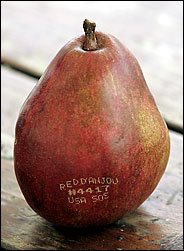 Again I'm stealing from bookofjoe. I can't help it. He's a great blogger. He often offers up his million dollar ideas for free to the first person willing to build them.
Well, here, up for grabs, is my first million dollar idea.
Sitting in an obesity conference all day long, you get to thinking about obesity.
Certainly one of the problems with regards to the development of obesity is the fact that if it sets in before the end of childhood, the likelihood is, it's going to stick.
One of the problem with childhood obesity is that the children are themselves consumers. And while you and I hopefully make health a priority in our lives, kids are dramatically swayed by marketing, with corporations preying on our children's unholy attachments to folks like Dora and using her simply to sell the pre-requisite Dora cereal and in general encourage children to consume highly refined, less nutritious foods.
I believe it was Dateline (or maybe 60 minutes...it was one of those shows) that showed children were in fact more likely to choose a rock with stickers of Sponge Bob on it for a snack, than a poor old banana.
Seeing that picture of the laser etched fruit got me thinking....
Why can't we laser etch Sponge Bobs and Doras and all sorts of cartoon characters onto our fruit and vegetables?
Now I know that this isn't going to in and of itself do a heck of a lot to stem the tide of obesity, but hey, if it'll help promote nutrition in our children, and at the same time generate profits for fruit and vegetable growers (both from increased purchase and from folks like Nickoledeon) it certainly can't hurt.
Probably a lot more than a million bucks for the person who can present Disney, Nickoledeon and others a means to market their cartoons on actually healthy products.
Thursday, October 19, 2006
It's easier to die than to win at McDonald's!
 Hat tip to Fast Food News for their expose on just how unlikely you'll win anything good playing the returning McDonald's Monopoly promotion.
To win even the smallest prize (a small McFlurry, a medium fries or a breakfast sandwich) your odds are 1 in 7.2 (that's seven nutritious trips to McD's!)
It gets more fun when we forget about the food and move on to the bigger ticket items.
Your odds of winning a Sony home theatre and flat panel HDTV are 1 in 91,697,000!
Your odds of winning a trip to Vegas are 1 in 114,621,250!
Your odds of winning a $50,000 prize are 1 in 3,500,000,000!
Your odds of winning the $5,000,000 grand prize are 1 in 41,497,391,309!
To put this in perspective for you I turned to the National Safety Council.
Buckle your seatbelts; you are 4,994 times more likely to die in a car accident this year than win the TV.
Hold onto that bannister; you are 625 times more likely to die falling down stairs this year than win the trip to Vegas.
Maybe drinking's not so fun; you are 4,729 times more likely to die from accidentally choking on your own vomit this year than win the $50,000.
and lastly....
Maybe move to Slovenia; you are a staggering 2,529,865 times more likely to get murdered this year than win the $5,000,000 grand prize.
Ain't stats grand?
Tuesday, October 17, 2006
Calories from your toolbar!
 Readers of this blog will know that I'm a strong believer in knowing about calories.
I don't believe in good calories or bad calories, I just think they're a good thing to be aware of.
The fact is, the currency of weight is calories. While certainly every single body is different and there are genetic differences in the ways people gain and lose weight, there's no doubt that in order to lose weight you need to eat fewer calories than you burn and that in order to gain weight you have to eat more calories than you burn.
For those reasons, I think it's a good idea to know calories. The analogy I like to draw upon is money.
Before I slap down my credit card, I like to look at the price tag of whatever it is I want to buy. Doesn't mean that price is the only thing that affects whether or not I'll buy something, but it definitely will factor into my decision making process.
Same thing for me with calories.
Knowing the calories in a food before I consume it factors into my decision as to whether or not I think it's worth it.
Calorie king, a brand and a website is a great place to look up calories, and I recently discovered that they've got a toolbar that installs with both Firefox and Internet Explorer where you can look up calories right off your toolbar.
Thanks Calorie King!
Monday, October 16, 2006
Hurray for Disney!
 Wow, never thought I'd utter those words!
Today Disney issued a press release stating that by 2008 it will have placed voluntary limits on trans fats, added sugars and remarkably calories in not only its theme parks but also its licensed and promotional products.
This is fairly remarkable stuff considering Disney has a very lengthy history of helping sell fast foods, sugared cereals and more and they have capitalized for literally decades on the inherent trust with their brand name.
Kelly Brownell, in his excellent book Food Fight (linked on the sidebar), recounts a story one of his colleagues told him about their four-year-old daughter at the supermarket seeing Betty Crocker's Disney Princess Fruit Snacks with Cinderalla, Snow White and the Little Mermaid on the box.
Daughter: "I Want that."Bottom line, Disney's got a lot of clout in the Supermarket.
Mother: "What is it?"
Daughter: "I don't know."
Good on ya Disney.
Saturday, October 14, 2006
Don't Drink the Cough Syrup!
 A patient asked me yesterday how many calories were in cough syrup. She'd been sick for a week and figured that she's been going through close to 8 teaspoons a day.
You know, I'm not usually surprised by calories.
This time I was floored. 15 calories per teaspoon!
Doesn't sound like much to you?
Drop per drop cough syrup has ELEVEN times the calories of Coca Cola!
To put that in perspective, my patient, by having the recommended maximum of 8 teaspoons a day, was drinking the equivalent number of calories of 1.2 cans of Coke.
There is some good news. There are sugar free cough syrups out there. I found one from Robitussin. I love their description of the product, it's almost a Quobesity,
"Robitussin® Cough Sugar-Free DM is specially formulated for diabetics, and health conscious consumers"I can't completely disagree with them.
What they're inferring of course is that if you're not health conscious, feel free to choose their other cloyingly sweet, ridiculously high in calorie, products.
Thursday, October 12, 2006
Quobesity
 Last week was my wife's birthday and as per our family's tradition, she picked her dinner of choice.
Just because I practice obesity medicine certainly doesn't mean I'm a perfectly healthy eater, nor do I preach to my patients that they need to be. It's about living the healthiest life a person can enjoy, not living the healthiest life there is.
I believe that one of the worst things someone trying to lose weight can do is to irrationally restrict dangerous foods. Doing so creates what I call "forbidden foods" which in turn have been shown by Christopher Fairburn to be very common triggers for binge eating (His book, Overcoming Binge Eating is linked on the sidebar and is certainly the best self-help book for binge eating disorder ever written).
What can happen to folks with forbidden foods is that when they do finally decide to have some, not knowing when they'll get some next, they tend to binge on it. Often post-binge guilt is tremendously demoralizing and may lead a person to in fact binge more due to the now severe emotions, and those binges can sometimes lead a person to abandon their weight loss effort altogether.
In my practice I've literally written prescriptions for chips, chocolate, ice cream, pizza, chinese foods and more so as to get rid of the notion of danger foods.
There's a simple question to ask yourself about any high-calorie food, "What's the least amount of ______ I need in my life to like my life".
We ordered from a local place that truly makes great Chinese takeout.
Today's Quobesity comes from the front of the menu.
I highlighted it to help you read it.
It reads,
Healthy, low fat foods, cooked in 100% vegetable oil
Let me tell you, that food was dripping with health!
Should you Weigh Yourself Daily?
 Yesterday's New England Journal of Medicine reports a study conducted by one of the biggest names in weight maintenance research - Rena Wing.
Rena heads up the National Weight Control Registry along with another fella named Jim Hill. The Registry was established in the 90s to help flesh out the factors involved in successful weight loss maintenance. To get into the registry you must have lost 30lbs and kept it off for 1 or more years.
The article in NEJM looks at the application of a maintenance program delivered either via telephone, the internet or face to face.
Not surprisingly, those with more face time were better at maintaining their weight loss.
The media however has picked up on another statistic from the article - those that weighed themselves more frequently seemed to keep the weight off better.
Having heard Rena present her findings at last year's American Heart Association Obesity Lifestyle and Cardiovascular Disease Symposium (which by the way was one of the best basic overviews of obesity I've ever been to and it's available online here for free!) I asked her what I thought was an important question.
What I wonder is whether or not success leads to daily weighing or whether daily weighing leads to success?
What I mean of course is I would imagine that those folks doing well with their lifestyles, would be more likely to use the scale to reinforce their successes, while those doing poorly may in fact be reticent to step on a scale for fear of what it might tell them.
Where there's no doubt is the fact that nipping weight regains in the bud is integral in successful weight maintenance.
What I would also like to point out is that while you're losing weight, I'm not a fan of daily weigh-ins. The fact is that weight fluctuates quite dramatically due to water retention, constipation and clothing and therefore daily weighing can at times be incredibly demoralizing as you might feel you're doing everything right and the scale shows you're up in weight.
I usually recommend that during weight loss, weigh once weekly, stark naked, Wednesday mornings (so as to provide a buffer from the weekend), and while I still don't know who's the chicken and who's the egg with daily weights during maintenance, I do recommend to my patients that once they've stopped losing weight, stepping on the scale daily and watching the trend can be very helpful.
I think it just keeps a person's head in the game, the fact is if you've got a body that has the genetic gift of being able to store calories for the future, it's not a terrible idea to track where you're at.
Wednesday, October 11, 2006
Put your Health Check where your Mouth is!
 I don't know if the Heart and Stroke Foundation folks read my blog, but if they do, this post won't be news to them.
Over one year ago now, I first met with some of the great folks over at the HSF to discuss their obesity platform.
The HSF has done a bang-up job of getting involved in educating the public about the risks of obesity, and likely has steered some to seek help with weight loss.
The good news stops there.
Problem is that without any guidance on where to go for help with weight loss, and with so many unethical, non-evidence based, commission paying, product pushing, weight loss scams and snake-oil salesman, likely the HSF is helping to market consumer fraud.
Even worse, because most patients tend to blame themselves for their failures at weight maintenance (even if the blame lies with the program), the HSF may actually make it less likely for people to effectively treat their weight as they may see their most recent failed attempt as their last.
It's been a year since I presented my arguments to the HSF. At the time they seemed very genuinely interested in discussing the potential use of the pre-existing Health Check program (currently being used to identify "healthy" foods in groceries and restaurants) to weight loss programs - that way consumers could look to see if the weight loss program they were considering was ethically and scientifically sound.
They invited me to come and speak at one of their policy planning meetings, but then a month prior told me that I got bumped to the next meeting, I then got bumped again and I haven't hear back from them.
Next I took this idea to the Canadian Obesity Network and again received a great deal of interest and in fact they ran a straw poll where over 75% of respondents thought it was a good idea for them to provide weight loss program ratings.
Unfortunately nothing has happened since then.
I find it very confusing that public health agencies and nutritional advocates make such strong (and often scary) statements about the risks of obesity and then do nothing to help guide patients to responsible weight loss programs.
Someone has to step up.
Monday, October 09, 2006
"Not Your Father's PE"
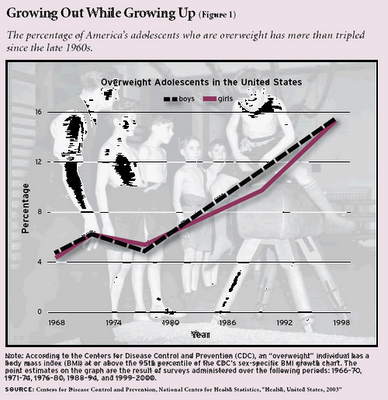 That's the title from a great article from John Cawley and colleagues out of the Hoover Institution and Education Next.
Not that anyone's going to listen to what they have to say.
You see they're saying things that most people don't want to hear.
They're saying that PE in schools is not going to be the magic bullet to our childhood obesity problem.
According to the article, adding an additional 200 minutes of PE time into a week led high school boys to report being active only an additional 7.6 minutes more per week!.
Perhaps the failure here has to do more with genetics and less with motivation.
A fascinating piece was published recently in the International Journal of Obesity. In it Dr. TJ Wilkin and colleagues proposed the existence of an "activitystat" in children whereby by means not yet elucidated (they propose neuro-hormonal regulation) somehow children are programmed to trend towards a specific amount of activity, and then not do more.
The study used uniaxial accelerometers (for objectifying the children's levels of activity) and then compared total daily activities in children with widely varied access to PE.
They included children from a school where they were receiving 9 hours of PE per week (of course a private prep school) to one where they were receiving 2.2 hours per week (a public school with an "Activemark Gold" award for their devotion to PE) to one where they were receiving 1.8 hours per week (an inner city school with no special provisions or facilities for exercise).
What was remarkable was that after all was said and done, all the kids were equally active (or equally inactive depending on how you choose to spin the article).
The kids who exercised more at school, exercised less at home and vice-versa.
To put this all into a different perspective. To burn off one Slammer, a kid would need to be vigourously active for over 30 minutes.
According to Dr. Cawley, assuming a kid only drinks one of these weekly, we'll have to add 10 hours of PE just to burn it off.
Too bad about those vending machines....you think maybe if we got rid of them altogether, or stocked them solely with water, zero-calorie beverages and skim milk (plain old skim milk), that we'd have more success than trying to make kids move?
Such a shame that politically, that'll be more of a challenge.
Sunday, October 08, 2006
We live in a very strange world
Not only because this event actually took place, not only because someone televised it, but mainly because of the use of the term, "athlete", by the commentators and the fact that one can make a living as a "professional eater".
Friday, October 06, 2006
Like-a-Bike
 It's not a bike, but it's like-a-bike.
My wife wouldn't let me buy one, she said it was too expensive.
Basically picture a small, toddler friendly bicycle with no pedals. By using their feet, children are able to propel themselves forward and by lifting their feet up, they're able to start to learn how to balance.
Apparently kids who use these basically graduate to two-wheelers and skip the training wheels.
On the website there's a great video of a kid tooling around on one.
I may have to buy one without my wife's permission.
Quobesity
 Went down to the House of Commons again yesterday to watch the Standing Committee on Health's continued focus on Childhood Obesity.
What was striking was how little some of the "experts" knew about the subject at hand.
A number of the experts were economists and indeed, when it came to their opinions on the effects of "fat taxes", I would not question their knowledge bases. It's when they strayed from their subject at hand when the quobesity flowed thick.
One gentleman concluded that the reason for childhood obesity had nothing to do with eating and everything to do with a lack of exercise.
He surmised that he already knows what's healthy, that he can "just ask his butcher just to cut some of the fat off of his steaks", but that it's lack of exercise that has led the World to gain weight.
He continued to wax philosophic on this culminating with today's quobesity installment.
"Why can't they just make a healthier chip? You know, I bet there already are healthy chips, I bet they sell them in health food stores."
Thursday, October 05, 2006
The Wee-Ride
 As the newspapers will tell you virtually daily, childhood obesity rates are growing rapidly. Parents will often call me to ask me what they should do about their overweight kids and generally my answer's always the same - treat your lifestyles.
Kids are not going to live lives different from their parents. Live the life you want your child to live, and that includes healthy regular eating with no meal skipping or snack skipping, calorie awareness and exercise.
Perhaps the easiest way to exercise is to focus on what I often call "Functional Exercise" rather than gyms, and perhaps one of the best functional exercises is going out for family walks or bike rides.
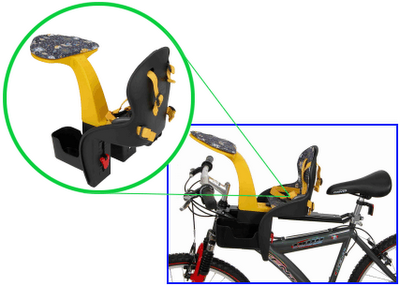
The Wee-Ride looks like a great option in place of one of those rear baby carriage thing. With the Wee-Ride you can talk easily with your child while riding and not have to worry about what's going on behind you. You can also buy an additional mounting bar so the Wee-Ride can be swapped between parental bikes.
Remember of course, once your child is old enough to ride, a better option would be their own bike.
Tomorrow I'll post on a great bike related product for toddlers.
Wednesday, October 04, 2006
Quobesity
 A new periodic feature on Weighty Matters will be Quobesity - quotes that in one way or another embody what's wrong and hopefully, occasionally, what's right with relation to our attitudes and knowledge about weight and weight related matters.
This quote comes from this past Sunday's Run for the Cure (for breast cancer research) where I'm proud to say that BMI won the Corporate Spirit Award by raising more money than any other team in Ottawa (not bad for a "corporation" with 5 full time employees) - we raised over $30,000!
As we were leaving the event some young teenagers working for McCain's were distributing their latest product - Smooth-EEZ, basically a just add milk and stir smoothie.
We asked them how many calories were in the servings and their response is today's Quobesity
"Oh not many! There's no sugar added - it's sweetened with honey!"For the record, more calories drop per drop than Coca Cola.
Tuesday, October 03, 2006
Geek-a-Cycle
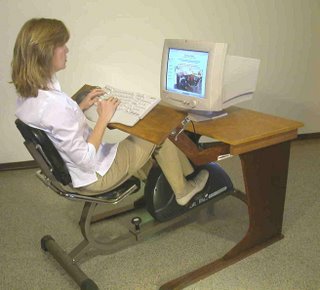 Hot on the heels of bookofjoe's treadmill desk comes the self-proclaimed "Geek-a-Cycle".
Touted as a means to pedal your way to a healthier you.
May not cause dramatic weight loss, but certainly ala Dr. Levine's NEAT hypothesis of weight management, it certainly can't hurt.
Yours for just $349.95, computer equipment not included.
Monday, October 02, 2006
Slammers - Coming soon to a school near you
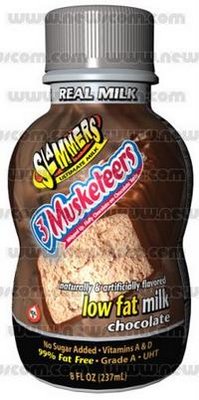 Horrifying. Here's an example of Big Food gone bad.
The press release touts their 99% fat-free-ness and their smaller 8oz serving sizes. It also brags how they meet the newer American Beverage Associate guidelines.
Here's their quote, "We saw an opportunity to create 'kid friendly', 99% reduced fat milk that is not only delicious to students, but also makes parents happy from a health and nutrition standpoint. We moved quickly to design a new package, and are proud to be the first company to provide vendable milk that meets the guidelines."
Wanna know what's in 'em?
According to the nutritional information (that took way too many clicks to get to) drinking just one of these will give your child 340 calories, more than DOUBLE the calories in a can of Coca Cola and almost 10 teaspoons of sugar.
I think that the parents that are being made "happy from a health and nutrition standpoint" better learn how to read nutrition facts labels. Might be good for them to know too that if their child's a 6 year old girl, that one drink likely accounts for 25% of the total number of calories she needs in a daytime!
Shame on Coca Cola for trying to market something so unreasonably unhealthy as a nutritious choice for children.
Friday, September 29, 2006
Food Industry Spin Doctors
 Yesterday I was given the honour of speaking in front of the Canadian House of Commons Standing Committee on Health on the subject of childhood obesity.
The panel I was on included one other clinician (a dietitian from London), an indigenous person's nutritional advocate, and then 3 corporate spokespersons representing a diverse range of companies from the restaurants, to Coca Cola, to Kentucky Fried Chicken.
Amazingly, but entirely not surprisingly, the industry spokespeople did their best to spin things in their favour.
The party line of course is that because obesity is so complex and multifactorial, to pick on any one thing as a cause would be inappropriate. I actually agree with that statement to a degree, but have a difficult time with the conclusion of all of these industry reps that therefore we should not pick on any of the various and multiple factors.
The Restaurant Industry's spokesperson tried to explain how mandatory labeling on menus of calories would be impossible due to supply chain variety. Amazingly she did that in the same breath that she mentioned the 42% of restaurant chains who voluntarily carry nutrition information in brochure form. I highly doubt that these brochures change with the supply chain.
She also questioned the value of putting calories on menus and stated that there has never been any evidence to suggest that calories on labels help. In fact that's not true. In a study available online, a high school, without providing any extra classes on the subject, simply posted calories on their cafeteria's menuboard. Immediately they noticed students choosing lower calorie options.
Certainly it would not take a degree in dietetics to know that the 2900 calorie Aussie Fries appetizer at the Outback steakhouse might be a poor choice.
Next was the beverage industry where there was much bragging about how they voluntarily took pop out of schools and replaced it with fruit drinks, juice and sports drinks. The spokesperson even bragged about the size of their containers: 250ml (8oz) containers for elementary schools, 300ml (10oz) for middle schools and 355ml (12oz) for high schools.
I of course had to point out that the expert advisory panel for the American Academy of Pediatrics with representatives from the Canadian Pediatric Society recommend that for children between 1-6 years old juice intake should be limited to 125-175mls (4-6oz) and from 7-18 years old limited to 250-355mls) and therefore every child through grade 9, with a single serving from the vending machine, actually exceeds daily recommended intake of juice. I would also like to note here that the daily recommended intake of fruit "drinks" and sports drinks is 0ml.
Remember drop per drop there are more calories in orange juice than Coke.
Now I don't blame the industry at all. They're doing their job. It's just a shame that more often than not, there's not someone there to unspin them.
Monday, September 25, 2006
Are you Giving your Kids Chocolate Bars for Breakfast?
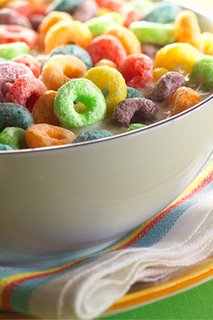 Would you feed your children chocolate bars for breakfast?
If you answered, "of course not" but give your children sugary cereals, you'd better get ready to revise your answer.
If you read food labels regularly, this might not be news, but if your child is eating a sugary cereal for breakfast, they're probably having as much or more sugar than they would if they ate a chocolate bar.
Some equivalents (based on a 50gm or 1.75oz serving):
Kellogg's Fruit Loops = 5.6 teaspoons sugar = Dark Chocolate Kit Kat Bar
Nestle Nesquick = 5.8 teaspoons sugar = Twix Bar
Post Sugar Crisps = 6.6 teaspoons sugar = Snickers Bar
Remember too that many kids will have more than one bowl.
So what should you do?
Try to give your kids cereals with 6-7 grams of fibre per serving, and unfortunately you have to be a bit cautious with the lower sugar cereals as well as often they may compensate with more carbohydrates and more calories.
Is it time yet to cut the sugary cereal out of the pantry?
Saturday, September 23, 2006
French Women DO get fat!
 You may have seen this book on the bookshelves. It's been a national best seller all over the world. Unfortunately it seems, the french women, aren't reading the book (or perhaps, like 98-99% of diet books, it fails in the most important part of weight management - sustainability).
A national survey conducted annually in France show that in fact overweight and obesity rates are rising rapidly. Currently 42% of France's population over the age of 15 is either overweight or obese.
It should be pretty telling to consumers. As of today, there are over 178,285 different diet books for sale on Amazon.com. If any single one of them was dramatically better than another, doctors offices worldwide would be prescribing it. In fact in the history of medicine, there has yet to be a study the definitively proves one diet is better than another for weight loss.
In my office at the Bariatric Medical Institute, there are no prescribed diets. Every person is an individual, with different cultural backgrounds and different dietary likes and dislikes.
Here are the only two criteria that matter for diet and weightloss:
1. You eat less calories than you burn (that will help you lose the weight)
2. You like what you're eating (that will help you keep it off)
Tuesday, September 19, 2006
Quiznos Calories
 Many times I've heard patients complain that they can't find any calories for Quiznos Subs. It's the subject of many angry rant blogs. I agree it's ridiculous that Quiznos USA refuses to release their nutritional information but the same cannot be said about Quiznos Australia. Over there their nutritional information is posted.
Now it's true not all the subs are the same as in the States, but given the nature of franchises I would imagine the numbers may well be comparable.
Only problem is their calories are listed in kilojoules.
To convert Kilojoules to Calories simply divide the number of kilojoules by 1000 and multiply by 239.
If you're worried about Calories, don't order the large white bread classic italian. It'll cost you 6755 kilojoules or 1614 calories, more than many of us burn in a daytime.
Thursday, September 14, 2006
McDonald's donates $2 million for obesity research
 Today McDonald's, in reference to the problem of childhood obesity reported that they "felt we needed to get greater education in this area" and therefore decided to donate $2 million in obesity research funding to the Scripps Institute.
Now by no means am I bashing McDonald's for funding research, nor am I bashing them for wanting to know more about childhood obesity, or even for the way they make their money.
I am however shocked that they feel the need to donate $2 million to help them to understand how they might play a greater role in the prevention of childhood obesity.
Without even wading into the debate about marketing food to children, how about they simply start dramatically reducing the portion sizes and calories counts of their children specific foods?
Hey, McDonald's, if you'd like to pay me even just $200,000 I'll help you out...anyone over there reading this? Anyone?
Friday, August 25, 2006
Star*!%*&ucks!
 Ok, I admit I took some blogger license with the post title. I've got nothing against Starbucks and in fact enjoy their coffee very much.
I am however going to use them to illustrate why the visible posting of calories on food items would be helpful.
Let's take a hypothetical 45 year old 150lb woman who like most North Americans, is inactive. According to the metabolism calculator I've referred to in a prior post, she likely burns 1800 calories daily.
Like most days, she decides she's going to hit Starbucks for coffee and breakfast. Having read about the health benefits of whole grain oats she chooses the Island Oat Bar and a Caramel Frappucino (hold the whip cream).
The Island Oat Bar has 760 calories including a heart busting 8 grams of saturated fat while her frappucino has 390 calories for a grand total of 1150 calories (more calories than 2 Big Macs or 4 McDonald's Cheeseburgers) or 65% of her total daily burned calories. Small wonder she's gaining weight and small wonder when she goes to her doctor to complain, she reports, "But I really don't eat very much". The fact is, not very much of high calorie food can still lead people to high calorie intakes.
As far as I'm concerned, it's only a matter of time until there is legislation to have calories on menuboards. Until that time, the onus is on each of us to find the calories ourselves.
A great website to look up calories is www.calorieking.com.
Remember you can gain weight on an all-salad diet if you eat enough salad and you can lose weight on an all ice-cream diet so long as you don't eat too much.
At the end of the day, it's the calories that count.
Wednesday, August 23, 2006
NEWSFLASH: Being overweight isn't good for you!
 In what I'm sure will be a disappointment to those individuals who still persist in denying that there is medical risk associated with obesity a landmark study was published in today's New England Journal of Medicine.
527,265 people were followed for over a decade in determining the risk of weight on life expectancy. The study was controlled for ethnicity, smoking status, education, physical activity and alcohol consumption.
During the 10 years of follow up 42,173 men and 19,144 women died. The death curves were U shaped with dramatic increases in risk as weight climbed.
These data also included 186,000 non-smokers. In that group the risk of death from obesity and overweight was substantially strengthened.
When restricting their observations to those who were free of preexisting diseases again there was a strengthening of the relationship between weight and death.
The bottom line's not really news - being overweight or obese is bad for your health.
Friday, August 18, 2006
The Fat Clock
 You know those clocks that count? The ones that post a real-time count of things like a country's accumulating national debt, number of people on earth, people dying of various diseases?
Well there's a new clock on the block - the Fat Clock. Using a fairly sophisticated home-made algorithm the Diet Detective website has a clock posting the running tally of the weight of all Americans. It takes into account birth rate, death rate, population age and other variables.
According to the clock, Americans are currently gaining 1,267 pounds per minute!
Tuesday, August 08, 2006
Walk away (briskly) from depression
 A great deal of well designed research has been published demonstrating that exercise is just as good, if not better, than antidepressants for mild to moderate depression.
One of the best papers on the matter was published in 2000 in the journal Psychosomatic Medicine. In it Michael Babyak and his co-authors randomly assigned 156 depressed adults to one of three groups: Zoloft, Exercise, or Zoloft plus exercise. They then looked at depression after 4 months and again after 10 months utilizing the fairly standard Hamilton Rating Scale for Depression.
Exercise involved 10 minutes of warmup followed by 30 minutes of moderate intensity cycling, jogging or brisk walking and finally by 5 minutes of cool down. This was performed 3 times per week.
The results were impressive. After 16 weeks of treatment all groups showed significant reductions in their depressive symptoms. Medication worked faster, but by week 16 exercise had caught up. What was more impressive were the results at 10 months - those exercising had lower remission rates than those on Zoloft or a combination of Zoloft and exercise.
The authors summarized their results with the following statement, "Each 50-minute increment in exercise per week was associated with a 50% decrease in the odds of being classified as depressed"
Bottom line: Don't throw out your pills, but slowly, along with your doctor, it may be reasonable to try to trade your drugs for some great shoes and a minor committment to exercise.
Wednesday, August 02, 2006
That's one scary cookie jar!
 Here's a cookie jar you don't want to get your hands stuck in - the Shockolate Vault designed to keep you away from your goodies.
Not recommended by me as a diet aid, definitely recommended by me as a gag gift, the Shockolate Vault, can be set to "protect" your valuables or goodies for a given period of time. Try to get to them before the time is up and "there will be shocking consequences".
Would make for some interesting, amateur science experiements.
Tuesday, July 11, 2006
Are you ready for the McGym?
 So on July 7th in Whittier California, McDonald's opened up the "R Gym"
"Equipped with stationary bicycles attached to video games, dance pads, basketball hoops, monkey bars, an obstacle course, and a host of other games, the R Gym is intended to provide a fun, easy and convenient way for children to increase their physical activity."
Well at least they're not trying to suggest that it will help combat childhood obesity, though they do state,
"McDonald's is committed to educating its customers about balancing food consumption and physical activity."
I wonder then if they'll educate customers that in order to "balance" that Happy Meal at the R Gym, they'd better budget at least 75 minutes of time for their children to pedal furiously because the 600 average Happy Meal calories will take over an hour of vigorous activity to burn off.
Somehow, I doubt they'll tell their patrons that.
Monday, July 10, 2006
Dying, literally, for a Big Mac
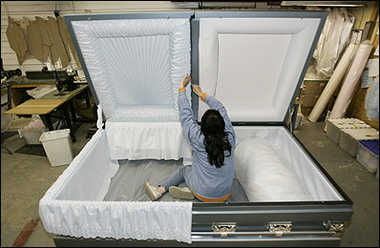 Much to my amazement, there exists a group of individuals who vehemently deny that obesity is medically risky. They're organized, write books and blogs, and often appear on national news shows claiming that it's all a big myth perpetuated through a combination of bias and capitalism. Should any of them read this blog, I would love their viewpoint on yet another in a never-ending line of well designed medical studies that clearly demonstrate the risks of obesity.
In this weeks Journal of the American Medical Association, Kathleen McTigue et al. looked at death rates and heart disease in 90,185 women following across 40 States for an average of 7 years.
Her results were not in the least bit surprising: The heavier the patient, the higher the death rate. For those with body mass indices between 30-35 death rates increased by 18%; for those with body mass indices between 35-40 death rates increased by 49%; and for those with body mass indices greater than 40 death rates rose by more than 100%.
An easier and far less scientific experiment is for you to think to yourself how many people dramatically overweight people you know who have made it past the age of 75. Speaking for myself and including the literally thousands of patients I used to have when I was working as a GP, along with the thousand or so I saw in stroke rehab, along with my friends and family, I can only think of around 30 over-75-year olds who had BMIs greater than 40, and none of them were living easy, carefree, healthy lives - they all had significant weight related co-morbidities that made their lives very difficult.
I'm all for beating down bias against obesity, and there's no doubt that some folks with significant amounts of weight to lose will lead long healthy lives unaffected by their weights. That being said, some smokers don't die from lung cancer, but of course that doesn't make smoking any healthier.
Wednesday, June 21, 2006
Low fat? Low carb? Who cares?
 Cover your ears medical organizations, low-fat is not the magic bullet for weight management. The low fat movement, born out of the simple fact that there are more calories per gram of fat than there are per gram of carbohydrate or protein, is dying a slow, painful death. Medical professionals and governments around the globe have latched onto the low fat approach as not only the healthiest way to live, but also as the only way to lose weight. It seems that finally, that tide is turning.
Two days ago the American Heart Association released their 2006 dietary recommendations and for the first time in over two decades, they focused on the currency of weight - calories, rather than just a blanket statement about the reduction of dietary fat (for full text visit the journal Circulation and read the 16 page scientific report of the AHA).
Another blow to the low-fat proponents came from this months issue of the journal Obesity where Rena Wing and Jim Hill have continued their exemplary reporting on what it takes to not only successfully lose weight, but more importantly keep it off. In 1994 Drs. Wing and Hill established the National Weight Control Registry in order to study people who had lost at least 30lbs and kept it off for at least 1 year (actually the average results are even better with the average registrant having lost 67lbs and kept it off for 5 or more years). What they found originally was that those folks who were successful did so with low-fat approaches. Of course the late 80s and early 90s were the low-fat diet years so it is not altogether surprising that the folks who enrolled in the registry had tried low-fat approaches. What had always frustrated me was that people often used the data from the registry to suggest that therefore low-fat was the only way to go. Well guess what, they're wrong - the registry is changing. In the article in Obesity, it turns out that those folks entering the registry in the late 90s and early 2000s in fact were much less likely to be on a low-fat diet.
Bottom line of course is it doesn't matter if it's low fat, high fat, low carb or high carb, if you're happy and it's less calories, it's good.
Tuesday, June 20, 2006
Television with Sole
 Gillian Swan, a design student in England, has designed yet another soldier in the fight against inactivity. Dubbed "Square Eyes" her unique shoe soles contain an electronic pressure sensor and a computer chip to record how many steps their wearer takes in a daytime. An embedded wireless transmitter then passes that information off to a receiver attached to the wearers television which decides based on the wearer's steps and exertion how much television they've earned that day. 100 steps = 1 minute of television.
Readers of my blog will know that I feel activity to be the smaller part of the equation with weight, but certainly any intervention that can help encourage (in this case perhaps force) children to be more active certainly cannot hurt.
Monday, May 29, 2006
A Healthy Search Engine
 The internet is a scary place to research your medical information. Anybody and his brother can make a very credible looking website to provide medical "information" and unfortunately much of the time, that information is woefully inaccurate. At times it may even be dangerous.
Thankfully, the folks who brought us Quackwatch have put together their own peer-reviewed medical search engine - The Internet Health Pilot. It searches only through evidence-based medical information and therefore provides only safe, reliable and informative results.
Tuesday, May 23, 2006
Don't Sit Too Close to the Candy Bowl!
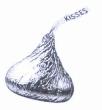 As anyone who's ever tried to lose weight before knows, proximity matters. Some foods simply can't be allowed into the house.
Now, thanks to Dr. Brian Wansink, we have proof that sitting too close to the candy bowl is probably a bad idea.
Dr. Wansink is the John S. Dyson Professor of Marketing at Cornell University and is the director of Cornell's Food and Brand Lab whose mandate it is to study "Why, What, When, and How Much We Eat".
In this months issue of the International Journal of Obesity Dr. Wansink details a study involving Hershey's Kisses.
The study was conducted over "Secretaries Week" where 40 secretatries from six different departments at the University of Illinois were given bowls of Hershey's Kisses. Each day each bowl was filled with 30 kisses. There were 20 clear bowls and 20 opaque bowls and there were four different study designs: Clear bowl right in front of you, opaque bowl right in front of you, clear bowl 6 feet away, opaque bowl 6 feet away. Every day researchers would swing by and count how many kisses were left in the bowl.
The results revealed that when the kisses were 6 feet away in an opaque bowl the average number of candies consumed per day was 3.1. 6 feet away in a clear bowl, 5.6, opaque bowl right in front of them, 4.6 and when in a clear bowl right in front of them, 7.7.
So not surprisingly, both visibility and proximity increase consumption. What was interesting was that proximity had a somewhat unexpected finding. When the food was more accessible people underestimated how many kisses they had vs. overestimating when further away.
A few bottom line messages. First, leave foods you want to eat more of in more visible and accessible locations. Don't banish your fresh fruits and vegetables to opaque crispers, leave them right out in the open on your fridge shelves and your countertops. Secondly, the bad stuff, don't necessarily throw it out but hide it behind other foods and banish it to the furthest reaches of your cupboard spaces. Lastly, if you ever get the chance to see Brian Wansinck give a lecture, jump at it - he's one of the best speakers I've had the pleasure of seeing.
Thursday, May 18, 2006
Self-hate Weight
 In this week's edition of the journal Obesity, there's a very sad article that quantifies just how pervasive the anti-fat bias in America really is.
It has long been established that obese people are stigmatized in education, employment and heath care. As well, it seems that the negative attitudes and stereotypes associated with obesity are acceptable in society given that we still regularly see them as the butt of jokes on television and in Hollywood.
It may surprise some readers here to learn that even obese people discriminate against the obese. In this study 37% of obese respondents reported that they preferred thin people, 27% of obese respondents said that thin people were more motivated and 27% of obese respondents said fat people were lazier.
This study also looked at "Personal trade-off items", meaning what would you be willing to give up or do in order to not be obese.
Of healthy weight individuals, 18% would rather give up 10 years of their lives than be obese, 36% would rather be divorced than be obese, 27% would rather be infertile than be obese, 21% would rather be severely depressed than be obese, 20% would rather be an alcoholic than be obese, 7% would rather lose a limb than be obese and 5% would rather be blind than be obese.
Now while those numbers are in and of themselves shocking, they become more shocking when you consider how the authors got their data. This study was funding and publicized by the Rudd Institute, an organization whose mission it is to address stigmatization and discrimination of obese individuals. The over 4000 respondents likely heard of the study either from the Rudd Institute's website, attending a presentation on weight sitigma given by one of the authors, or reading a news article on stigma that made reference to the website where the study's data were collected. Therefore the people who responded with such negative attitudes and stereotypes towards obesity were actually the people in society who might be expected to have the least amount of anti-fat bias.
Like the Rudd Institute says, "See the person, not the pounds". Clearly as a society, we still have a long way to go.
Tuesday, May 09, 2006
Track Calories with your Keychain!
 I always recommend tracking calories to patients trying to lose weight. The simplest analogy is money, and the currency of weight in our bodies is calories. Before you buy anything, you need to know how much it costs.
Calorie counting can be difficult and while there are many free online services that can help track calories (www.sparkpeople.com, www.fitday.com) they still require hunting for calories.
No more. Enter Training Peak's Calorie Scanner which conveniently fits on your keychain and then scans the barcodes of the foods that you're eating. Couple that with Training Peak's online/desktop calorie software and all of a sudden those barcodes translate into calories and nutritional information.
Only problem I can see is that my from scratch spaghetti sauce doesn't come with a barcode.
Cost is a bit steep as well - $216.30 for a scanner with a one year subscription.
Monday, May 08, 2006
It's Depressing to Stop Exercising
 This month the journal Psychosomatic Medicine published a very interesting paper on the effects of stopping exercise on mood.
Their study involved taking 40 regular exercisers (>30mins per time, >3times/week) who were not taking or receiving any psychological or psychiatric treatment, and simply asking 20 of them to stop exercising for two weeks. They then compared symptoms and mood between those who continued exercising versus those who stopped.
Within one week of stopping exercise, compared with folks still exercising the study subjects reported more fatigue and depressive symptoms which then worsened in week number two.
While we probably didn't need a study to prove this (anyone who exercises regularly and has to stop knows this to be true already), here is now proof of yet another reason not to stop exercising!
Friday, May 05, 2006
The HP Photosmart R927 Super Incredible Diet Plan
 Perhaps in response to our growing waistlines HP has come up with a Super-Incredible-Diet-Plan - don't lose weight and use their cameras with their "slimming" feature and presto-chango you've lost weight.
The picture here shows the subtle changes the camera produces using Hurley from Lost fame.
If this isn't a sad statement about where we've come as a society, I don't know what is.
Thursday, May 04, 2006
Today is Project ACES Day - Another misguided effort in the war on obesity.

I can't tell you how frustrated I get when events such as Project ACES are touted as soldiers in the fight against obesity.
Started by Len Saunders, a New Jersey schoolteacher in 1989 Project ACES (All Children Exercise Simultaneously) involves trying to get children across the world exercising for 15 minutes simultaneously.
Going to the Project ACES website it promotes itself as making, "fitness fun for kids", "promoting health and nutrition", "promoting sport and exercise", and "supporting physical education", and there is no doubt in my mind that all of those are worthy, wonderful and achievable goals for the Project.
You know what's not an achievable goal? Having 15 minutes of exercise a day put a dent in childhood obesity rates. Yet the AP describes Project ACES this way, "Students in all 50 states and at least 50 other countries were urged to exercise en masse for 15 minutes Wednesday, all to curb alarming rates of childhood obesity."
So why is it not reasonable to report Project ACES as an obesity intervention? Quite simply, exercise does not burn that many calories.
In fact I would argue that were the Canadian and American governments successful at getting every last citizen to exercise 30 minutes a day it would actually lead to North Americans growing even larger because then everyone would feel justified in rewarding their exercise with food. They would feel justified because our governments and countless allied health organizations constantly present the misguided notion that exercise alone is enough to lead to weight loss or prevent weight gain.
Fact is 30 minutes per day of exercise probably burns no more than 250 calories. Reward exercise with food 3 times a week and kiss 30 minutes of even daily exercise goodbye. It takes well over an hour of vigourous exercise to work off one Big Mac or a bag of potato chips.
If we are to succeed in preventing the rise of obesity in our countries, the focus has to be on food and more specifically on calories.
I can't tell you how many patients I've seen who've said to me, "I shouldn't be this weight because I exercise a lot", or, "It doesn't make sense because I only eat healthy food."
Obesity prevention, fitness and healthy eating are all extremely important determinants of health. To lump them all together as one effort takes away from the importance of each in our health and discourages those who "eat healthy" and "exercise" but don't lose weight, from ever trying.
Thursday, April 20, 2006
The very shaky "link" between obesity and depression
 Today the Canadian Journal of Psychiatry published an article that the media has picked up upon that states that depression is more prevalent in obese patients.
The Montreal Gazette states, "Obesity-depression link is confirmed", CanWest News Service states, "Obesity, depression have same root causes, study suggests".
So what did the study state? It stated that 19% of obese Canadians were depressed compared with "only" 15% of the general population.
To me that sure doesn't seem like a slam-dunk difference.
There are many co-morbdities associated for obesity that apparently were not controlled that almost certainly could contribute to the development of depression. Things like pain from increased incidences of osteoarthritis, worry from cardiovascular disease and diabetes, bias and discrimination in the workplace, frustration with weight loss difficulties.
As well, the majority of medications used in the treatment of depression themselves directly lead to weight gain and while the medication induced weight gain is not always dramatic, it can be.
Bottom line for me is that there are a lot of realities commonly associated with obesity that are in and of themselves depressing and there are a lot of realities associated with the treatment of depression that are in and of themselves obesogenic.
Wednesday, April 19, 2006
The American Board of Bariatric Medicine

Did you know that the only medical body in North America that offers any form of certification in Obesity Medicine is the American Board of Bariatric Medicine?
I find it astounding that despite weight and diet related illness being the second most preventable cause of death in North America, contributing billions of dollars in health care costs and dramatically affecting patients' qualities of life, that there is only one organization specifically designed to certify and educate physicians in the whys and wherefores of weight management.
Having gone to medical school in the 1990s, I can tell you first hand that weight management was certainly not something discussed in more than an, "eat less, exercise more" manner.
While at the end of the day of course that's what weight loss comes down to, weight is complicated. It's a complex interplay involving genetics, learned behaviour, co-existing medical problems, medication, and lifestyle and there's no question that the average family doctor probably was not taught enough to properly address it.
I can only hope that over the course of the coming years, medical schools and residency programs start taking obesity seriously and help educate future physicians not only in weight management, but also helps teach them how to compassionately address this sensitive and complicated issue.
Monday, April 10, 2006
The Nutricate Receipt - Great idea!
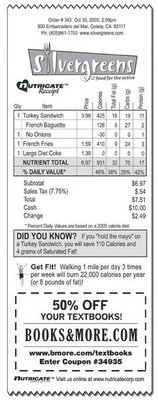 The Nutricate Corporation based out of Santa Barbara, California has come up with a brilliant new receipt for restaurants - the Nutricate Receipt which provides nutritional information regarding the meal you've just paid for.
I love this idea, but it would be better if at the bottom of the receipt it would give a breakdown of how long you'd have to exercise to burn off those calories. For instance in their demo receipt some poor soul had 931 calories for lunch. In order to burn that off he/she'd have to walk at 3.5mph for 3.5 HOURs or cycle at 10mph for 2.2 HOURs.
So was that turkey sandwich and fries really worth it?
Tuesday, March 21, 2006
Skinny? Have I got a hotel for you!

Norden, Germany. Juergen Heckrodt the owner of Hotel Ostfriesland has an interesting policy. He charges half a euro per kilogram for his rooms with a maximum cost of 39 Euros.
While this policy may not impact on global obesity rates, it's certainly unique!
Tuesday, March 14, 2006
Do play the McGame!
 Find out if you have what it takes to run a ruthless multinational corporation! Play the Mcvideogame and you can play like the big boys - exploiting underdeveloped countries and low-wage workers, feeding cattle hormones and antibiotics to boost growth and improve your bottom line.
Friday, February 24, 2006
Don't drink the McWater
 Enter Jasmine Roberts, a 15 year old high school student in Tampa, Florida. Clearly an inquisitive young woman, she hypothesized that the ice machines in fast food restaurants would be great homes for bacteria.
So what she did was collect ice from 5 different fast food restaurants and plated the melted liquid on agar (bacteria food).
Here's where you get to smile. For a comparison group, she used toilet water from those same restaurants.
The results?
In Jasmine's words, "I never thought the toilet water would be cleaner"
Don't drink the McWater...or at the very least, don't have the McIce.
Wednesday, February 22, 2006
Cafeteria Big Brother

Parents in Houston now have a new tool in their battle against childhood obesity - Cybersoft Primero ParentOnline (warning PDF) allows parents to restrict the choices their children make in the school cafeteria. If you don't want little Billy to have dessert, simply don't allow it in his profile. As well, parents will be able to track their child's choices.
While this indeed may be helpful, it does seem a bit overlordish to me.
At the end of the day, the best way to treat your children is to focus on yourselves. If you take the time to make healthier dietary choices, control your own portions, limit desserts, and make exercise a part of your daily lives, guess what, your children will learn from you. If instead exercise consists of picking up the remote control, food is hurried, dessert is frequent, that's going to be what your children learn.
Monday, February 20, 2006
Gatorade vs. Pedialyte - Who ya got?
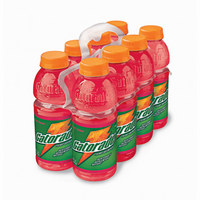
Good news for parents with kids with vomiting and diarrhea. As we all know products like Pedialyte are very expensive and actually have expiry dates that make us feel guilty if we have them on hand. A study done in India randomly divided 61 kids into either getting Gatorade or a commercial pediatric electrolyte solution. The results? No differences.
I'd be recommending 3/4 strength gatorade any way you can get it into your kid. Remember, chugging may well lead to vomiting so a tablespoon every 5 minutes or in the form of a popsicle are probably the better ways to go.
Thursday, January 12, 2006
Actually some good news for obesity...unless you live in Italy

A survey of 1900 Americans yesterday reported somewhat shocking results. The percentage of Americans who viewed overweight people as less attractive dropped from 55% back in 1986 to 24% today. Given the rapid rise in overweight and obesity rates, that's actually fairly good news - especially considering that obesity certainly is still considered by many to be an acceptable target for scorn.
Of course, that's an American survey. Results were also released yesterday regarding a survey conducted in Italy that showed that Italians viewed obesity as "worse than adultery" in the hierarchy of deadly sins.
Thursday, January 05, 2006
TV vs. BOB - Who Ya Got?

As many people know, TV viewing increases the risk of childhood obesity. In fact, it has been shown that the risk of obesity in pre-school children increases by 6% for every hour of television he or she watches per day and if there's a TV in their bedroom, their risk rises by 31%
Enter BOB. BOB helps parents manage their child's TV time. It utilizes a personal PIN number and allows parents to set the number of hours a child is allowed to watch television per week and also provides individual user reports for each PIN.
So TV vs. BOB....who ya got?
Monday, January 02, 2006
If you're trying to lose weight, stop reading this!

Dr. Angelo Tremblay and researchers out of Quebec did a fascinating study. They took 15 University students and randomized them into two groups. One group sat and rested for 45 minutes. The other group had to read a document and write a 450 word summary of it. They were then all led to an all-you-can-eat buffet.
Guess what, the people who spent time thinking ate considerably more than those who rested.
Are you still reading? For heaven's sake stop already, you're going to get hungry!
Subscribe to:
Comments (Atom)

