Saturday, November 18, 2006

All Fat is Bad

At least that's what Health Canada has consistently told us.

Would you be surprised to learn that the type of fat in your diet is much more important than the amount of fat in your diet?

My guess is probably not - there's been a tremendous amount of very well publicized research that has proven that blindly following a low-fat diet doesn't seem to help with any particular health outcomes and that diets richer in healthy fats are, well, healthier.

You might however be surprised at how much the type of fat you choose in your diet affects your health.

Let's start with the bad fats, the saturated fats and the trans fats - there's no disputing the fact they're not good for you.

Starting with saturated fats, Dr. Ancel Keys back in 1956 with the Seven Countries Study (another very important epidemiological data base) was the first to show that countries with diets higher in saturated fats had higher levels of heart disease. In his studies however, the total amounts of fats in the diet were not linked with heart disease and the country with the highest amount of total fat, Crete, also had the lowest rate of heart disease. Perhaps this is why results of clinical trials looking at simple overall fat reduction are not terribly impressive.

In January of this year, a series of 3 articles came out in the Journal of the American Medical Association detailing the results of the largest dietary fat trial ever conducted. The study they were detailing was the Women's Health Initiative Controlled Dietary Modification Trial where 48,835 women were randomly assigned to a low-fat diet (less than 20% of calories from fat) or to a comparison group and were followed for over 8 years. The papers reported that low-fat diets did not lower the risks of colon cancer, breast cancer or heart disease.

On to trans-fats. Trans fats today constitute roughly 3-7 percent of the calories we consume from fat. Trans fats come from shortenings, fried foods and many commercially baked goods (goods that almost always also use refined flours).

Trans fats have been shown to raise bad cholesterol, raise triglycerides, lower good cholesterol and make our blood stickier increasing the risk of blood clots. Trans fats have also been shown to increase the process of inflammation in our body which in turn has been implicated in heart disease and diabetes and may well also be involved in other disease processes.

Using the Nurses Health Study again, Dr. Walter Willett and colleagues showed that women who ate the most trans fats (3% of total daily calories worth) were 50 percent more likely to develop heart disease over a 14 year period than those who ate the least. Conversely, women who ate the lowest amount of trans fats and the highest amount of healthy fats (we'll get to healthy fats in a moment), were 70 percent less likely to develop heart disease.

The Center for Science in the public interest estimates that removing trans fat from the food supply in North America will prevent between 11,000 and 30,000 deaths per year and save over $50 billion dollars in annual health care expenditures. Interestingly Dr. Willett in his book Eat, Drink and Be Healthy states that he feels these numbers are underestimations as CSPI's report did not take into account the potentially harmful effects trans fats have on diabetes risk.

In June 2006 Health Canada released the findings of their Trans Fat Task Force and made recommendations to our government for the elimination of trans fats from our food supply. Given the strength of the research as well as the degree of damage trans-fats cause, it's hard to fathom why our government is not acting on these recommendations.

Now onto the good fats. The good fats are the unsaturated fats. Monounsaturated fats are found in vegetable oils, avocados and nuts and polyunsaturated fats are found in whole grains and fatty fish. You've probably read a great many claims about these fats and if your eyes have been open you've been seeing food products touting how much of them they contain, especially with regards to omega-3s. Omega-3 fats are unsaturated fats and there are three types of them, ALA, DHA and EPA. ALA is the most common, it's found in a variety of vegetable oils, while EPA and DHA come mainly from fish.

Again using the Nurses Health Study and the Health Professionals Follow Up Study Dr. Walter Willett and colleagues have calculated that replacing just 5 percent of total calories currently consumed from saturated fat with unsaturated fat would reduce the risk of heart attack or death by about 40 percent. In contrast they also showed that replacing saturated fat with carbohydrates (like we're told to do by the Food Guide) showed much smaller reductions in risk.

To summarize the studies on omega-3 fatty acids, they lower levels of LDL or bad cholesterol, they help to prevent the increase in triglycerides in high carbohydrate based diets, they reduce the development of irregular heartbeats (a major cause of sudden cardiac death) and they reduce the tendency for clots to form in our arteries.

A famous study called the GISSI Prevention trial took more than 11,000 men and women who had survived a heart attack and randomly assigned them to taking either a placebo or a 1-gram capsule of omega-3s. At the end of 3 years, there were over 14 percent fewer deaths in the omega-3 group (sudden deaths cut by 50%) and fewer second heart attacks and strokes.

So now that you've heard how terrible trans-fats are for you and how healthy unsaturated fats are for you would you like to know what the draft Food Guide had to say on the matter?

Dr. Willett, on reviewing the draft Food Guide had this to say on the Guide's fat recommendations,

"Like the US Guidelines, the draft Canadian document is still fat phobic. There is suggestion to use a very limited amount of vegetable oils, but there are recommendations to reduce or avoid fat in general, when it really trans fat in partially hydrogenated foods that should be totally avoided and saturated fat that should be limited. The main message should be to replace trans and saturated fat with unsaturated fats."
The words trans fat do not appear even once in the draft Food Guide, this despite the ridiculously large amount of evidence pointing to the need for their elimination. Health Canada's own Trans-Fat Task Force report recommends we eliminate them from our diet and Health Canada's own labeling laws required trans-fat to be listed on our food labels. Why then don't they point us in the Food Guide to look for and steer clear of trans fats?

Regarding healthy fats, the words unsaturated fats do appear twice. There's a statement that tells use to use vegetable oils high in unsaturated fats "most of the time", and then there's a statement to aim for a small amount of unsaturated oils or soft margarine each day. There's no mention of the healthy fats found in fish and the only call to action on fish is buried on page 6 where it says consume fish once a week. There's also no recommendation to try to replace some of the saturated fats in our diet with unsaturated fats (remember, replace 5% of one with the other and the risk of heart attack and death goes down by 40%).

So just as with the data supporting the preferential consumption of whole grains over refined grains, the preferential consumption of unsaturated fat over saturated fat and the elimination of trans fats from our diets are as black and white as things get in medicine.

Unfortunately our Food Guide seems hopelessly mired in gray.

Tomorrow: All Meat is Good, and Please Eat More of it - Beef farmers rejoice, Health Canada recommends Canadians eat more beef and still doesn't tell us fish is a healthier choice.

Yesterday: Please Eat White Bread - Why Wonder Bread's more in touch with the evidence on whole wheat than Health Canada.

Please Eat White Bread

Even Wonder Bread knows whole grains are healthier. They of course still have their original recipe, but now you can also choose 100% whole grain wonder bread and something they call whole grain white.

The evidence on the benefits of whole grains are as impressive as the evidence on the risks of refined grains.

Using the Nurses Health Study and the Health Professionals Follow-up Study, perhaps the two most important epidemiological studies in history, Dr. Walter Willett and his colleagues have shown that diets higher in whole grains reduce the risk of both diabetes and heart disease by 30% while also reducing the risk of stroke by 20%.

A more recent study revealed that diets highest in whole grains carried with them HALF the risk of developing metabolic syndrome (a constellation of high blood pressure, insulin resistance and high cholesterol).

Conversely, in those same studies, diets highest in white bread, white rice, french fries and cooked potatoes were all associated with increased risk of diabetes and in the study looking at metabolic syndrome, diets highest in refined carbohydrates carried with them DOUBLE the risk of its development.

Why then does Health Canada want us to eat so much of the white stuff?

The exact wording on the draft Guide states, "Make half your choices whole grain each day" which of course directly implies that the other half be refined.

Dr. Walter Willett, in viewing the April 2006 draft Canada's Food Guide had this to say,

"refined grains have little nutritional value and thus provide empty calories, reduce HDL cholesterol, raise triglycerides, are thus not surprisingly related to higher risks of type 2 diabetes and coronary heart disease. Refined grains should be on the list of foods to minimize, along with saturated fat."
So again you might wonder, why exactly is Health Canada pushing the refined grains?

Amazingly when trying to explain themselves to a reporter from the Citizen, Health Canada officials claimed that the reason they recommend half our grains come from refined carbohydrates was due to refined flour's mandatory fortification with folic acid and its affect on the incidence of neural tube defects.

I spoke with Dr. Godfrey Oakley about this, he's one of the world's experts on folic acid fortification. There's no doubt that folic acid fortification of refined grains is one of the greatest public health triumphs of our time as mandatory fortification has silently reduced the risk of neural tube defects like spina bifida in our children.

In recounting the history of folic acid fortification Dr. Oakley noted that Health Canada was very much opposed to fortification when it became mandatory in the United States in 1996 but due to pressure from the grain industry (who were already fortifying their products in the much larger market share of the United States) acquiesced and in 1998 made fortification mandatory in Canada as well.

Despite this irony (certainly Health Canada is entitled to learn from their own mistakes), the argument is hollow and it really highlights the shortsightedness of worrying more about nutrients than about foods.

While there's no doubt that reducing the incidence of neural tube defects is an important public health concern, I certainly wouldn't want to make the argument that it was more important than minimizing diabetes and heart disease.

To put some numbers to this, since the introduction of mandatory folic acid fortification in refined flours, the incidence of open neural tube defects in Ontario has dropped from 1.13 per 1,000 pregnancies to 0.58 per 1,000 pregnancies.

On the other hand, according to Health Canada, roughly 1 in 16 Canadians currently have diabetes, a number expected by the World Health Organization to reach 1 in 9 by the year 2025. Health Canada estimates diabetes currently costs Canadians close to $9 billion dollars a year.

Heart disease according to Health Canada is,
"the number one killer in Canada. It is also the most costly disease in Canada, putting the greatest burden on our national health care system."
1 in 2 Canadians die due to heart disease.

So what do you think are more important public health targets? Diabetes and heart disease or open neural tube defects?

Does it make sense to you to recommend the consumption of refined carbohydrates to minimize the risk of open neural tube defects at the expense of increasing the rates of heart disease and diabetes? Would it not make sense to recommend diets higher in whole grains to decrease the risk of diabetes and heart disease and perhaps at the same time recommend a pennies-a-day multivitamin?

Frankly, we shouldn't have to choose! There should be nothing stopping Health Canada from mounting a vocal and tireless campaign to fortify our whole grains with folic acid, allowing them then to recommend we minimize our consumption of diabetes and heart disease inducing refined flours and still consume enough folic acid to decrease our risk of open neural tube defects.

The fact that Health Canada is not doing so again begs the question how much politics and the food industry influence their decisions.

Tomorrow: All Fat is Bad - Fat phobia still runs rampant at Health Canada.

Last Friday: Consultation? What Consultation - I suppose if by consultation you mean what fonts you like, then yes, there was an extensive consultative process

Thursday, November 16, 2006

Consultation? What Consultation?

Health Canada is very proud of their consultative process. They will happily talk about their coast-to-coast consultations and how they spent more time doing outreach with this Food Guide revision than any other.

With regards to their coast-to-coast consultations, it's true, they did travel coast-to-coast and they did indeed have an online consultation process open to all Canadians.

Unfortunately, those consultations were about form, not substance.

Don't believe me? Check them out yourself online where you can see that indeed Health Canada wanted input, it's just that the input that they wanted was pretty much relegated to what font you liked, what pictures you wanted, how many pages it should be, which vegetables should be pictured and so on.

Still don't believe me? Here's a quote from Health Canada on the matter,

"One of the criticisms is that there was little focus on the actual pattern and more focus on the packaging of the pattern. That was indeed a constraint that emerged out of the online approach to the consultation."
Ok, so you might argue that maybe the online consultation should have been about form and not substance, after all they were reaching out to the average Canadian, not to folks with specialized knowledge in nutrition.

Ok, well that leaves us with the in-person group consultations.

Our registered dietitian Shawna Hunt attended the in person group consultation that took place in Ottawa on November 24th, 2005.

She was excited to be given the opportunity to have discussions on what she saw were major shortcomings in the nutritional recommendations of the proposed Guide as well as the incredible number of calories it would lead Canadians to consume.

Wanna know what she got instead?

Pretty much the same forms involved in the online consultation.

As far as discussions go, one of the more heated "discussions" that took place that day involved an industry representative from the Dairy Board who angrily argued that because the milk carton depicted in the proposed Guide's pictorial representation of food choices was slightly askew compared with the soy beverage, that those depictions might therefore lead Canadians to consume less milk and more soy. Important discussion for the Dairy board? Maybe. Important for the health and welfare of Canadians? Not so much.

Ok, so the online consultation wasn't too impressive and neither was the group consultations...how about the personal outreach?

I experienced that outreach.

Shortly after my views on the Food Guide were published in the Canadian Medical Association Journal, I received a phone call from Health Canada asking if we could set up a meeting. We of course obliged and within a week we met face-to-face with Health Canada officials.

On the one hand, it was quite nice for them to have come to chat with us. Unfortunately, there was another hand. If the purpose of the meeting was for Health Canada to say that indeed I'd been "heard", then I suppose the meeting was a great success. The problem is, there is a very big difference between someone being heard and someone actually listening.

Shawna, our dietitian, had prepared a number of test diets based off of the draft Food Guide's recommendations. She prepared a best case diet, a typical diet and a worst case diet to illustrate the incredible number of calories following the Food Guide would lead Canadians to consume.

Among other objections, Health Canada objected to Shawna's choice of quinoa, a whole grain in one of her test diets, that her use of nuts was not an appropriate source of protein, and that avocados were not an appropriate fruit choice.

We were both told that Health Canada had done their own modeling for calories and that their models were much lower than ours.

I firmly and wholeheartedly believe that to be true.

Frankly at the time, we couldn't understand (none of us, not I, not Shawna and not Health Canada) where the discrepancy in calories came from as it's not an especially difficult procedure to calculate calories and we and Health Canada were quite confident that we had done so correctly.

In fact, we both had.

The problem is, the reason their models are lower than ours is because, for a lack of a better term, the calorie-counting book they used is woefully outdated and it supplied them with non-real world data in the calculation of their calories (stay tuned for the post on this subject specifically).

In the end I believe they left our offices, really not having heard much of what we had said, but concerned enough to apparently have told CTV that they refused to appear together with me in any type of debate style format (this is what CTV told me when I specifically asked them if they could arrange a frank and open discussion on air between me and Health Canada officials).

Bottom line of course is the simple act of having consultations does not necessarily mean that the appropriate questions were asked during the consultative process, that the appropriate people were involved in the consultative process, and that if the appropriate people were involved that their input was included. Perhaps this is why on Halloween, included in their motion to have the draft Food Guide tabled before the House of Commons, the Standing Committee on Health members also asked that Health Canada table,
"a list of people brought forward who were actually consulted, the types of questions that were asked, and also to ensure and take a look at where those suggestions ended up and whether or not they were incorporated into the food guide."
At the end of the day, if Health Canada is so confident in their draft's revisions, why don't they simply release them for all to see?

Nothing would please me more than to see that our concerns have been addressed and that in fact the Food Guide has undergone a dramatic overhaul and rejuvenation.

Of course even if that were true, I would still be scratching my head about the process. The draft of the Guide that I've seen, that Dr. Willett has seen, that the Centre for Science in the Public Interest has seen, was released in April 2006, not in November 2005 as Health Canada purports. For those keeping track, April 2006 is 27 months after the revisions began. However even if we do talk about the November draft where as Health Canada officials themselves state,
"What we did in November was come out with a platform. It was the best we could do at the time. What we heard back was, "Sorry, it's not good enough"
I have to ask, why the heck wasn't it good enough? Was 27 months not long enough to come out with a Food Guide? Didn't they undertake an incredible number of consultations and conduct more outreach than any other Food Guide? What exactly did they do for 27 months? Were their experts lacking in expertise? Were there undue and irresponsible pressures being put to bear on those experts? Were their experts simply not listened to?

After 27 months of research and work, I would expect something significantly better than, "Sorry, it's not good enough", after all, these aren't medical secrets we're discussing.

Monday: Please Eat White Bread - Why Wonder Bread's more in touch with the evidence on whole wheat than Health Canada.

Yesterday: At Least You'll Get Enough Zinc - Health Canada cares a lot about nutrients...not so much about foods. Last time I checked, I eat foods, not nutrients.

Tuesday, November 14, 2006

At Least You'll Get Enough Zinc

Zinc is a micro nutrient, as are all vitamins and minerals that are essential in minute amounts for healthy cellular growth and metabolism.

There's actually a micronutrient encyclopedia that details how much of them we need (called Dietary Reference Intakes or DRIs) printed by the Institute of Medicine (IOM). The IOM describes their work on DRIs as, "eight exhaustive volumes" (there's a great sales pitch) but if you'd like some lighter reading you can pick up their 560 page summary for the low-low price of just $44.96.

As noted in yesterday's post, Canada's Food Guide has been explicitly modeled to ensure that Canadians who follow the Food Guide will meet their daily micro nutrient requirements.

You might think that sounds like a good idea. Certainly having a vitamin or mineral deficiency can lead people to medical illness.

I guess the question is what's more important, steering people to dietary choices that prevent micro nutrient deficiencies, or steering people to dietary choices that minimize the risk of chronic diseases?

The answer's a no-brainer.

The fact is there isn't a rash of micro nutrient deficiencies in Canada, and that's despite the fact that the majority of the population does not currently practice tremendously healthy eating. Even back in 1982 when the then Food Guide recommended the consumption of far less food (the 1982 Food Guide recommended that we consume 113% fewer grain products, 50% fewer milk products, 67% fewer vegetables and fruit and 25% fewer meat and meat alternatives) there were no micro nutrient deficiency outbreaks.

The fact is, the bulk of our understanding of the role of diet on the prevention of chronic disease has to do with the effects of increased or decreased consumption of whole foods, not of micro nutrients.

The fact is the burden of chronic disease in our society is climbing at an atrociously rapid rate (the WHO projects a doubling of cases of type 2 diabetes by 2025).

The World Health Organization in their 160 page Technical Report Series #916, Diet, Nutrition and the Prevention of Chronic Diseases summarized the evidence for and against both nutrients and foods in the prevention of chronic disease.

To quote the report with regards to targeting nutrients,

"Seldom is there a single "best value" for such a goal. Instead, consistent with the concept of a safe range of population averages that would be consistent with the maintenance of health .... Sometimes there is no lower limit, this implies that there is no evidence that the nutrient is required in the diet and hence low intake should not give rise to concern."
On the other hand, with regards to whole foods, Technical Report #916 has a lot to say, as does reams of research into the effects of foods and their role in chronic disease prevention.

To be consistent with our best evidence the WHO, and anyone who's up to date with the medical literature, would say that if our Food Guide reflected best available evidence it would be unambiguously encouraging Canadians to preferentialy consume (in no particular order):

  • Fruits
  • Vegetables
  • Whole grains
  • Legumes
  • Fish
  • Nuts


  • While minimizing the consumption of:

  • Free sugars (white rice, white flour, white sugar, potatoes)
  • Red meat, and more specifically processed red meat
  • Salt
  • Hydrogenated oils


  • I'm sure that the majority of you reading this blog already know the above lists to be true.

    Why then does the proposed Food Guide not make these explicit recommendations?

    Truly, I don't have the answer, but however you slice it, the answer is disturbing.

    Bottom line, in a country where there are no outbreaks of micro nutrient deficiencies; in a country with a tremendous burden of chronic complex diseases; with a Food Guide where the units of guidance are foods and not micro nutrients; with a backdrop of research where the wealth of our understanding lies again in foods and not nutrients; to have relied on micro nutrients to shape the recommendations rather than foods is at best short sighted and at worst, a dearly missed opportunity for change.

    Tomorrow: Consultation? What Consultation - I suppose if by consultation you mean what fonts you like, then yes, there was an extensive consultative process

    Yesterday: Broken from the Get Go - Get this, the new Food Guide is based off of current Canadian dietary patterns....where 40% of all vegetables consumed are potatoes with over half of the potatoes being consumed coming from french fries or potato chips. That seems smart.

    (To see the WHO summary on whole foods and chronic disease in more detail and a mirroring of the concerns of this post by the Centre for Science in the Public Interest (CSPI) please read CSPI's December 2004 formal submission to Health Canada on their then concerns on the revisions to the Canada Food Guide. Unfortunately since that time, their concerns haven't changed)

    Sunday, November 12, 2006

    Broken from the Get Go


    So let's say you've decided that Canadians aren't making the healthiest of dietary choices. Let's even say you're Diane Gorman the then Assistant Deputy Minister of the Health Products and Food Branch of Health Canada and you're kicking off the process of revising the Food Guide. You'll be quoted as saying,

    "The current edition of the Guide is 10 years old. Within this time, scientific knowledge about the relationship between diet and health has evolved. The lifestyle of Canadians has changed and the environment within which people are making choices about healthy eating has changed significantly."
    Suggesting of course that the Food Guide's going to have to help Canadians make healthier choices in our evolving and toxic food environment.

    Do you think that a good starting point for improving the choices Canadians make would be to collect data on what Canadians are currently consuming?

    I suppose it might be nice to have that information to contrast it with what you're going to be recommending.

    Do you think that using that information to ensure that you make as few changes as possible would be a good idea?

    Health Canada does.

    In an overly complicated document, Health Canada detailed their methodology on how they came up with the skeleton for our next food guide.

    To summarize as best I can,
    1. A pool of "food choices" was created using provincial food and nutrition telephone survey data from British Columbia, Manitoba, Ontario and Quebec.

    2. The popularity of what was most commonly being consumed in those provinces was given a rank. In a moment of clarity in the document Health Canada explains,
      "For instance, if the relative popularity of apples is 30% within the available fruit choices, then there is a 30% probability that apples will be included as any given fruit choice."
    3. 500 "Test" diets were created using the ranked popularity of foods for every age and sex group detailed by the proposed Food Guide.

    4. The test diets were evaluated to see if following them would lead Canadians to meet their nutrient requirements (a whole post will be devoted to why this isn't a great plan tomorrow). Here's Health Canada's quote on the matter,
      "The test diets are evaluated to see if nutrient requirements are met. The modeling switches back and forth until no further adjustments to the diet pattern are needed to achieve nutrient targets."
    5. Presto-NO-chango we've got new recommendations that stick as closely as possible to what Canadians are currently eating.
    It seems quite backwards to me that the basis for our new Food Guide should be our current pattern of eating.

    The Food Guide should be steering Canadians to healthier foods as a whole. By starting from our current dietary baseline rather than from scratch, Health Canada immediately abandoned the option of simply using the best available medical evidence to recommend diets that minimize the risk of chronic disease development.

    There are many examples of how this modeling can go wrong because the simple fact that Canadians eat a lot of red meat, potatoes and refined grains don't make them healthy choices.

    To illustrate what I mean, let's take a closer look at a food too rarely singled out - potatoes.

    Over 40% of the vegetables consumed by Canadians are potatoes, and of that 40%, over half are in french fry or potato chip form. Therefore according to Health Canada's formulas, in their test diets there is a 40% probability of potatoes being included as a vegetable choice. There are indeed nutrients in potatoes, but the question that's more important to ask is, "Is there any risk in eating a lot of potatoes"?

    The answer is certainly yes.

    It's a certainty firstly because half of the potatoes consumed by Canadians are fried.

    It's a certainty secondly because ample evidence exists to suggest that high potato consumption has risk. Potatoes increase blood sugar and insulin levels nearly as fast as pure white table sugar which is potentially why in a 20 year study looking at 84,555 women there was an increased risk of type II diabetes in women with higher potato consumption.

    Dr. Walter Willett, the chair of nutrition at Harvard since 1991 and arguably the most important nutritional epidemiologist in history has this to say about potatoes in his exceptional book, Eat, Drink and be Healthy,
    "More than two hundred studies have shown that people who eat plenty of fruits and vegetables decrease their chances of having heart attacks or strokes, of developing a variety of cancers or of suffering from constipation or other digestive problems. The same body of evidence shows that potatoes don't contribute to this benefit. Potatoes should be an occasional food, eaten in modest amounts, not a daily vegetable."
    Without a doubt, the Food Guide's take on potatoes should be to recommend their minimization in your diet. Guess what? It doesn't.

    By modeling off our current dietary choices, healthier food recommendations will be ignored simply because current Canadian eating patterns meet the dietary reference intake patterns for micronutrients.

    Problem is, our current level of understanding of the effects of diet and chronic disease prevention is much more about the foods we eat rather than the nutrients we consume, which is why it would be worth recommending that we minimize foods such as potatoes rather than simply rate them by micronutrient content and worse still, popularity.

    Tomorrow: At Least You'll Get Enough Zinc - Health Canada cares a lot about nutrients...not so much about foods. Last time I checked, I eat foods, not nutrients.

    Yesterday:
    Big Food Has a Seat - Health Canada's bizarre inclusion of the Food Industry in the shaping of the Guide.

    Big Food Has a Seat

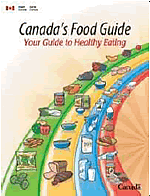
    On January 20th, 2004 Health Canada kicked off the start to the 1992 Food Guide's revision with what I can gather from the photo on the left (from Health Canada's January 20th Meeting Page), a gala affair. It was in fact a by-invitation only meeting of "stakeholders".
    Want to know who was invited?

    A full 1/3 of all of the attendees represented the Food Industry, including:

  • Brewers of Canada
  • The Canadian Meat Council
  • The Canadian Sugar Institute
  • The Canola Council of Canada
  • The Confectionery Manufacturers Association of Canada
  • Dairy Farmers of Canada
  • Edible Oil Foods Association of Canada
  • Food and Consumer Products Manufacturers of Canada
  • Kellogg Canada Inc.
  • Refreshments Canada
  • Weston Bakeries Limited
  • The Beef Information Centre


  • [November 4th, 2007 - interesting, Health Canada has removed the list that was once online detailing the various "stakeholders", and in its place is the following paragraph:
    "Invitees to the meeting included representatives from a broad range of national stakeholder organizations, such as health professional associations, non-governmental organizations, consumer groups, universities/academics, food industry and trade organizations and federal, provincial, territorial and municipal governments. Approximately 200 stakeholders were invited; about 110 stakeholders attended the meeting."
    It's a shame I didn't save the list - I'll scrounge through my records and see if I printed it up)]

    Now you might say to me that I'm being overly critical, that indeed the Food Industry are stakeholders and therefore should be told about the fact that the Food Guide's about to be revised. Surely the Food Guide is big business for the Food Industry. If the Guide changes its recommendations on what we should be eating, over time that will certainly be reflected in what Canadians purchase. That reflection might well enter into tens or hundreds of millions of dollars of either lost or earned revenues to the industries involved.

    Fair enough, Big Food needs to know that the Food Guide's being revised....but do they really need to be involved in the revisions?

    Shouldn't Health Canada's Food Guide's recommendations solely reflect what science and medicine understand to be the healthiest way for us to eat?

    Shouldn't Big Food simply be advised as to what the recommendations are going to be?

    Health Canada doesn't think so.

    The Food Guide Advisory Committee, one of the top tiers of the revision process is a 12 member Committee where a full 25% of the members purely serve Big Food.

    Here are some alternatives to the Big Food members' biographies on Health Canada's website:

    1. Sydney Massey is the Nutrition Education Manager and Spokesperson for the BC Dairy Foundation.

      The same BC Dairy Foundation whose homepage right now has a link to a section entitled,
      "Don't tell Mom, but Chocolate Milk is good for you".
      The same BC Dairy Foundation whose stated mandate is,
      "BC Dairy Foundation (BCDF) is a not-for-profit organization with the mandate of increasing consumption of milk in British Columbia".
      The same Sydney Massey who when interviewed by the CBC regarding the meta-analysis that concluded that increased milk consumption was linked to increased risk of ovarian cancer said,
      "Well, you can show an association between wearing skirts and breast cancer, but it doesn't mean that wearing skirts causes breast cancer. It just means that there's something here we have to take a look at."
      Yeah, that darned International Journal of Cancer. Who do they think they are summarizing over 21 different studies to come to their conclusion.

      Do you think she can be objective about the Dairy recommendations of the Guide?

    2. Sean McPhee leads an industry group representing 95,000 oilseed growers, oilseed producers and makers of oilseed-based food products. This is the same Sean McPhee who has his own website and company Sean McPhee & Associates. Here's what his website says he and his company are really good at,
      "Sean McPhee & Associates has an accomplished track record in using communication skills to help clients successfully manage issues that impact their business including genetic modification of foods, workers’ compensation reform, endocrine modulating substances, emerging environmental imperatives such as global warming, and international global trade negotiations. We have successfully capitalized on external issue developments, protecting market share and enabling clients to include astute issue management strategies into business plans."
      According to his website, it's not just the oilseed growers that Health Canada mentions that he represents. From his homepage,
      "We have helped clients successfully launch products in cutting edge new categories, build public support for high profile regulatory challenges, negotiate complex issues like global warming and genetically modified organisms, and manage communications for a number of sensitive mergers, acquisitions and divestitures.

      Our client experience includes consumer packaged goods, trade associations, financial services, professional services, food and beverage, biotechnology, chemicals, not-for-profit, environment and government."
      Sean is the Executive Director of the Vegetable Oil Industry of Canada (VOIC). They put out a press release expressing their joy when Sean was appointed to the advisory board. In that press release VOIC's position on the revisions is made very clear,
      "VOIC is calling on Health Canada to acknowledge and place a greater emphasis in Canada’s Food Guide on (a) promoting consumption of healthy plant-based fats which include liquid vegetable oils such as canola, soy, sunflower, corn, olive and peanut and (b) the inclusion of additional foods high in calcium such as fortified soy beverage and fortified margarine, a product that should be available to consumers."
      Does he sound objective to you?

    3. Carolyn O'Brien at the time of her appointment to the advisory committee was the Director of Scientific & Regulatory Affairs at the Food and Consumer Products Manufacturers of Canada (FCPMC).

      According to the FCPMC, they are,
      "the largest industry association in Canada representing the food and consumer products industry."
      Interestingly on the FCPMC website, if you want to have a look at their Public Policy Initiatives you get asked for a username and password. Guess their public policy initiatives aren't meant to be seen by the public.

      I found their mandate on Agriculture and Agri-Foods Canada's website,
      "To enhance growth and competitiveness of the food and consumer products manufacturing industry."
      Wanna know who she represented? To see the complete list of FCPMC member companies, scroll to page 5 of the linked pdf. Highlights include Cadbury, Pepsi-Cola, The Canadian Salt Company, Coca-Cola, Con-Agra (KFC), Frito Lay, Breyers, Heinz, Humpty Dumpty Snack Foods, McCain, Minute Maid, Nestle, Redpath Sugars, Sara Lee and Voortman Cookies.

      I suppose it is safe to assume that Ms. O'Brien was very pleased that Health Canada wanted to ensure that Frito Lay and Coca-Cola have representation on the Food Guide Advisory Committee....after all, they are member corporations...umm, I mean"stakeholders".
    In fact, the Food Industry is a stakeholder, but I think that its role as a stakeholder is to be informed of the decisions that Health Canada makes, not inform the decisions themselves.

    I certainly can't blame the Food Industry for accepting their bizarre invitations to the table, nor would I blame them for a moment if during their involvement, they tried to protect their products and promote their sales - that's what industry does.

    I can however blame Health Canada.

    Canada's Food Guide is for all intents and purposes, something that we would call in medicine, a clinical practice guideline. It's supposed to be our best recommendations as to what people should eat to protect or improve their health. In order to ensure that bias doesn't enter into the development of a clinical practice guideline, the folks drawing up the guidelines must be free from conflict of interest lest their conflicts of interest impact on their recommendations.

    I can't think of anyone with greater conflicts of interest in the creation of a Food Guide than the folks who sell and promote the food.

    There is an irrefutable body of evidence that has taught us that what we eat affects how long we live and how well we live, and while I empathize with those companies where new recommendations may cause a decrease in sales, that's not even remotely a good enough excuse not to make those recommendations.

    We're talking about people's lives here.

    Frito-Lay should not have any say in what Canadians should eat.

    Tomorrow: Broken from the Get Go - Get this, the new Food Guide is based off of current Canadian dietary patterns....where 40% of all vegetables consumed are potatoes with over half of the potatoes being consumed coming from french fries or potato chips. That seems smart.

    Yesterday: Canada's Food Guide to Unhealthy Eating - An Overview

    Canada's Food Guide to Unhealthy Eating

    Canada's Food Guide to Healthy Eating is an oxymoron.

    Everything the Food Guide should be - an evidence-based, easy to understand and implement guide to lead Canadians to follow a pattern of eating that will minimize their risk of developing chronic diseases (including obesity) - it isn't. What's worse is that the proposed revision to the Food Guide, which as we speak is ready for it's release on an unsuspecting public, is still horribly flawed.

    [NOTE: Original post updated to include information on the final, disappointing product]

    I testified on some of the Food Guide's deficiencies in the House of Commons back in September. Since then Health Canada was recalled to the Standing Committee on Health, and on Halloween, the Standing Committee passed a motion to have the proposed revision to the Food Guide tabled before the Committee.

    The next week I was asked to speak to the Canadian Medical Association regarding my concerns (Health Canada was also invited to present their case). My understanding of the outcome is that the CMA has expressed their concerns directly to Tony Clement, the Minister of Health.

    Please follow the links below to explore the bizarre revision process, the involvement of the food industry, the dismissal of evidence-based research and the end results of 3 years of "work" at Health Canada.

    1. Big Food Has a Seat - Health Canada's bizarre inclusion of the Food Industry in the shaping of the Guide
    2. Broken from the Get Go - Get this, the revised Food Guide is based off of current Canadian dietary patterns....where 40% of all vegetables consumed are potatoes with over half of the potatoes being consumed coming from french fries or potato chips
    3. At Least You'll Get Enough Zinc - Health Canada cares a lot about nutrients...not so much about foods. Last time I checked, I eat foods, not nutrients.
    4. Consultation? What Consultation? - I suppose if by consultation you mean what fonts you like then yes, there was an extensive consultative process
    5. Please Eat White Bread - Why Wonder Bread's more in touch with the evidence on whole wheat than Health Canada.
    6. All Fat is Bad - Fat phobia still runs rampant at Health Canada.
    7. All Meat is Good, and Please Eat More of it - Beef farmers rejoice, Health Canada recommends Canadians eat more beef and still doesn't tell us fish is a healthier choice.
    8. Eat Less Fruit and Vegetables - Amazingly that's part of Health Canada's new recommendations
    9. Drink Lots and Lots of Milk - Don't worry about all that research that suggests that in fact it might not be so good for you.
    10. A Match NOT Made in Heaven - The 1997 Nutrient File and Canada's Food Guide working together to increase obesity.
    11. Oh, and you Can't have Ketchup - How Health Canada has ignored 25% of your dietary energy intake.
    12. Guidance? What Guidance? - The sage advice of the Food Guide on how to manage your weight
    13. Health Canada's Quobesities - My favourite quotes from Health Canada officials on the matter of the Food Guide.
    14. What Can You Do? - Some ideas about how to make your concerns known, and where can you turn to for sound dietary advice?
    15. Epilogue - A Grading of the final February 2007 version of Canada's Food Guide.
    16. The Bad Joke they Call "My Food Guide" - Did you know Health Canada thinks Chocolate Milk, Pudding and Muffins are healthy choices?
    17. Why the Food Guide Matters - How the Food Guide impacts the average Canadian, including those who don't read the Food Guide.
    18. Who Won the Food Guide Sweepstakes - Which of the many Food Industry interests squeezed the most out of their involvement in the revision?
    19. ? = 88.5 - (61.9 x age [y])+ PA x { (26.7 x weight [kg]) + (903 x height [m]) } + 20 - Health Canada's almost unspeakably useless means of helping you determine your personal Calorie needs
    At the very base of this post there's a little envelope icon. Please click it. Send the post to yourself and then use your own email account to cut, paste and forward that enclosed link to all of your friends and family. If you're a blogger, please link to it. If you're a medical student or a dietetic student, please forward it off to your listservs. I will be updating this post with links to the entire series as it gets published. With enough public concern something can be done before the Food Guide is released.

    The Center for Science in the Public Interest estimates that every year in Canada 21,000-47,000 Canadians die from diet and weight related illnesses that cost taxpayers between $6.6 and $11 billion dollars a year.

    I believe that Canadians deserve a Food Guide that reflects medicine's best understanding of the effect of diet on chronic disease prevention.

    I also believe that Canadians deserve a Food Guide that will not make them gain weight if they follow it.

    Tomorrow: Big Food Has a Seat - Health Canada's bizarre inclusion of the Food Industry in the shaping of the Guide.

    Friday, November 10, 2006

    Big Milk


    The milk industry is completely unscrupulous. Their claims range from of course, osteoporosis prevention, to weight loss, to PMS treatment and more.

    Dr. Willett, in a critique of Canada's pending Food Guide (next week will be all Food Guide, all week and will highlight many of Dr. Willett's concerns on the nutritional deficiencies of the Food Guide and mine on the fact that it will almost certainly, if followed, lead you to gain weight) stated,

    "the draft Canadian guidelines advocate large amounts of dairy products. There is really not a credible scientific basis for this. The usual justification is that this will reduce osteoporosis and fractures, but large prospective studies consistently show no benefit of high dairy consumption on fracture incidence."
    and,
    "The high dairy intake would not be a major issue if it were clearly safe. However, the US Guidelines completely ignored a very substantial body of data showing increased risks of aggressive and fatal prostate cancer with high dairy consumption. Also, many studies have found increased risks of ovarian cancer with high dairy consumption. Although the findings for ovarian cancer have not been entirely consistent, a recent meta-analysis of prospective studies found about a 25% increase in ovarian cancer with lactose intake equivalent to three glasses of milk per day."
    But we'll get into all of this next week. Today's Funny Friday (I realize that's tough to see so far in this post)!

    Today for your viewing pleasure I'm featuring milk commercials and their outrageous claims. One thing I can definitely say positively about the milk industry, they sure do make great ads.

    1. Osteoporosis Prevention (from the California Fluid Milk Products Advisory Board)

    2. PMS Prevention (from the Got Milk campaign)

    3. Grow muscles and a giant balloon head (from the Milk, It Does a Body Good campaign)

    4. Be "Big" and stop worrying about bullies (from the Milk, It Does a Body Good campaign)

    They're even more unscrupulous in Japan....

    5. Grow very tall.

    6. Enhance your bust


    Lastly, here's how the folks from the Family Guy perceive where milk ads are going.


    BC "Bans" Junk Food In Hospitals

    Don't get too excited.

    On Tuesday Gordon Campbell, BC's premier, announced that by 2009 "junk food" will be phased out of vending machines from all government owned buildings (including hospitals).

    While that sounds lovely there are some obvious shortcomings of that statement.

    Firstly, what will constitute junk food?

    In a prior post I talked about Slammers, a new skim milk based chocolate bar in a bottle which meets at least the American Beverage Association/Clinton Foundation and the American federal government's dairy checkoff program which will be sold in vending machines in elementary schools. I imagine 100% juice will be there as well, in servings sizes larger than those recommended for children and adults by the proposed Beverage Guidance Panel championed by, you guessed it, Dr. Walter Willett (along with Barry Popkin, Lawrence Armstrong, George Bray, Benjamin Caballero and Balz Frei).

    Secondly, what about the junk food restaurants?

    I was horrified to learn that The Ottawa Heart Institute is bringing in a Tim Horton's.

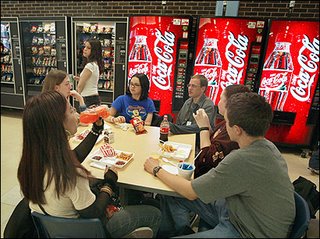
    What a nice one stop shop.

    Chase down your quadruple bypass with one of Tim Horton's new Sausage, Egg and Cheese breakfast sandwiches with 20gr of saturated fat and 920mg of sodium. Gotta keep business, I mean patients, coming I guess.

    I'll have to get to Funny Friday later...right now I'm too ticked off.

    Pathetic.

    Thursday, November 09, 2006

    Low Carb Diets again Prove Safe

    My patients will tell you, there's no particular diet that I believe to be better than another for weight management.

    I only have two real rules regarding diets and weight management:

    1. If you want to lose weight, you have to eat fewer calories than you burn.
    2. If you want to keep it off, you have to actually like what you're eating.

    I've often said that if anyone ever walked into my office and told me that they love low-carb diets, lose weight on them but don't stick to them because they're scared they're not healthy I'd simply tell them to get back to low-carbs and get out of my office.

    Fact is low carb dieting has proven itself to be safe time and time again.

    Well, it's time again, again.

    Yesterday in the New England Journal of Medicine Thomas Halton and colleagues (including Walt Willett) published a 20 year retrospective study utilizing data from the 82,802 nurses in the Nurses Health Study who have completed their extensive dietary questionnaires, looking at the rate of development of heart disease as a function of low-carb dieting.

    I'll just skip straight to their conclusion,

    "Our findings suggest that diets lower in carbohydrate and higher in protein and fat are not associated with increased risk of coronary heart disease in women. When vegetable sources of fat and protein are chosen, these diets may moderately reduce the risk of coronary heart disease."
    Frankly my only problem with low-carb diets is the fact that most people find them far too restrictive to stick to....and of course, if you don't like the way you lose the weight, it'll never stay off.

    Wednesday, November 08, 2006

    64-198

    Sad day in Canada.

    Bill C-283 (to put calories on menus) voted down in the House 64-198.

    Guess the government prefers watching the $11 billion dollars currently lost yearly to weight related illness grow rather than empower Canadians with more information to help guide their choices.

    To see the Center for Science in the Public Interest's statement on this sadly unsurprising outcome, click here.

    Tuesday, November 07, 2006

    Stupidest Products Ever or Brilliant Exercise Inventions?

    I'm at a bit of a loss here.

    As far as I'm concerned, it's not just one incredibly stupid product, it's a whole incredibly stupid product line.

    Treadmills, exercise bikes and cross trainers for children ages 3-8.

    Gymkids is the braintrust behind the idea.

    And these things aren't cheap. $200 or so per product.

    Now I'm not knocking kids exercising, but why can't a parent just buy a kid some shoes and play with them? Or a bike? Or a jungle gym?

    Gymkids explicitly states on their website that, "Supervision by a responsible adult should be undertaken at all times."

    I would love to meet the parents that actually sit around watching their kids walk on itty-bitty treadmills instead of playing with them.

    My wife suggested that perhaps it was for parents who themselves use home gyms so if the parent was working out, the kid could too - That said, can you picture a 3 year old running on a treadmill for any sustainable length of time?

    Do other people think these are ridiculous or am I being overly critical?

    Monday, November 06, 2006

    Why Does the City Waste my Tax Dollars?


    Yesterday I received a couriered package from the City of Ottawa Public Health department. I imagine every doctor in Ottawa received the same package (or at least every family doc).

    In this high priority package was a list of upcoming flu shot clinics, a reader survey, the Physician’s update newsletter, a list of communicable diseases that I’m bound to report to the Ministry of Health, a form that I can fax to receive Ottawa Public Health immunization documents, a flyer from the Centretown Community Health Centre on their Community Diabetes Education Program, a handout on how to start a patient on insulin (in English and in French), a phone list for physicians/health care providers in the Ottawa Public Health Department and 20 fifteen page minibooks called, “Influenza Pandemic – Are YOU ready (with ‘you’ indeed being emphasized by means of a magnifying glass on the cover).

    I especially like the minibook. There’s a handy dandy top ten list of emergencies that the City of Ottawa could face:

    1. An infectious disease outbreak
    2. An earthquake
    3. A radiation-related emergency
    4. Water contamination
    5. A lifeline (sewer system) failure
    6. An ice storm
    7. An act of terrorism
    8. An explosion
    9. A demonstration or riot
    10. A hazardous material spill.
    The package weighed 1.3lbs!

    First question of course is does the City actually believe their disaster planning handout is a useful thing for residents to have? Do people truly not realize that washing your hands is a good idea with a flu outbreak? Does it really help to be told to expect 80 deaths per day during a hypothetical outbreak?

    More important question, why wasn’t it mailed to me rather than wasting my tax dollars on god knows how much in courier costs?

    I couldn't resist, I had to know - wanna know how much money was wasted?

    Playing around on DHL's website (that's who shipped these materials) based on the package's size and weight I came up with a rough cost of $15 for that shipment.

    Using the CPSO Doctor Search tool I identified 1050 family doctors in Ottawa. Simple math says $15,750 spent yesterday to send something that I would imagine 99% of family doctors will chuck into the garbage with little more than a cursory glance.

    Of course I have no idea if they've restricted their mailing just to family docs. If they sent it out to all the docs, the CPSO site says there are 3,359 doctors in Ottawa. That's $50,385 in courier costs.

    Some more bad news - they ship stuff like this out 3 times per year! If we assume similar sized shipments and costs, that's $47,250 per year if exclusively sent to family docs and $151,155 per year if sent to all docs.

    [UPDATE: My Ottawa sources (a local OB/GYN among them) inform me that indeed, ALL doctors in Ottawa received the mailing!]

    Much as I think the content was useless, even if I thought the content were valuable, it certainly wasn't an emergency and could easily have been sent in plain old mail. Last time I checked, no disasters in Ottawa. If it had been sent regular old mail Canada Post's site says it would have cost roughly $6.60 per.

    I'm curious if this is a problem restricted to Ottawa or whether there is a pandemic of spending at our various public health units.

    UPDATE: See most recent post detailing City's investigation

    Wendy's - The New Authority on Nutrition!

    What a coup for Wendy's!

    They've teamed up with the American Dietetic Association to bring you a new website called Wendy's Mom-RD.

    Here's a quote from the home page,

    "Wendy's and the American Dietetic Association developed the Mom-RD program to provide moms with useful information that empowers them to make smarter choices when it comes to feeding their families"
    Contrast that statement with Wendy's new slogan, "Do what tastes right".

    What's the ADA doing getting in bed with Wendy's? For the life of me, other than money, I can't imagine what would motivate the ADA to team up with a company that uses toys and advertising to sell high calorie, non-nutritious food to children (currently they're using the Peanuts to sell Kids' meals).

    Wanna know what's in a Kids' meal? Even one of their healthier meals, the one advertised on the Kids' Meal section of Wendy's website, the turkey sandwich with the 2% milk and the granola with yogurt, has 650 calories, 8 grams of artery clogging saturated fat and a whopping 1,280 grams of sodium.

    Next question, have you ever met a kid who actually ordered the turkey sandwich with milk and granola? I'm actually scared to crunch the numbers for the Jr. Bacon Cheeseburger, the kids' fries and the pop.

    Amazingly, in the website's section on, "10 Tips for Cutting Calories and Fats" they don't explicitly mention, "Don't eat at Wendy's".

    Such a shame that the ADA and our Canadian equivalent the DoC (Dietitians of Canada) are far from shy from courting Big Food dollars.

    Saturday, November 04, 2006

    Support Bill C-283

    Please find below a letter from Mr. Bill Jeffery, the Canadian National Coordinator of the Centre for Science in the Public Interest. It has to do with the pending vote (this coming Wednesday!) on Bill C-283 that would require large chain restaurants to have calories listed on their menus.

    As I'm sure you've guessed already, I'm all for this Bill.

    Unfortunately my piece in support of it that will be coming out in the next Farm Boy flyer will apparently be two days too late.

    Below are links to allow you to "Fax" your MP (all you need is your postal code, the wonders of the internet will do the rest) and the means to look up their phone number.

    Don't be part of the silent majority. Take two minutes, follow the links and maybe, just maybe, the little guy'll win one vs. Big Food.

    "Take 10 minutes, today, to help ensure that labels of fresh meat and processed food, and menus at large chain-restaurants are required to provide key nutrition information! This will complement the information require on many packaged foods since December 2005.

    Parliament is scheduled to vote on Bill C-283 this Wednesday, November 8th.

    Wednesday's vote is too close to call. All parties are being heavily lobbied by the large chain restaurants. (Mom & Pop restaurants and small chains would be exempt). You can help ensure that your MP thinks first about the public interest, and the health and pocketbooks of your family and the 100,000 or so other constituents in your riding, instead of yielding to pressure from a few self-serving food companies.

    You can send a free, Internet-based fax from Fax Your MP to support Bill C-283 (food labelling). As long as you know your postal code, the "Fax-Your-MP" tool will automatically identify your MP's name and correct fax number. Of course, add a few personal words of your own to the model letter we've prepared for you. It will make your letter have even more impact!

    If at all possible, send the fax right now. The vote is scheduled for Wednesday, but MPs are very busy and, if they don't receive the fax by Tuesday afternoon, there's a chance they won't see your letter before they cast their vote.

    The Centre for Science in the Public Interest has been working hard for nearly four years to convince MPs to support this bill, and now is a critical juncture. You could help even more by following-up on your letter with a quick phone call to your MP's office (in the riding or Ottawa) and the office of Minister of Health, Tony Clement. If your MP is not available to talk to you, leave a voice mail message or ask the staff to tell your MP (and Minister Clement) that you support the bill and you hope all MPs will too! You can find MPs' phone numbers in the blue pages of your local phone directory, by calling 1-800-0-Canada (1-800-622-6232), or by visiting the Parliament of Canada web-site: MPs' Phone Numbers .

    I hope you can make the time to help support this campaign at this critical juncture and forward this e-mail to your friends, colleagues and any listerves or newsgroups you think might interested.

    -Bill

    ---------------------------------------------
    Bill Jeffery, LLB, National Coordinator
    Centre for Science in the Public Interest
    Suite 4550, CTTC Bldg.
    1125 Colonel By Drive
    Ottawa, Ontario K1S 5R1
    CANADA
    Website: http://www.cspinet.org/canada (Fax Your MP is also available on our home-page by clicking on the "Fax Your MP" icon near the bottom of our home-page.)

    CSPI is a non-profit health advocacy organization specializing in nutrition and food safety issues with offices in Ottawa, and Washington, D.C. CSPI's Ottawa health advocacy office is primarily funded by more than 100,000 subscribers to the Canadian edition of Nutrition Action Healthletter. CSPI does not accept funding from industry or government and Nutrition Action does not carry advertisements.

    To join our Action Alert list, visit: http://www.cspinet.org/canada/e_activists.html


    Friday, November 03, 2006

    Ever Wonder What it Would be Like to Get Hit by 1,000s of Pies?

    I find Japanese television to be both spellbinding and jaw dropping.

    Here, for Funny Friday, is a 3-part video of a Japanese television show which from what I can gather involves an unfortunate gentleman who for some reason has agreed to spend an entire day getting hit by cream pies.

    The clips are lengthy, the humour builds slowly, but boy did I enjoy them.

    I especially liked it in the first clip when the man tries to make himself some toast and one of the cream-pie ninjas throw a pie in his toaster. I also liked the third segment when the man while trying to sleep is awoken by an older woman coming out of his closet and then eating the cream off the pie guy's face (this scene potentially not for younger eyes).

    The pies begin at the 2:06 mark in the first video and then they just don't stop.

    Clearly I'm a simple, simple man.

    Have a great weekend!


    "Just Like Home" Quobesity


    Perhaps this should be a "Obesimage".

    Saw this in our Toysrus flyer today.

    It's called the Just Like Home Deli shop play set.

    Looking at the picture I see hot dogs, hamburgers, onion rings, potato chips, doughnuts, chocolate milk, juice, ketchup and mustard, white bread, pancakes with butter, cookies and bacon.

    Wanna argue with me and say, "Come on Yoni, it says it's a deli shop play set, you're twisting the picture".

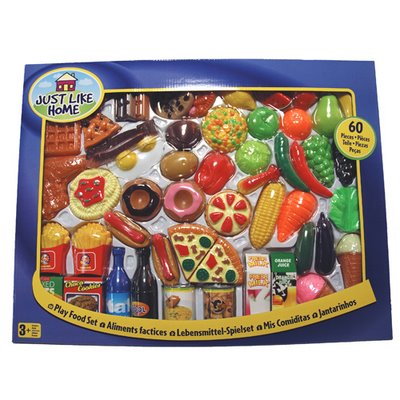
    Fine, here's the same company's Just Like Home 60 piece food set.

    Pizza, doughnuts, cola, cookies, hot dogs, orange juice, ice cream, waffles, cheesecake, french fries, bacon, chocolate and perhaps a butter tart?

    I think the vegetables are thrown in so the parents who buy the kit can say,

    "Come on Timmy, you can't play with your french fries until you finish playing with your carrots!"
    ..... Just like home.

    Thursday, November 02, 2006

    Do Restaurants Trigger Binge Eating?

    Hot off the Reuters newswire is a story about how perhaps eating at restaurants triggers binge eating.

    The story builds off a paper by Dr. Gayle M. Timmerman from the University of Austin Texas who published a study on the matter in the Western Journal of Nursing Research.

    In the study Dr. Timmerman utilized food diaries to track the dietary intake of 71 self-reported binge eaters and 46 dieters who don't have a bingeing history. They then tracked calories consumed in restaurants by bingers and non-bingers and concluded that binge eaters were more likely to binge in restaurants.

    I have two major problems with the study.

    The first is the fact that food diary work is notoriously inaccurate in terms of intake, but more importantly, food diary work is often extremely stressful and difficult for patients who truly suffer with binge eating disorder. The fact that only 3 of the 117 food diaries were excluded due to questionable content to me suggests immediately that something's up with this study because there's no way that if you asked 117 folks to keep a food diary, that 97.5% actually kept them, let alone kept them accurately enough to be worth inclusion into a study.

    The second problem I have is that what was not included in the analysis was daily caloric distribution.

    One of the primary triggers for binge eating behaviours is hunger. The most common cause of hunger in our society is meal and snack skipping. While the study did control for total daily calories, not discussing caloric distribution to me makes it impossible to interpret the results.

    One of the most commonly adopted backfiring strategies for many dieters involves the notion that if they know they're going to go out for dinner, they'll cut back on their daytime calories to compensate for those they'll consume at night. Often this will involve skipping meals or skipping snacks or purposely having very light meals that day.

    This of course then leads to hunger and combining hunger with a restaurant and a predisposition to binge eating is a recipe for.......you guessed it, binge eating.

    Dr. Timmerman concludes that,

    "Restaurants provide ample delicious food cues which when coupled with negative emotions provide a high risk environment that challenges non-purge binge eaters' control of food intake."

    I would likely want the data reanalyzed for frequency of meals, distribution of protein and I imagine the conclusion that would then be drawn would look something like,
    "Restaurants provide ample delicious food cues which when coupled with meal skipping, snack skipping and hunger provides a high risk environment that challenges everyone's, especially binge eaters', control of food intake."

    As I've said many times before - you don't crave green leafy salads when you're hungry.

    Best advice I can give is the same advice I give my patients:

    Never sit down to any meal, especially a restaurant meal, hungry.

    Wednesday, November 01, 2006

    Overweight? Don't Blame Suburbia

    I've had a bone to pick for a long time with folks who feel that our rapidly growing waistlines are attributable to a lack of exercise.

    I have an even bigger bone to pick with those who say our lack of exercise is due to growing rates of urban sprawl.

    Fact is, the numbers for me just don't add up.

    It's a very unfair thing - the number of calories burned through exercise isn't anything to write home about. Therefore I struggle with the notion that weight in society is going up due to a lack of exercise let alone a lack of simply being able to walk to your corner store.

    Many studies have reported that the less walkable neighbourhoods of suburbia contribute to obesity and they conclude that by reporting that the percentage of those who are overweight or obese are higher in areas of urban sprawl.

    The problem with that argument is that we really don't know if it's cause or effect.

    That is perhaps, until now.

    In a paper that came out of my alma matter, Lawrence Frank at the University of Toronto has published a very nice piece of research. In a paper entitled, Fat City: Questioning the Relationship Between Urban Sprawl and Obesity he does just that (question the relationship).

    Basically what Dr. Frank hypothesized is that perhaps weight in fact impacts on choice of neighourhood, rather than neighbourhood impacting on weight.

    He and his team took data from the very unsexily named Confidential Geocode Data of the National Longitudinal Survey of Youth 1979. They followed 6,000 individuals during a 6 year study period. They tracked these individuals' residential addresses and weights over time. What they were looking for was whether or not individuals gained weight when they moved to a more sprawling neighbourhood or lost weight when they moved to a less sprawling one.

    To summarize a fairly complicated paper is Dr. Frank's conclusion,

    "Overall we find no evidence that neighbourhood characteristics have any causal effect on weight"
    I also agree wholeheartedly with their statement,
    "It follows immediately from our results that recent calls to redesign cities in order to combat the rise in obesity are misguided."
    That's not to say there's no value in improving the "walkability" of neighbourhoods - I'm all for that, but I'm for it to encourage fitness, a very important determinant of health. What it won't do is affect weight.

    The math's just not there.

    Operation Play-Doh a Great Success!

    Hope everyone had a great Halloween.

    I did my own experiment this Halloween.

    I had read an article in the Journal of Nutrition Education and Behavior that suggested kids would be just as happy choosing toys as they would candy on Halloween.

    My wife and I put that to the test last night.

    We offered kids the choice between sugar-free gum and Play-Doh. The Play-Doh came in these individual packs and we bought 50 of them for $15.

    I'd say 80% of the kids chose Play-Doh and virtually 100% of the parents were thrilled we weren't handing out more candy.

    The best line of the evening came from a 7 or 8 year old goblin. When offered the choice between Playdoh and gum he asked,

    Umm...the Play-doh, can you eat it?
    When we told him no, he chose the gum.

    The picture by the way, that's me and my beautiful daughter. Sorry it's blurry. One of my patients actually made me the Burger King costume.

    I think it's a fitting costume...after all, Halloween's supposed to be scary.

    Tuesday, October 31, 2006

    The Incredible Eating Reminder Gizmo

    One of the most basic tenets of successful weight loss and weight maintenance is that if your life includes hunger, success is going to be a huge challenge.
    Hunger is one of the most basic human drives. Hundreds of millions of years of evolution have taught us to eat when we're hungry, and guess what, it's also taught us what foods have calories. We don't crave green leafy salads when we're hungry.

    One of the best and easiest ways to minimize hunger in your life is to ensure that you practice pre-emptive eating. Eat before you get hunger and you'll have a much easier time controlling portions and choices.

    Problem is, there's no internal cue to tell you to eat before you get hungry.

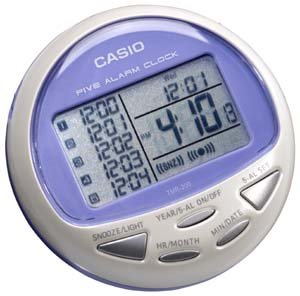
    I've often recommended to patients that they buy watches that beep at them when it's snack time (I recommend no more than 3 hours between meals and snacks). Only thing is, those watches are kinda ugly.

    In comes a patient with a brilliant solution. She bought a vibrating alarm pillbox. It's got five alarms and it's easy to set. She keeps hers in her pocket and when it vibrates, she eats.

    I found one on Amazon.com for $14.95 and it's linked here:


    Great idea!

    Monday, October 30, 2006

    Big Food Quobesity

    Here's a doozy. In fact, it's such a doozy, it'll take up two quotes.

    They're from the Director of Public Affairs for Refreshments Canada and they took place this past September in the Legislative Assembly of British Columbia during a meeting of the Select Standing Committee on Health. The meeting of course was to discuss the issue of the growing rate of childhood obesity in Canada.

    The Director was painting a rosy picture of the refreshments offered to school children. There's water, juice, milk, sports drinks, diet beverages, juice drinks (read sugar drinks), and was also bragging that the serving sizes were capped at 355ml....one serving of which of course would exceed the American Academy of Pediatrics recommendations on juice consumption by 27%.

    Anyhow, here's why it's a good idea to have larger servings and non-nutritional beverages in our schools,

    We believe that offering students a variety of beverages, while encouraging the shift toward nutritious and low-calorie options, will help them develop positive attitudes toward healthy eating.
    AND

    Dietitians we consulted supported the expanded choices in the high schools, saying that high school students need the opportunity to use more sophisticated critical-thinking skills. They also told us that high school students need to develop an awareness of how their food and other health choices may impact health later in life.
    So come on everyone, they're just trying to help our children with their critical thinking!

    They're good people.

    Saturday, October 28, 2006

    Telegrams for Beyond the Grave

    So I was all excited to have launched a new feature - Funny Fridays and had a great clip up of Steve Carrell from the Daily Show getting his daily vegetables from "all-vegetable" Crisco.

    Unfortunately last night Comedy Central decided to lawyer up and all of their clips on youtube are gone.

    So I had to find something else.

    In honour of Halloween, here's Afterlife Telegrams.

    For just $5, a "terminally ill volunteer" will memorize your telegram and deliver it when he dies.

    I'm not making this stuff up.

    Thursday, October 26, 2006

    Team Hoyt

    Maybe you've seen these folks before on the blogosphere. I hadn't. I came across them at one of our web developer's blogs

    Reading about them on his blog, I thought it must be a hoax.

    It's not.

    I'm going to do what virtually everyone who's blogged about the Hoyts have done - paste an article in its entirety into my blog. For good measure, I'm also going to throw in two remarkable videos.

    To call them inspirational would be an understatement.

    Never say, "I can't" again.

    (Article from Rick Reilly, Sport Illustrated)

    I try to be a good father. Give my kids mulligans. Work nights to pay for their text messaging. Take them to swimsuit shoots.

    But compared with Dick Hoyt, I suck.

    Eighty-five times he's pushed his disabled son, Rick, 26.2 miles in marathons. Eight times he's not only pushed him 26.2 miles in a wheelchair but also towed him 2.4 miles in a dinghy while swimming and pedaled him 112 miles in a seat on the handlebars — all in the same day.

    Dick's also pulled him cross-country skiing, taken him on his back mountain climbing and once hauled him across the U.S. on a bike. Makes taking your son bowling look a little lame, right?

    And what has Rick done for his father? Not much — except save his life.

    This love story began in Winchester, Mass., 43 years ago, when Rick was strangled by the umbilical cord during birth, leaving him brain-damaged and unable to control his limbs.

    "He'll be a vegetable the rest of his life," Dick says doctors told him and his wife, Judy, when Rick was nine months old. "Put him in an institution."

    But the Hoyts weren't buying it. They noticed the way Rick's eyes followed them around the room. When Rick was 11 they took him to the engineering department at Tufts University and asked if there was anything to help the boy communicate. "No way," Dick says he was told. "There's nothing going on in his brain."

    "Tell him a joke," Dick countered. They did. Rick laughed. Turns out a lot was going on in his brain.

    Rigged up with a computer that allowed him to control the cursor by touching a switch with the side of his head, Rick was finally able to communicate. First words? "Go Bruins!" And after a high school classmate was paralyzed in an accident and the school organized a charity run for him, Rick pecked out, "Dad, I want to do that."

    Yeah, right. How was Dick, a self-described "porker" who never ran more than a mile at a time, going to push his son five miles? Still, he tried. "Then it was me who was handicapped," Dick says. "I was sore for two weeks."

    That day changed Rick's life. "Dad," he typed, "when we were running, it felt like I wasn't disabled anymore!"

    And that sentence changed Dick's life. He became obsessed with giving Rick that feeling as often as he could. He got into such hard-belly shape that he and Rick were ready to try the 1979 Boston Marathon.

    "No way," Dick was told by a race official. The Hoyts weren't quite a single runner, and they weren't quite a wheelchair competitor. For a few years Dick and Rick just joined the massive field and ran anyway, then they found a way to get into the race officially: In 1983 they ran another marathon so fast they made the qualifying time for Boston the following year.

    Then somebody said, "Hey, Dick, why not a triathlon?"

    How's a guy who never learned to swim and hadn't ridden a bike since he was six going to haul his 110-pound kid through a triathlon? Still, Dick tried.

    Now they've done 212 triathlons, including four grueling 15-hour Ironmans in Hawaii. It must be a buzzkill to be a 25-year-old stud getting passed by an old guy towing a grown man in a dinghy, don't you think?

    Hey, Dick, why not see how you'd do on your own? "No way," he says. Dick does it purely for "the awesome feeling" he gets seeing Rick with a cantaloupe smile as they run, swim and ride together.

    This year, at ages 65 and 43, Dick and Rick finished their 24th Boston Marathon, in 5,083rd place out of more than 20,000 starters. Their best time? Two hours, 40 minutes in 1992 — only 35 minutes off the world record, which, in case you don't keep track of these things, happens to be held by a guy who was not pushing another man in a wheelchair at the time.

    "No question about it," Rick types. "My dad is the Father of the Century."

    And Dick got something else out of all this too. Two years ago he had a mild heart attack during a race. Doctors found that one of his arteries was 95% clogged. "If you hadn't been in such great shape," one doctor told him, "you probably would've died 15 years ago."

    So, in a way, Dick and Rick saved each other's life.

    Rick, who has his own apartment (he gets home care) and works in Boston, and Dick, retired from the military and living in Holland, Mass., always find ways to be together. They give speeches around the country and compete in some backbreaking race every weekend, including this Father's Day.

    That night, Rick will buy his dad dinner, but the thing he really wants to give him is a gift he can never buy.

    "The thing I'd most like," Rick types, "is that my dad would sit in the chair and I would push him once."

    Way to go Hoyts!