Tuesday, June 19, 2012

Does Dieting Increase Diabetes Risk?


That's certainly the message that HAES practitioner Linda Bacon wanted her followers to believe. In fact her tweet suggests that "even short periods of calorie restriction" increase diabetes risk.

In case you're not familiar with Dr. Bacon her work challenges the assumptions made about obesity and she has been highly critical of studies linking obesity with morbidity and mortality.

In an interview she gave to Med Journal Watch she explains why she believes not everyone agrees with her conclusions,

"My experience from having worked closely with many obesity researchers who are more conventionally-minded than me is that they are so strongly mired in their assumptions, that they don't look at the evidence."
And now back to diabetes and dieting, the story of which in this case begins back in time during the Dutch famine of World War II which they not so affectionately call the Hongerwinter (hunger winter).

It was September 1944. The Germans blockaded Holland and cut off food and fuel shipments to punish the Dutch people who opposed the Nazi regime. Food stocks dwindled. By the end of November rations amounted to fewer than 1,000 calories a day, and by February, to 580. 4.5 million people suffered, and over 22,000 perished. At the famine's worst daily rations amounted to half of a medium sized potato and 2 slices of bread. To compound matters, fuel was nearly impossible to come by and despite frigid winter temperatures, gas, heat and electricity were turned off. The famine lasted until May 1945.

Can you imagine being a child in Holland during the famine? The suffering and the horror they must have felt are unfathomable and when coupled with the severe and prolonged under-nutrition they experienced perhaps it's no surprise that their cohort have seen increases in risk of a variety of medical conditions including type 2 diabetes.  It's their experiences that Dr. Bacon uses as the source for her diabetes related caution against dieting.

The link Dr. Bacon provided in her assertive tweet about dieting and type 2 diabetes risk led to a a paper entitled, "Famine Exposure in the Young and the Risk of Type 2 Diabetes in Adulthood". In it researchers studied 7,557 Dutch women who endured the Hongerwinter and who on average were 9 years old when it occurred. Subjects were stratified into 3 groups on the basis of their self-reported exposure to famine - none, moderate and severe. The researchers found a small and statistically significant increase in risk to those women who reported themselves as moderately or severely affected by famine and this risk, while slightly attenuated, persisted after controlling for age at start of famine, education, BMI, waist circumference and waist to hip ratio.

The authors also noted that their study was unable to distinguish whether or not this association was related to under-nutrition or to famine related stress and point readers to a Finnish study that found a similar increase in lifetime risk of type 2 diabetes associating with the results of a psychological stress test in childhood war evacuees.

So in the end it would seem that from reading the evidence enduring a moderate to severe famine at a young age increases the risk of developing type 2 diabetes perhaps by way of the impact of under-nutrition, or perhaps by way of the impact of psychological stress, or perhaps by another as yet not elucidated cause.

In no way shape or form does this data suggest that "dieting" increases the risk of type 2 diabetes and in no way shape or form is suffering through a famine where daily rations include 2 small slices of bread and half a potato fairly described as a "short period of calorie restriction".

For Dr. Bacon this seems to be a bit of a pattern - slam conventional researchers for being, "so strongly mired in their assumptions that they don't look at the evidence", and then be so strongly mired in her assumptions that either she herself doesn't look at the evidence, or if she does her confirmation bias is so powerful that she'll happily find a way to present it to fit her narrative (click here for more examples). When I questioned her about this particular example on Twitter, despite her battle cry on Huffington Post of, "Show me the data we demand, and you should, too", she blocked me.

A few days ago dietitian and HAES advocate Julie Rochefort asked me on Twitter what barriers I saw to mobilizing HAES into practice. The main one I see seems to be regularly reflected by Dr. Bacon - knee jerk anger and either the willful manipulation of evidence, or a lack of critical appraisal of data so long as it seems to fit the HAES storyline.

Dr. Bacon is certainly HAES' most visible champion and role model. Responding to criticism with anger and manipulating or simply not critically evaluating HAES friendly data undermines the credibility of HAES as a whole, makes HAES easier for detractors to dismiss, and sets an absolutely terrible example for HAES practitioners and supporters to follow.

Annet van Abeelen, Sjoerd Elias, Patrick Bossuyt, Diederick Grobbee, Yvonne van der Schouw, Tessa Roseboom, & Cuno Uiterwaal (2012). Famine Exposure in the Young and the Risk of Type 2 Diabetes in Adulthood Diabetes DOI: 10.2337/db11-1559

Monday, June 18, 2012

World's Most Dangerous Piece of Cake has 5x the Calories & Sugar of BK's Bacon Sundae!


Amazing the hoopla over Burger King's bacon sundae when really it's quite a bore.

Sure it's got 510 calories and 15 teaspoons of sugar, and yes of course it has bacon, but compared with what else is out there nutritional travesty wise this one's a sleeper.

Here are 10 fast food desserts that make a bacon sundae look downright healthy including what I'm billing as the world's most dangerous piece of cake:

  1. McDonald's Large Rolo McFlurry - 830 calories, 26 teaspoons of sugar.
  2. Denny's Oreo Blender Blaster - 890 calories, 19.25 teaspoons of sugar
  3. Coldstone Creamery Gotta Have It Oreo Creme Ice Cream - 1,060 calories, 22.75 teaspoons of sugar
  4. Cinnabon Pecanbon - 1,080 calories, 19 teaspoons of sugar
  5. Dairy Queen Banana Cream Pie Blizzard - 1,090 calories, 29 teaspoons of sugar
  6. Chili's Chocolate Chip Paradise Pie - 1,250 calories, 40.75 teaspoons of sugar
  7. Applebee's Chocolate Chip Cookie Sundae - 1,550 calories, 52 teaspoons of sugar
  8. Outback Steakhouse Chocolate Thunder From Down Under - 1,554 calories, 33 teaspoons of sugar
  9. Cheesecake Factory Chocolate Tower Truffle Cake - 1,679 calories, 51.5 teaspoons of sugar
  10. The Keg Carrot Cake a la mode - 2,344 calories, 65 teaspoons of sugar (just 7 teaspoons shy of 1.5 CUPS)!


Friday, June 15, 2012

Why Can't We All Just Get Along?

One of the things I both love and hate about nutrition and healthy living blogging and research is the tremendous amount of passion with which people fuel their convictions.

I love it because it sure makes life interesting. I hate it because oftentimes (and I'm certainly not innocent here either) it leads to people taking a difference of opinion as a personal slight.

At the end of the day, whatever strategy or theory you might espouse, sometimes it's a good idea to remember that we're all in this together and more likely than not, have the same end goals in mind - a happier and healthier population.

So for today's Funny Friday picture your favorite feuding duo and then watch this video.  Maybe we can learn to all get along.

Have a great weekend

(email subscribers, you need to visit the blog to watch)


Thursday, June 14, 2012

Make Sure Your Inches Aren't Actually Miles


It's human nature, isn't it? If you give yourself an inch, you're liable to take a mile.

Skip your workout for no good reason, rely on boxes for your family's nutrition, have a "write-off" vacation, a regularly scheduled "cheat" day - there are no shortage of inches out there just waiting to get turned into miles.

Now of course, there will be times where real life does preclude your best intentions and inches are necessarily and understandably taken, but it's the inches for no reason that I worry about.

I blogged once that there are times when suffering's warranted. Another time I blogged about how healthy living requires effort. Both are true, but I can't help but wonder how many folks' best intentions were waylaid by the simple fact that they bit off more than they could chew - that their inches were in fact miles.

Better to take small careful steps of change than to require huge bounding leaps as this race never ends and you really best try not to get tired.

Wednesday, June 13, 2012

What's In That 32oz Powerade Coke Pres. Buys Her Kid Post Exercise?

Not sure if you saw this interview with Katie Bayne, the President and General Manager of Sparkling Beverages for Coca-Cola, but in it this Mom of 2 recounts how,

"if my son has lacrosse practice for three hours, we go straight to McDonald’s and buy a 32-ounce Powerade."
That intrigued me and so I visited my friendly neighborhood online nutrition database and I crunched some numbers for 32-ounce Mountain Blast Powerades (the kind sold by McDonald's).

As you might imagine, there's a whole pile of sugar, a bit of salt, some vitamins and some food coloring.

Thought I'd try my hand at creating a home made version and at the same time make my first ever video blog (please forgive a bit of camera shake when viewing fullscreen).

Email subscribers - if you'd like to watch the video, you'll have to visit the blog.


Tuesday, June 12, 2012

Coca-Cola's Chief Scientific Officer's Staggering Cognitive Dissonance


That's the nice way to look at it.

How else could you explain her defense of a product (sugar sweetened beverages) that accounts for a full 7% of total consumed calories and is itself devoid of any nutritional benefit?

Rhona S. Applebaum, vice president and chief scientific and regulatory officer at The Coca-Cola Co., in an article first published in the Sacramento Bee (since removed from their site it seems so I've linked to a web cache), states that,

"If we are really honest with ourselves, we know that no one group or sector can solve this problem alone and searching for a silver bullet that miraculously stops obesity is just not realistic. Targeting scapegoats or pointing fingers is simply a waste of energy."
Hmmmm, let's see.....while it's true that no single raindrop thinks it's responsible for the flood, and while one sandbag alone's not going to do the trick, what if there were one sandbag that could target 36% of the floodwater (will get to that number momentarily)? That'd be one helluva sandbag, no?

So what does Dr. Applebaum recommend? That,
"Instead, we should apply our energy to solutions that have been shown to work."
I'm sorry Dr. Applebaum - I'm not familiar with any interventions that to date have been shown to work, especially not those you allude to including more physically active jobs and of course, just moving more.

It's curious that moving is what Dr. Applebaum points her finger at all the while talking about solutions that have been "shown to work" given that there has never been any real world studies demonstrating a dramatic impact of exercise on weight loss. Nor am I aware of any public health interventions that have ever sustained increases in population based exercise levels. As far as real world studies go some suggest that even exercising an hour a day for 20 years won't protect against weight gain, and with kids, that a 10 fold difference in activity won't matter a whit.

Recently one of my favourite bloggers Stephan Guyenet posted a graph that might interest Dr. Applebaum. It's a graph superimposing America's weight gain with caloric intake over time.


So since 1970 or so we've seen caloric intake rise by roughly 550 calories per day.

If we take the beverage industry's own data at face value, that for the average American sugared beverages account for a staggering 7% of their total daily calories, that would account for 196 of the 550 calories we're now over consuming as a nation, or to put that another way, 36% of the 550 calorie a day flood. Now to be fair, we were drinking sugar sweetened beverages back in 1970 - but rates of consumption since then have tripled. Subtracting 1970 consumption from today still leaves Dr. Applebaum's baby accounting for a full 24% of the flood.

Sure seems like one hell of a juicy raindrop/giant sandbag to target to me, and frankly anyone who thinks differently I'd argue is either mired in some cogency crippling cognitive dissonance, or is on someone's corporate payroll.

Or both.

Monday, June 11, 2012

How Many Meals a Day Should You Eat?


"Should" is such a strong word.

Looking to the evidence base isn't much help either as there's plenty of evidence to support pretty much each and every eating style, modality, and diet.  Moreover, I'd argue that even if the evidence did firmly fall into the camp of one style or diet being "the best", that wouldn't change the fact that following it may prove non-enjoyable (and hence non-sustainable) to many.

"Should" presumes that everyone is the same. Same genetics, same co-morbidities, same lifestyles, same likes, same dislikes, same, same, same.

The thing is we're not all the same.

In my practice we tend to start people on 3 meals and 2-3 snacks a day, all inclusive of protein and at least 300 calories a meal and 100 a snack. We do that because experientially with us, for a great many folks, that spread has proven helpful in reducing cravings, hunger and struggle, and for busy people with jobs and young families, it's often more practical than larger, less frequent meals.

But it's not useful for everyone!

We have other folks on 3 square meal a day regimes.

I've even suggested an intermittent fasting (IF) style 2 meals a day to folks whose lifestyles and struggles suggested they may be well suited to it.

And as far as dietary style goes we've had Paleo folks, classic low-carb'ers, vegetarians, vegans, low-fat fanatics and certainly everything in between.

In my clinical practice, I'm not married to anything other than a person living the healthiest life they can honestly enjoy.

Those folks who firmly believe everyone "should" be doing things a certain way? That there's one "right" way to diet; one "right" way to eat; one "right" form of exercise; one "right" road to health?

I think they're wrong.

Saturday, June 09, 2012

Saturday Stories: Behaviour Change, Calories and Gulps


Weight Maven's Beth Mazur has a funky video as part of her piece on facilitating behaviour change.

Whole Health Source's Stephan Guyenet on why calories still count (though why we're eating so many more, that's still up for debate).

Mark Bittman's brilliant take on the large cup ban in NYC (it's not a soda ban).

And a bonus - former Coke marketing exec states he has a large karmic debt to pay for the Cokes he helped to sell.


Friday, June 08, 2012

I Think I Need a Case of This Stuff!

It's "Naptime!", and I'm guessing most parents wish they had a bottle stashed around somewhere.

And it's also today's Funny Friday video, probably best described as both horrifically inappropriate and hilarious.

Have a great weekend!

(email subscribers, you need to head to the blog to watch)


Thursday, June 07, 2012

Guest Post: Cake Wars Rock Nova Scotia Schools


There are cake wars in Nova Scotia.

On the one side is Nova Scotia's school food policy that specifically advises schools not to fund raise with junk food. On the other side is Ms. Pamela Lovelace who believes that schools have no business in banning specific foods and that,

"Quite frankly, it's up to the parents to determine whether or not we want to allow our kids candy."
Now I've covered why I think the but parents can just say "NO" argument falls short before - instead today we have a much more civil discussion from my colleagues Drs. Sara Kirk, Tarra Penney and Jessie-Lee McIssac out of Dalhousie University and their Applied Research Collaborations for Health (ARCH).
Let’s stop fighting about cake and focus on what’s important!

Sara Kirk, Tarra Penney and Jessie-Lee McIssac

In 1986, Canada became a world leader as the home of the Ottawa Charter for Health Promotion, a landmark international agreement that sought to build healthy public policy and create supportive environments for health. This culmination of evidence and call for action acknowledges the powerful role that our own individual circumstances play in our ability to live healthy, rich lives. It is based on the notion that, as a society, we thrive or wane together and it provides recommendations to ensure that our citizens, families and children have the best chance to create wellness for themselves by providing the best possible environment for them to live, work and play. Although the charter itself remains a long way from its goal of “health for all by 2000”, in 2005, Nova Scotia became recognised across Canada and internationally for its leadership in creating a Food and Nutrition Policy for Nova Scotia Public Schools. Rooted in evidence and community consultation, the policy is designed to protect school environments from the constant barrage of cheap, nutritionally void, highly processed foods that challenge us all in our decisions to make healthy choices and engage in healthy behaviours. Given that Nova Scotians are among the least healthy in the country – with high rates of chronic disease, the highest proportion of individuals with multiple chronic conditions and high rates of food insecurity - it could be argued that we are desperate for environments that make being healthy a little easier, and why not start with our children? Our schools?

In the province, a weekend school fundraiser, and the resulting media coverage (and a video here), has raised questions regarding the interpretation of the policy for Nova Scotian schools. The criticisms put forward highlight how much work still needs to be done to ensure that parents, families and citizens understand the difficult choices we need to make as a society in order to create the supportive environments necessary to make the healthy choice the easy choice, especially in places where our children spend significant amounts of their time. The policy challenges us as parents and citizens to come up with innovative ways to combine tradition, health and fun in ways that will set up the next generation of citizens for life-long health. The policy sets an important precedent that schools are one place where we can help our children to learn about healthy eating and active living and model these behaviours. We need to recognise that supporting healthy behaviours could actually save lives and money, as well as helping our children to succeed. Why would we not want this for our children? As a colleague who works in school health so eloquently put it, “it’s amazing that some people will put up such resistance to offering healthy food choices to our students…when it is the right thing to do”.


Wednesday, June 06, 2012

Think a Class Action Lawsuit Will Stop Nutella from Making Ridiculous Claims? Think Again.


In case you hadn't heard Nutella was hit with a class action lawsuit consequent to their promotion of Nutella as, "An example of a tasty yet balanced breakfast", when in actuality, at least by the numbers, Nutella's not quite as balanced as no-name chocolate icing.

Now much has been made about the suit and how it's going to stop Nutella from making that claim, but the thing is, it's not.

I took a phone call the other day from a consumer advocate lawyer named Mark Lavery who's opposed to the settlement as written. He alerted me to this paragraph,

"Ferrero will modify the back panel of the label for Nutella (the “Information Panel”) by removing the phrase "An example of a tasty yet balanced breakfast” and replacing it with “Turn a balanced breakfast into a tasty one” (the “Revised Statement”). Ferrero retains the right to determine, in its sole discretion, the location, size and other design characteristics relating to the Revised Statement"
Mr. Lavery's concern, and it's one that I share, is that the new statement, "Turn a balanced breakfast into a tasty one", is just as disingenuous as the original. Wouldn't adding chocolate icing to your breakfast "unbalance" it, or is the goal to "balance" healthy with sugar to ensure it's not too healthy? My additional concern is that not only does it still seem to suggest Nutella is a nutritious choice, it now suggests that actually healthy breakfasts aren't tasty.

Now I realize that many people felt this lawsuit was frivolous and I'm not going to get into that here, I just want to ask you, do you think the new statement is any less misleading than the old one?

I've written a brief statement for Mr. Lavery. If you're interested in doing the same, you can reach him here. Deadline's this Friday.
Declaration of Dr. Yoni Freedhoff, MD

My name is Yoni Freedhoff and I’m a physician, an Assistant Professor of Family Medicine at the University of Ottawa, the former Family Medicine Chair of the Canadian Obesity Network, a Diplomate of the American Board of Obesity Medicine, and a vocal public health advocate.

People often think healthy living is intuitive. They think that since they can envisage what “healthy living” looks like in their minds, that it’s therefore a simple choice. If only that were the case. While there is no shortage of impediments to healthy living in our modern world, certainly one of the most prevalent and dangerous is disingenuous marketing. People simply don’t have the time, background or frankly the inclination to read food labels carefully, let alone understand them - a fact that perhaps has not been lost over the years on the marketers of Nutella.

Looking at the settlement’s injunctive relief I’m confused by the proposed wording which in my mind is no less misleading than the original which was in question. The statement, “Turn a balanced breakfast into a tasty one” implies two things. First that adding Nutella to a balanced breakfast would still leave that breakfast “balanced”, and secondly that actually balanced breakfasts aren’t tasty.

Again, nutrition isn’t intuitive, and in large part that knowledge gap is fueled by marketing. Having watched my fair share of television commercials, and read my fair share of magazine advertisements, I know that included in Nutella in some capacity are hazelnuts and milk - nutritional heroes to many. Perhaps that’s why even I was surprised to learn that in a head to head comparison with no name chocolate icing, Nutella was found to have 25% more calories and nearly 30% more sugar. In fact by weight Nutella is 57% sugar (21g of sugar per 37g serving) and as far as nutritional benefits go, Nutella’s are negligible at best providing an effectively insignificant 4% of daily calcium and iron needs.

Which brings me back to the question of whether or not Nutella can be a part of a “balanced” breakfast? As a medical doctor and an expert in both nutrition and obesity I would argue that adding a dollop of no-name chocolate icing to a “balanced” breakfast would in fact unbalance it, making what was once healthy, not. Consequently one might argue that adding a dollop of Nutella with 25% more calories and 30% more sugar than no-name chocolate icing, regardless of the miniscule amounts of calcium and iron Nutella may contain, would perhaps make that breakfast 30% more unbalanced than would adding the icing were such a measure actually quantifiable.

Personally I liken Nutella to a spreadable chocolate bar. If you believe that adding a chocolate bar to a balanced breakfast leaves it balanced, then by all means give Nutella this marketing get-out-of-jail free golden ticket. On the other hand, if you think allowing Nutella to explicitly continue to suggest, in a society where 1 in 3 children are overweight or obese and the rates of pediatric diabetes are skyrocketing, that the inclusion of chocolate bars with children’s meals precludes nutritional balance, perhaps the wording of this settlement’s proposed injunctive relief deserves a sober second look.

I declare under penalty of perjury under the laws of the United States of America that the foregoing is true and correct.

Executed on June 5th, 2012

Sincerely,

Dr. Yoni Freedhoff, MD, CCFP, Dip ABOM
Assistant Professor, Family Medicine, University of Ottawa
Medical Director, Bariatric Medical Institute
575 West Hunt Club, Suite 100
Ottawa ON K2G5W5


Tuesday, June 05, 2012

The Greatest Danger of Processed "Home Cooking"


It's not necessarily the actual food, but rather it's what it teaches.

Take the fish example up above. Nutritionally I'm guessing that it's pretty much the same as if you breaded, seasoned and pan fried the fish yourself.

But the message?

The message is that good healthy food comes in boxes.

And the message that's lost?

That it's actually not even remotely difficult to buy fresh fish, season it and pan fry it. And if fresh is a challenge, perhaps even preparing plain frozen fish fillets that you first thaw for a few moments in a sink full of water. 

Reliance on boxes robs people and their highly impressionable children of the basic life skill and healthy living importance of cooking while simultaneously perpetuating the de-prioritization of actual meal preparation from our modern day lives.  While the final outcome in this case might be nutritionally comparable, and might even take 1 or 2 minutes less time than from scratch, I'll still label it as part of the problem, rather than part of the solution.  Sure, rely on products like this in a pinch, but I'm guessing many rely on them more often than not.

We're not going to solve society's nutrition related woes with boxes.

Monday, June 04, 2012

SickKids Foundation President Defends Junk Food Fundraising


So last Monday I blogged about how SickKids Foundation was hypocritically normalizing eating out and encouraging the consumption of junk food in the name of raising money to combat childhood obesity .

I sent my post over to SickKids Foundation president Ted Garrard and he was kind enough to send me a response as well as give me permission to post it.

Basically Mr. Garrard's position is that because those same institutions that are inviting people to purchase such things as onion rings, pizzas, cookies, desserts, Chinese take out have "low fat" items too, that it's alright.

To me that's the food industry apologists' version of the, "but I was just following orders" argument.

Have a read, and if you're interested in sending your thoughts to Mr. Garrard, you can do so by clicking here, or leave a comment on the blog as I'm hopeful the Foundation will be reading,
Dear Dr. Freedhoff,

Thank you for your e-mail and for taking an interest in our first-ever Healthy & Happy campaign. We take all comments and feedback seriously.

In your recent blog about SickKids, you allude to several cause marketing relationships linked to our current campaign. These are valued corporate partners of SickKids Foundation who have come on board to help us raise critical funds for The Hospital for Sick Children.

These corporate sponsors offer a wide range of food and beverage choices, including low-fat options for the health conscious consumer. These are also family-friendly retailers and restaurants and we believe their customers align with our target demographic for this campaign. We believe that important components of a healthy and happy lifestyle include making healthy food choices, being active, being mindful of portion sizes and all things in moderation.

That said, we will take feedback like yours into consideration as we move forward with planning next year’s Healthy & Happy campaign.

The Healthy & Happy effort is based on one simple premise – every child deserves to be healthy and happy. Ultimately we are trying to create a platform to discuss the seriousness of child health issues while reflecting the spirit of happiness which we believe is so important for all children. It is meant to be a positive and feel good experience for anyone who is touched by our campaign. If you visit our site at www.dothehappy.com you will see the positive influence this campaign is having for families who rely on SickKids every day.

Please know that we appreciate and value your perspective, and I want to thank you again for your feedback.

Ted


Saturday, June 02, 2012

Saturday Stories: Fructose Science, Fat Consumption, and fMRI Flaws


David Despain posts a what I would consider a must read interview with Dr. John Sievenpiper on the non-hyped state of the science surrounding fructose.

Evelyn over at the Carb Sane-Asylum looks at some recent NHANES data and concludes that NHANES data probably isn't very good data but that if you do believe it, society hasn't swapped fat for carbs since 1970 (just to help when you read her piece - she's talking about absolute consumption, not percentiles as the graphs do demonstrate a percentile decrease whereas absolutes would put fat consumption at only a roughly +/- 5g a day change since 1970).

And lastly two awesome pieces explaining why fMRI studies probably aren't too exciting. The first is an oldie from Wired magazine on how an fMRI machine suggested a dead salmon could interpret human emotions and the second is last weeks' Vaughan Bell article from the Guardian that steered me to the dead salmon.


Friday, June 01, 2012

This Is Exactly How I Eat Peas

Today's Funny Friday video was like looking in a mirror.

Have a great weekend!

(email subscribers you need to go to the blog to watch)


Thursday, May 31, 2012

My Vote For the World's Least Healthy Beverage


Grape juice.

Now I know some of you might be thinking but what about sugared soda or energy drinks or even alcoholic energy drinks?

Sure, all of those are horrible - but none of those are marketed in the name of health, and that's what puts grape juice at the top of my least healthy beverage pyramid.
"2 servings of fruit in every glass?"
I know I'm a broken record on grape juice, but who cares if it's got vitamin C in it? Would you drink nearly a quarter of a cup of maple syrup a day if it had 100% of your Vitamin C requirements? Probably not....yet it takes nearly a full quarter cup of maple syrup to reach the calories and 10 teaspoons of sugar provided by every cup of grape juice.

(BTW - Grape juice has double the calories and sugar of other juices. Given the American Academy of Pediatrics and the Canadian Pediatric Society both recommend limiting juice to 1/2 a cup for small kids and 1 cup for large ones, I'm guessing they'd recommend limiting grape juice to 1/4 of a cup for wee ones, and 1/2 for everyone else)

Wednesday, May 30, 2012

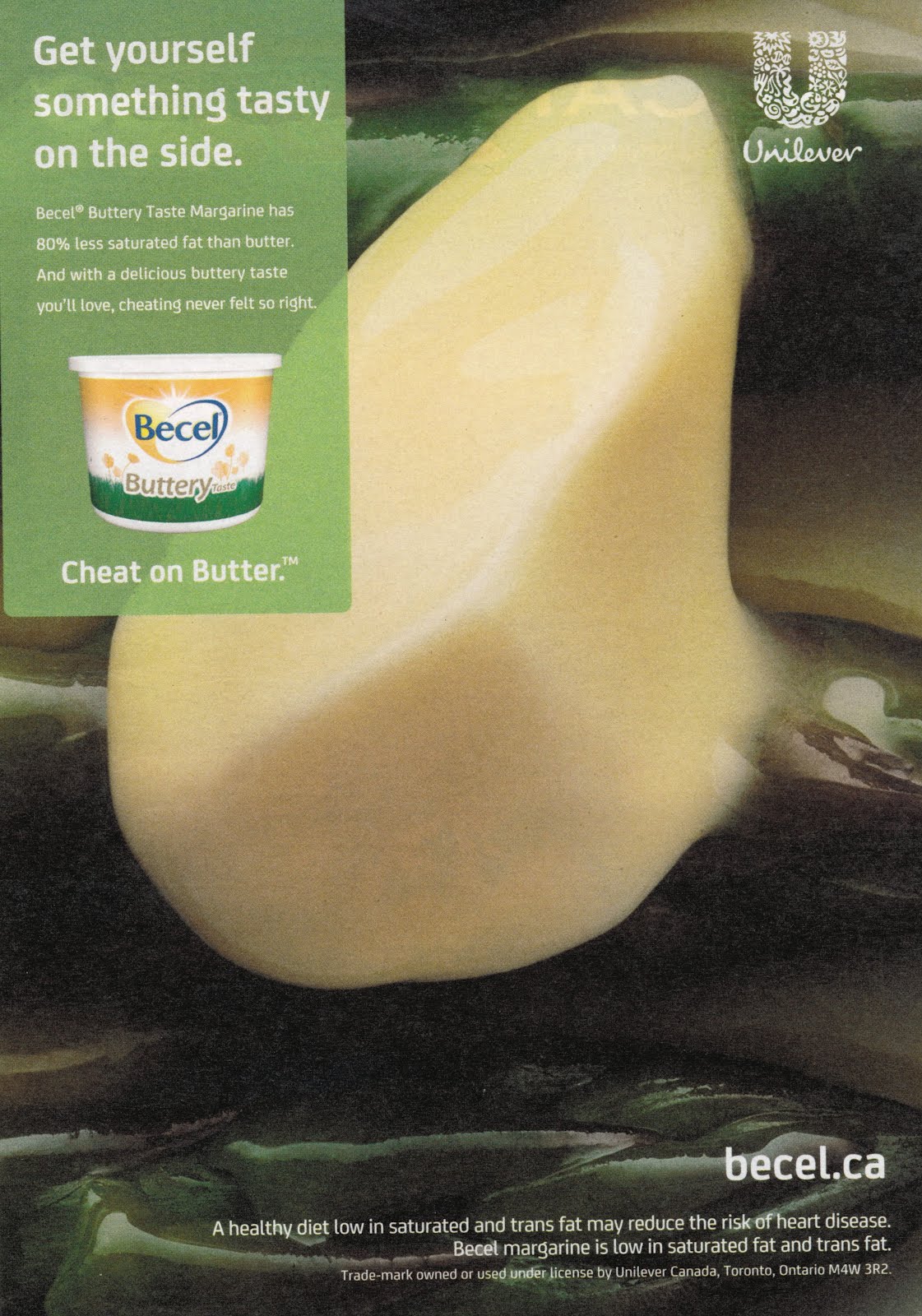
Badvertising: For God's Sake, Just Frickin' Eat Butter!


Yet another example of why national Food Guides matter.

Here's an advertisement from Becel for its Becel Buttery Taste Margarine which they flog as,
"having 80% less saturated fat than butter and with a delicious buttery taste"
They also make sure to note,
"A healthy diet low in saturated and trans fat may reduce the risk of heart disease"
Yet saturated fat has been exonerated as being an independent risk factor of disease....probably something worth telling the general public, but of course Health Canada can't possibly respond to a changing evidence base by actually changing recommendations. I mean come on, that would mean changing the Food Guide more frequently than every 10-15 years.  That's just crazy talk.

You know what else has a "delicious buttery taste"? Frickin' BUTTER! And it has the same number of calories as the margarine you're buying because you like the taste of butter but are scared of it because your government told you to be.  Well guess what?  Butter's not going to hurt you and guaranteed, it'll be far more delicious than your "buttery",
"Canola and sunflower oils 74%, water, modified palm and palm kernel oils 6%, salt 1.5%, buttermilk powder 1%, soy lecithin 0.2%, natural & artificial flavor, potassium sorbate, vegetable monoglycerides, citric acid, alpha-tocopherol acetate, calcium disodium EDTA, vitamin A palmitate, beta-carotene, vitamin D3."
Just frickin' eat butter!

Sigh.

Tuesday, May 29, 2012

Biggest Loser MD Deluded, Unethical or Clueless?


Take your pick, but I think he's got to be one of those three.

His name is Dr. Robert Huizenga and last week he presented a Biggest Loser themed report at the 21st Annual Scientific and Clinical Congress of the American Association of Clinical Endocrinologists in Philadelphia.

The presentation detailed what an overly excited press release called a "pioneering study" whereby Huizenga found that when looking at 35 contestants from seasons 11, 12 and 13 of The Biggest Loser, severe dietary restriction combined with insane amounts of exercise dramatically improved metabolic outcomes including diabetes and hypertension.

That's "pioneering"? Is it really news that weight loss and exercise improve diabetes and hypertension? The only outcome related to hypertension and diabetes that would have been surprising to me would have been if they didn't markedly improve.

But where I'm truly left dumbfounded is Huizenga's reported consequent belief that the Biggest Loser modality of weight management - literally a minimum of 4 hours a day of exercise coupled with a highly restricted diet - is, "a better mousetrap".

I'm not sure what world Dr. Huizenga comes from, but in the one where I live people, even if they want to, don't have four spare hours a day to exercise. You see in my world people have jobs, families and other real-life-actual-human-being things that regardless of their weight or health intentions, are going to supersede any misguided physician's recommendations that in order to be healthy they need to spend every third waking hour of their lives in a gym. I'm thinking if 4 hours a day of exercise is his "better mousetrap", he'd best be prepared not to catch any mice.

And there are more differences between our two worlds. For instance in mine virtually everyone knows how incredibly unrealistic and perhaps even unethical it would be to suggest a better mousetrap had been built if it's build was based on Biggest Loser contestant outcomes without looking at whether or not those outcomes were preserved when the show turned off its ever present cameras. Not so apparently in Huizenga's world where his conclusions are indeed based on Biggest Loser participants' outcomes recorded only at the end of their 24 week contest. An end where his subjects were all still competing for huge sums of prize money, and where they were still being followed by television cameras, millions of viewers, and the potential to turn their experiences into careers. Hardly an end that's clinically applicable to the general population.

There's one other piece that's really bothering me. Why did Huizenga's study only include 35 contestants? By my count that's only 59% of those seasons' contestants. A pretty terrible loss to follow up in a venue where as is evidenced by each season's finale, there's virtually no loss to follow up.

Huizenga's apparently applied for a grant to compare outcomes between bariatric surgery and  Biggest Loser contestants. If funded let's hope that his study design doesn't include subject cherry picking, and that his follow up period is at the very least a clinically useful few years long, though given what he's done here, I won't hold my breath hoping for an ethical and appropriate methodology.

As to Huizenga's motives - well aside from supporting his show and television career I can think of two: Cognitive dissonance and confirmation bias.  Those two?  They're like the bed bugs of science, except instead of spreading disease, they spread delusion.

Someone ought to fumigate that guy.

Monday, May 28, 2012

Sick Kids Hospital Fights Childhood Obesity with Pizza, Onion Rings & Cake?


And gelatos, desserts at multiple restaurants, cookies at coffee shops, pub based fish and chips, massive sugary smoothies, and Chinese take out.

It's all part of their "Happy and Healthy Kids" campaign which according to their website, was launched because,
"Current trends are troubling. This is the first generation of children in modern history that may have a shorter lifespan than their parents because of child health issues like obesity."
So how is Sick Kids planning on fighting that?

By raising money.

And how are they going to do that?

By encouraging the ongoing normalization of eating out, supporting the health washing of junk food, and by providing consumers (including children and parents of children) further incentives not to actually cook.

Genius?

What Sick Kids Foundation is doing - fighting childhood obesity by helping to sell junk food through cause marketing - it's akin to a cancer hospital fighting lung cancer by helping to sell cigarettes.

Except that cancer hospitals don't do that.  They don't because it would be unbelievably hypocritical and would encourage and excuse patently unhealthy behaviour.

They don't because it would be frankly inexcusable.

Saturday, May 26, 2012

Saturday Stories: A's, POM and Apps!


My friend and colleague Arya Sharma on the launch of the Canadian Obesity Network's 5As of Obesity Management.

Marion Nestle explores POM's interesting take on the "truth".

Nice piece by David Freedman in the Atlantic on the quantified self and weight management.


Friday, May 25, 2012

Teaching the Young Bloods How It's Done

I might not love Pepsi Co., but there's no denying this is one helluva entertaining ad.

Today's Funny Friday stars NBA rookie of the year Kyrie Irving.

Have a great weekend!

(email subscribers, you've got to head over to the blog to watch)


[Hat tip to LIVESTRONG's Adam Bornstein]

Thursday, May 24, 2012

Are Public Drinking Fountains Disappearing?


Am I losing my mind?

Maybe it's just my addled memory but I seem to recall public drinking fountains being everywhere when I was a kid. Every school, every park, every playground, every public building - everywhere had a drinking fountain.

Nowadays they seem to be in much scarcer supply.

So what happened? Why have they disappeared?  Was it the insane rise of the bottled water movement that simply drove down demand?  Was it fears of communicable disease?  Were they purposely removed so as to encourage concession and vending machine sales?

Or is it just all in my head?

I know I have readers from all over the world. Would love to hear if your public drinking fountains are going the way of the dodo too. Have you noticed their removal?

Tuesday, May 22, 2012

Ontario's Expert Childhood Obesity Panel Conspicuously Lacking in Experts


Did you hear?  Ontario is planning on reducing childhood obesity by 20% in the next 5 years!

I first heard that target when I was contacted by Ontario Health Minister Deb Matthews' office back in early February. They wanted to chat with me about my thoughts regarding childhood obesity. I told them that I thought it was a symptom of a broken environment and that unless they focus on the environment as their target for change, they're not going to get anywhere. That'd be like trying to deal with chronic flooding not by building a levee, but rather by focusing on swimming lessons. Furthermore I told her that if the campaign targets obesity itself as the problem, that it might well increase societal weight bias and stigma as it suggests a blame and shame based individualized cause of obesity.  I also told her that I thought their 20% reduction in 5 years target was miles beyond hopeful.

I'm guessing what I had to say wasn't what they wanted to hear as I was not invited to join her office's Healthy Kids Panel.

So who was invited to join?

The panel is made up of a random hodge podge of folks. It's being co- chaired by a very nice former local politician turned newly minted hospital CEO and the dynamic head of a national encourage kids to exercise program. Having spoken with both in the past, I've no doubt they'll be able to "build consensus" (that's what the Ontario Healthy Kids Panel's webpage suggests they're there to do) among the members, but will the consensus be useful?  That would depend on the members.  So who is on their expert panel which according to the Healthy Kids Panel webpage, "possess(es) a broad understanding of childhood obesity"?:
  • 2 physicians, neither of who list obesity even as an interest on their own official bio pages.
  • A PhD researcher who while interested in obesity, is interested in the impact of the baby's in womb environment on obesity - fascinating, but far from prime time when it comes to interventions.
  • A Registered Nurse without any special interest in obesity mentioned in her Ontario Healthy Kids Panel bio.
  • A "young First Nations mother" (that's how she's billed by her official bio) who refers to herself as a "Senior Communications Specialist" on her LinkedIn page. 
  • An "award winning journalist and mother of 3". Despite trying, I couldn't find any mention of her having a special interest or expertise in obesity.
  • The Senior Vice President of Health and Wellness for Loblaw Companies Limited - a massive Canadian grocery store chain.
  • The President of YMCA Ontario.
  • A healthy living cookbook author and caterer.
  • The Executive Director of the Propel Centre for Population Health Impact whose biography doesn't list obesity as an interest or background.
  • The CEO of the Health Strategy Innovation Cell at Massey College and author of XXL: Obesity and the Limits of Shame. He has a true interest and expertise in obesity and while I may not share all of his views, I'm glad at least there's one person on the panel where obesity is a major part of their life's work.
  • The Vice-President, Food Policy Scientific and Regulatory Affairs with Food and Consumer Products of Canada - a food industry advocacy organization
  • A marketing and advertising expert with no reported special interest in obesity.
  • The head of the Canadian national office of Right to Play - a wonderful organization that aims to improve the lives of children through play. His biography lists no special interest or background in obesity.
  • The MPP for Scarborough-Agincourt and Parliamentary Assistant to the Minister of Community Safety and Correctional Services. According to Google, the word "obesity" doesn't appear once on her official campaign webpage.
I don't doubt the panel's sincerity for a moment, but caring about children or childhood obesity is not the same thing as having expertise, and while there are one or two panel members who truly do have expertise in childhood obesity, shouldn't there be more?  Moreover, do you really think the panel chairs are going to be able to build any consensus that would impact negatively on the food industry given their representation at the table?

As a highly complex and multi-factorial problem perhaps the silver-ish lining is that there is no shortage of initiatives we could undertake to tackle childhood obesity. Here's hoping that when I blog about this panel's actual recommendations down the road I'll be referring back to this post as prematurely negative and will speak glowingly of the panel's plans.

So here's my plea to the panel - please make me look bad.  Put out something more useful than just the same old, eat less move more drek we've all come to know and loathe.  Actually tackle issues like predatory food industry marketing and front-of-package deceptions, nutrition facts panel reforms, actually useful school food policies including the removal of sweetened milk from sale, childhood advertising bans, the return of home economics, zoning laws for fast food around schools, innovative incentive or disincentive taxation, an explicit recommendation that juice be limited to a maximum half a cup a day and that it's basically just flat soda with a smattering of vitamins and certainly not a fruit equivalent, a true discussion of energy balance that explicitly hammers home the fact that exercise is insufficient by itself to make any dent in weight, a campaign designed to combat caloric illiteracy, mandatory calorie labeling in restaurants, a fight against the ugly prevalence of weight bias, a massive campaign designed to increase home cooking by specifically recommending we eat out less frequently in restaurants and purchase fewer boxed meals - just to name a few.

There's nothing I'd love more than to have to eat a huge serving of crow.

Monday, May 21, 2012

Have You Ever Experienced a Post Race Day Bonk?


(Not that kind of bonk!)

It's certainly happened to me. I've trained for months to run a triathlon or a plain road race, kicked my own butt on race day, only to find the next bunch of weeks (and at least once or twice - months) I take it far easier than someone committed to healthy living ought to.

I'm betting it'll happen to a few folks in my office too as this past Saturday just shy of 40 clients from my office ran in the now 6th annual Dr. Freedhoff Try-a-Tri Challenge (thanks Somersault!). For many, it was the their first triathlon. For some it was their first ever race.

I'd be willing to wager that at least one person from the race is going to see me in my office in the next few weeks inexplicably struggling with their healthy living behaviours - not just with fitness, but with food too - and all consequent to a post-race bonk.

Healthy living? It's a marathon. An ultra-marathon. A never-ending ultra-marathon.

Sure it's alright, in fact it's downright human, to relax here and there, perhaps especially after a major job well done.

But if you really want to finish this race remember consistency is key,and quickly getting back to your pre-race day lives is something you might want to strive for.

If you're really stuck?

You can always sign up for another race.

Congratulations to everyone for a really wonderful day!

Have you ever had a post race day bonk? How long did yours last?

Saturday, May 19, 2012

Saturday Stories: Superweeds, Poetry and More HBO


Marion Nestle on the perils of genetically modified crops (hint, eating them won't hurt you, but planting them might).

Snarky, weight lifting, columnist and personal trainer James Fell writes what he calls, "the worst weight loss poem ever written".

Michele Simon, via Grist, on her thoughts after watching Weight of the Nation (assuming I get a chance to watch it this weekend, my thoughts may be in next week sometime)


Friday, May 18, 2012

The All New F*&% You Pizza From Pizza Hut

Did you happen to see the insane pizzas that Pizza Hut's making these days (like this one with the cheeseburger crust)?

Well today's Funny Friday is their all new F*&* You Pizza.

Fair warning! They use the word F*$@ a lot.

Have a great weekend!

(email subscribers, to see the video, you'll have to visit the blog)


Thursday, May 17, 2012

An Actually Healthy Restaurant?


Maybe it is possible.

This one's in Tokyo and it was designed by the Tanita scale corporation.

According to this tiny news item,
"Each table is fitted with a weighing scale to ensure healthy portions can be measured out, while a timer tells the diner when the optimum duration of 20 minutes for completing their lunch is over. Professional dieticians are also on hand to provide free advice on eating regimes in a special counselling room."
Sounds fabulous to me (other than that weird timer thing).

Wednesday, May 16, 2012

The Truth? Healthy Living Requires Effort.


(I want to preface this post by explicitly stating it isn't about weight. Healthy living isn't determined by your weight and this post applies to everyone regardless of their weight - being skinny is no more automatically synonymous with living a healthy life than being fat is with living an unhealthy one)

I need to expand a bit on my last few posts.

The unfair truth is that living a healthy life requires effort. It requires making time to include regular exercise. It requires making time to cook real food. For most, those two things will require reorganizing schedules, taking long hard looks at after school and work obligations, and for many it will require developing new skill sets involving both fitness and cooking.

It wasn't always this way.

Once upon a time many jobs were physically demanding. Once upon a time eating out and processed meals simply weren't an option. Once upon a time calories weren't cheap. Once upon a time we had more time.

And don't get me wrong, I'm not suggesting life was idyllic 60 years ago. Human nature being what it is I'm sure many still didn't prioritize exercise, and that many more, while cooking, certainly weren't cooking healthful meals.

That said, if someone wanted to improve their health 60 years ago, cooking wouldn't be a foreign concept, and their after work and weekend time for things like fitness would likely not have been taken up with after school chauffeuring or the electronic tethers to which we've all grown accustomed and dependent.

What you need to do to improve your health may not be in and of itself complicated, but finding the time and skill to do so in this current environment undoubtedly is.

But it's only a hardship if you make it one. Attitude's crucial to winning a healthy living fight. Exercise isn't about day to day suffering, it's about living a longer, better, more functionally independent, literally less painful life. Cooking's not about being a time consuming chore, it's about improving the health of your family and perhaps becoming less reliant on medications.

And one thing's for certain. It does require effort, and if anyone (including yourself) ever tells you differently they're either ignorant or they're liars.

Like anything valuable in life - education, marriage, parenthood, work - you get out what you put in, there are no shortcuts.

So what do you need to do? First I'd recommend you ignore the minutia and remember that there's no perfect diet (for health or for weight management) and no one way to go - and please ignore whatever the latest study they're trumpeting in the news. And then?
  • Cook more frequently from whole ingredients (eating out less frequently and eating fewer processed meals).
  • Move more and intentionally include as much exercise as you can enjoy into your life (your toothbrush level of exercise).
  • Live the life you want your children to live and include them in all of your health living endeavors (teaching them the joy and value of cooking and exercise)
  • Be a quitter if you need to.
  • Never ever forget that the best you can do varies day by day and that your personal best is always great.

Is it fair?

Never.

Is it easy?

Definitely not at the beginning, and certainly not always after that.

Is it doable?

Absolutely.

It's about priorities and choices. That doesn't mean you're a bad person or parent if you don't choose to live with a healthy lifestyle - we're all entitled to choose the way in which we live our lives - but if your desire is a healthy lifestyle and you simply think it isn't doable then I think you're shortchanging yourself.

Health is incredibly valuable.  It requires effort.  There's just no way around that.

Tuesday, May 15, 2012

A Single "Food Product" That Encapsulates the Entirety of the Problem.


"Fast Franks".

Fast?

Because cooking a hot dog and putting it in a bun is "slow"?

But this Frankenfood speaks volumes.

As a society we value convenience and speed over nearly everything else. Consequently there's a demand for products like "Fast Franks", or more commonly for health washed products that people feel give them the same benefits as from scratch but quickly and conveniently.

Is there anything in life that's valuable that requires little or no effort?

Cooking, and perhaps slightly more specifically, prioritizing and finding the time to cook healthful meals - at this point, there's no way around it.

[Hat tip to Twitter's @teacherace for sending me the photo]

Monday, May 14, 2012

McDonald's Helping Kids Get Their "5 A Day" With Fruit Soda?


They're selling it on the backs of the ridiculous notion perpetuated by the likes of Canada's Food Guide, MyPlate, and virtually every national eating guide that juice counts as a fruit.

It's called "Fruitizz", and it's a carbonated fruit juice being promoted by McDonald's as being a healthy choice for kids.

What's in it?

6 teaspoons of sugar per cup. For those counting, that's more than Coca-Cola. Oh, and they serve it in 500mL cups, so 12 teaspoons of sugar accounting for 98% of the drink's 200 calories.

But the best (worst) part?

They're rolling it out on the basis of national food guides and stating that drinking it, because it's a juice, makes it part of a kid's 5-A-Day (remember national food guidelines, including those in Canada, the US and the UK, explicitly and inanely consider juice to be a fruit).

Don't believe me?

Here's the cup.


The truly awful part?

There's buy-in.

Check out this completely clueless quote by Malcolm Clark a spokesperson for the British Heart Foundation funded Children's Food Campaign,
"It's encouraging to see companies like McDonald's making it easier for parents to make healthier choices for their children.

The best news for children's health will be if fruit-based drinks start to displace sugary drinks such as Coca-Cola from children's menus in McDonald's.
"
Yes Mr. Clark, it's so incredibly encouraging that McDonald's is giving parents another reason to feel comfortable not cooking their children a healthy dinner and that they're doing so on the back of a beverage that they (and you) are teaching kids and their parents is a "fruit" - a fruit that's nutritionally equivalent to sugared soda with a smattering of vitamins. Ugh. The best news for children's health would be if organizations like yours actually stopped supporting the notion that you can ever buy health in a restaurant let alone with beverages that drop per drop have the same, or in this case for heaven's sake more sugar than "sugary drinks such as Coca-Cola".

Facepalm!

[And while you're at it, check out the commercial from the UK. Putting aside the fruit-washing, I'm thinking the kids in the video are likely accurate representations of what your kids will be like following their counts-towards-5-a-day sugar rushes.]

(email subscribers, you need to visit the blog to watch)


Saturday, May 12, 2012

Saturday Stories: Disease Screening and an HBO Related Double Shot


Alan Cassels on how screening tests (for prostate cancer, breast cancer, etc.) over promise, under deliver and may cause more harm than good.

Jezebel's Lindy West and her Weight of the Nation inspired plea to stop shaming fat people.

John Hoffman, Executive Producer of HBO's Weight of the Nation discusses the basics of his documentary series.

[While a great many have been quick to condemn the documentary sight unseen, I'm looking forward to watching it. Certainly John's post suggests it'll be a far cry from individualized blame and instead  may well be a first mainstream and literally prime time foray into teaching the world that obesity's an environmental issue, that it's not as simple as just pushing away from the table and saying "no".  To me at least, that sounds like a monumental step forward and slamming folks for taking it may not be the best way to further, encourage or inspire an important shift in thinking.  Perhaps instead we should be looking to further their and the world's thinking through polite, thoughtful, and common ground acknowledging discussions.]

Friday, May 11, 2012

Just in Time for Mother's Day - Labor Reparations!

I can't help it.

I have to post a second Funny Friday video - in honor of Mother's Day.

Another must watch (with some cursing thrown in so turn down the volume).


An Absolutely Brilliant Commercial

Some Funny Friday videos are more must watch than others.

Today's is high on the must watch list.

Have a great weekend!

(Email subscribers, if you'd like to watch the video, you'll have to visit the blog)


Thursday, May 10, 2012

Book Review: Jeannie Marshall's Outside the Box - Why Our Children Need Real Food

[Full disclosure - book sent to me by the author]

I’m a newly minted Jeannie Marshall fan.

I first learned about Jeannie when she sent me a direct message on Twitter asking for my address so that she could send me a copy of her new book, Outside the Box: Why Our Children Need Real Food, Not Food Products for review. Being immersed in writing my own book, having 3 young children, running a busy medical office, and working on two new ventures that still aren’t ready to be unveiled, I wrote back thanking her, but that I was likely too busy to read it right now. She rapidly tweeted back not to worry, I didn’t need to read it, I just needed to put a sticky note on it stating, “Brilliant” , and then leave it on my desk. I think I literally laughed out loud.

The book arrived a week or two later, and (sorry Jeannie), without a “Brilliant” post-it, it sat on my desk.

When it came time to pack for my recent 40th birthday trip to Scotland (thanks Dad!) for the Speyside Whiskey Festival (amazing), and having read a beautifully written article by Jeannie in the Globe and Mail, I decided to bring it along.

It didn’t disappoint.

Simply put, in the book Jeannie uses her own personal experiences raising her young son Nico in Italy as a means to frame her thoughts around the role of food in modern culture. Her thesis is one that I wholeheartedly share – that a global loss of cooking and its replacement by “food products” created by profit-driven corporations is one of the primary drivers of malnutrition and chronic disease in society today. It’s an ironic cause given that many of these products are being marketed on the basis of claims of health benefits, claims often splashed on the product packaging and advertising, but really where as Jeannie so aptly puts it,
Science again is being used as a marketing tool to convince parents that these children’s foods are superior to the traditional foods that previous generations have eaten”,
and that in turn that we as consumers,
read the health pages of the newspaper for advice on which nutrients we need, or we read the labels on boxes to find out what to eat instead of following the traditional wisdom of our culture”.
Scarier still that traditional wisdom is often two generations old at this point, and is at risk of disappearing altogether.

Jeannie’s concern is that our tastes and our relationships with food are forged when we’re young - really young, and that our busy lives might be setting up a generation for struggle. In discussing ready-to-eat baby foods she notes,
If we feed babies food like this, even though it might not be bad for their overall health, that’s the taste we are teaching them to like”,
and then in a commentary on food advertising targeting kids and its impact on their relationship with food laments,
I don’t really want Pepsi Co. and Coca-Cola and other food companies giving my child health and nutrition advice. The problem is not only what these companies tell children to eat, but how they depict food as entertainment, and as something to grab on the run.
Jeannie’s writing is a delight. Very easy to read, warm and engaging, and she makes a strong case for a return to home cooking. The bond she’s forming with her young son Nico permeates her work, and more to the point, it's being forged in her kitchen.

Politically Jeannie wonders, as I do, why the multinationals' interests seem to matter more to folks like the World Health Organization than in fact, our health. She interviews a senior nutritionist with the UN who notes that at a recent conference around the challenge of ensuring adequate nutrition that virtually every single one of the hundreds of talks and posters dealt with the fortification of heavily processed foods, and states that,
The food industry acts as though micronutrient deficiencies are a disease that people need to be cured of, rather than something that happens when you don’t have enough to eat.
The one area where I wish Jeannie spent more time were in solutions. While she definitely covers the issue of the time involved well (it doesn’t need to be fancy or take forever), she doesn’t spend much on the dollars involved in procuring fresh food and indeed, this is a very common and regular argument that comes up when discussing home cooking. That said, in part I think it’s about priorities. I’d argue that actual food and cooking are often prioritized far lower on the totem pole of needs than they need to be, where families, including poor ones, are spending as much or more on a fast food dinner than they might have on home cooked meals.  What I think is missing isn't necessarily the direct dollars, but the indirect effect poverty might have on the skill set as a function of lesser access to higher education and greater time demands, and that failing is part and parcel of the problem Jeannie’s described – the industrialization of not just modern day food, but also our modern day relationship with it.

I’d also have loved a few recipes. Whether it was for her pappa, Valencia’s soup and meatballs, fresh pasta, or a pasta madre – her writing is so passionate, it made me want to try them all. I also have to call her on one small paragraph of the book where she suggests whole foods have magic calories that somehow don’t count (they all do, healthy or otherwise), but all told, this was a wonderful read and one I’d recommend to everyone, and especially to families with young children.

Ultimately I think this is Jeannie’s real message,
The one thing I feel I cannot do is abandon my little boy to the food industry. Individuals can do whatever they want. They can microwave frozen dinners or order in Thai food. But parents have to protect and nurture their children, and feeding them is part of that job. Many parents try to do it within the confines set by the food industry, but I don’t think an industry can give us the foods our children really need to eat”,
and,
I have friends who defiantly refuse to cook for themselves and their families: they buy frozen pizza, canned soup, salad in a bad and factory-made cookies. I don’t think that’s the way to go. It seems like refusing to brush your teeth or wash your clothes. Cooking is a life skill. It’s one we should practice and definitely share with our children.
Jeannie, thanks for a great read, and if you’re ever in Ottawa and you’d like to trade an airport pickup and a night in my home for teaching my wife and I a few recipes from Italy, you’ve got a deal (and if you bring me part of an old pasta madre, I'll even share some of the 30 year old Glenfarclas I was drinking while reading parts of your book).

Consider this my "Brilliant" post-it.

(You can follow Jeannie Marshall on Twitter)

[Here's an Amazon Associates link to the Canadian Amazon listing of Outside the Box: Why Our Children Need Real Food, Not Food Products (for some reason, I can't find a US Amazon link, but Amazon Canada does ship books to US as well]

Wednesday, May 09, 2012

Badvertsing: Swanson's Garlic Chicken Skillet Ain't Home Cooking


"It looks like home cooking.
It tastes like home cooking.
Because it's just like home cooking
."

It's called "cookwashing" - where the food industry has hoodwinked us into believing that mixing and stirring packets together constitutes "home cooking".

So is Swanson's Garlic Chicken Skillet really like home cooking?

Sure if you normally would add a near literal teaspoon of salt and a dollop of trans-fat to a skillet meal of chicken, vegetables and pasta. Maybe too if these are the ingredients you'd likely be cooking with,
"Vegetables: Broccoli, Carrots, Corn. Pasta With Garlic Sauce: Cooked Enriched Pasta, Vegetable Oil (Soy And Coconut Oils And/Or Hydrogenated Soybean Oils), Sweet Cream Powder (Cream, Skim Milk, Soy Lecithin), Skim Milk, Salt, Seasoning (Garlic Powder, Enriched Flour, Parsley, Sugar, Hydrolyzed Milk Protein, Autolyzed Yeast Extract, Natural And Artificial Flavour, Spice), Natural Flavour. Grilled Diced Chicken Breast Coated With Seasoning: Chicken, Water, Isolated Soy Protein, Seasoning (Sugar, Garlic, Dehydrated Romano Cheese (Milk, Bacterial Cultures, Salt, Enzymes), Dehydrated Onion), Salt, Sodium Phosphates, Natural Flavour. Coating: Corn Flour, Wheat Flour, Salt, Corn Starch, Spices, Paprika, Maltodextrin, Caramel Colour, Defatted Soy Flour, Sodium Alginate, Baking Powder, Extractives Of Paprika. Contains: Milk, Soy, Wheat."
While I've certainly come across far worse processed meals than this one, home cooking it's definitely not, while the suggestion that it is, that's simultaneously the food industry's most seductive and destructive lie.

Tuesday, May 08, 2012

Badvertising: Quaker Oatmeal's Super Grains?


I know you've heard of super fruit (even though there's no such thing), but have you ever heard of "super grains"?

I hadn't, at least not until I saw this badvertisement for Quaker Maple and Brown Sugar Instant Oatmeal.

So what's in a packet of this stuff?

About the same amount of fibre as a slice of whole grain bread along with 3.5 teaspoons of sugar (and that's before you add any of your own).

Super grains?

Hardly.

More like "Sugar grains".

Monday, May 07, 2012

Badvertising: KD Smart High Fibre....Still Stupid


So does 5g of orphaned fibre make Kraft Dinner a nutritious choice?

Looking at the KD Smart homepage you can read Kraft's rationale for creating their KD Smart line,
"Why did we create it? We know the dinner table can become a daily battleground between parents and picky eaters, especially when nutritious foods are involved. So we set out to make a new KD that kids would love to eat and parents would be proud to serve.

KD Smart has added ingredients, contains no artificial flavours, colours or preservatives, and has the same cheesy taste that even the pickiest eaters can't resist.
"
So it would seem that Kraft wants you to believe that KD Smart is a "nutritious food", and for good measure also invokes the natural fallacy to hammer that message home.

So what do you get in a box of KD Smart?

Refined white flour to which orphaned oat hulls, some inulin and a whole pile of salt are added.

Ok, so it doesn't actually read "orphaned oat hulls" on the label, instead it reads "oat-hull fibre". I'd argue orphaned oat hulls would be more accurate as adding just the oat hull fibre does not convey the same nutritional benefits as actually eating whole grain oats that includes not only the hulls, but also the germs.

And is 5g of fibre really brag worthy? It's less fibre than your child would get consuming a fruit with a peel, and less than they'd likely get eating a sandwich made with actual whole grain whole wheat flour.

Sure, KD's definitely a North American rite of childhood passage, but "nutritious" and "Smart"? Not on your life.

Saturday, May 05, 2012

Saturday Stories: Vitamins, Soccer Snacks, and Murderers


Sweat Science's and Which Comes First Cardio or Weight's Alex Hutchinson gives 3 reasons why you might want to reconsider your multivitamin

David Staples from the Edmonton Journal on why he hates soccer snacks (I do too).

The Globe and Mail's Andre Picard discusses the incredible stigma of mental illness through the lens of Norway's Anders Breivik


Friday, May 04, 2012

Looking for the Next Big Thing? How About Dance Walking?

First there was Zumba.

Now? There's this Funny Friday's Dance Walking.

Have a great weekend!

(Friday's my day off preaching. Email subscribers, head to the blog to watch)


Thursday, May 03, 2012

Badvertising: Fruitsations +Veggies are Neither Fruit Nor Vegetable

Undercover veggies eh?

I've blogged about undercover veggies before. Not sure what your definition of undercover veggies would be, but mine would be pureed vegetables.

Unfortunately that's not Mott's definition.

Mott's definition is adding concentrated carrot juice, cucumber juice and bell pepper juice to apple sauce.

Vegetable juice is most assuredly not a vegetable.

And that's not all. The ad copy reads,
"There is now one serving of fruit and veggies in each delicious cup"
So there's one serving of fruit and one serving of veggies in each cup, right?

Wrong.

If you follow the symbol to the fine print you'll discover that according to Mott's definitions of fruits and veggies there is 2/3 of a serving of fruit and 1/3 of a serving of veggies in each cup.

Funny thing though, despite Fruitsations +Veggies claiming to provide 2/3 of a serving a fruit and 1/3 of a serving of veggies each container has only half the fibre and 1/40th the Vitamin A of one lonely carrot.

So what do you actually get with a container of Fruitsations +Veggies? A container full of sugary mush where 80% of its calories come from sugar and where nearly all of the vitamins, phytonutrients of fibre of fruits and vegetables have been stripped away.

Yum?


Wednesday, May 02, 2012

Sometimes it's Good to be a Quitter!


One of the most common struggles people recount in my office is time management.

Yet oftentimes, on review, many of those same folks' lives are filled with obligations that are far from required.

Clearly we can't just decide to stop working or caring for our families, but no doubt most of us fill up parts of our lives with volunteer work, over the top dedication to the office, and/or unnecessarily involved parenting.

Work-life balance is definitely a determinant of health. Stress due to lack of time can wreak havoc on many areas of life including sleep and mood where disturbances in either in turn may lead to increases in appetite or cravings.

There's no doubt it's not fun to admit to yourself you've got too much on your plate, and even less fun to clear it. That said, if you're feeling constantly overwhelmed I'd argue you owe it not only to yourself, but to the causes you might be quitting, to take a step back - because if you're not able to give them your full attention, you're taking up a spot that might be filled by a person who could.

Are there things in your life that you can let go of, but simple guilt or pride is stopping you? Are there things you can delegate to others? Are there things that if they weren't hanging over your head you might feel lighter, sleep better and have more time to dedicate to yourself?

Is there something you can quit?

Tuesday, May 01, 2012

Nutella Canada Yet to Get the Memo that Nutella's Not Nutritious

In case you missed it, Nutella USA is paying $3 million dollars to settle a class action lawsuit that was launched due to what the plaintiffs felt were advertisements that misled people into believing that Nutella, spreadable candy, was nutritious.

Just had a quick peek at the Nutella Canada website.

What'd I learn there?
"Moms across Canada choose NUTELLA® as a part of their children's nutritious breakfast."
I also learned that along with piggybacking on feel good charities like Breakfast for Learning, Nutella Canada healthwashes itself by supporting the Canadian Soccer Association, and tries to appear credible and health conscious by quoting the Canadian Pediatric Society on its website.

Spreadable candy ought to be marketable as spreadable candy, no? Why resort to pretending it's healthy?

[For the folks who think Nutella's being unfairly treated, I'd recommend you keep in mind the fact that compared with no-name chocolate icing, from a health perspective, the chocolate icing's the better choice.]