
 I never thought I'd see the name Dean Ornish linked with McDonald's, but then I guess I'd never looked.
Sure enough, if you wander around McDonald's website there's a page by Dr. Ornish with tips on heart health.
Dr. Ornish, founder of the Preventive Medicine Research Institute, has made a name for himself promoting lifestyle change in the treatment and prevention of cardiovascular disease. One of the basic tenets of Dr. Ornish's work is the adoption of a diet extremely low in saturated fat.
Why then would Dr. Ornish lend his name to McDonald's?
Dr. Ornish, on his own site, advocates for diets that contain less than 10% of daily Calories from fat.
He notes in a talk available here, that by helping corporations steer customers to healthier choices, he's making a positive difference. He specifically cites the salads at McDonald's as being very beneficial.
Looking at the salads at McDonald's, depending on how you order them, many have as much fat as a quarter pounder and almost as many Calories.
In fact, order chicken in any of your salads, including the Asian salad he notes in the aforementioned talk, and you'll likely reach your entire day's Dean Ornish limit for fat intake.
Dr. Ornish also reports working with ConAgra (Kentucky Fried Chicken) and Pepsi Co.
I don't understand how Dr. Ornish is comfortable working for these corporations when without a doubt, he counsels his own patients not to eat there.
My guess?
Big Food has big pockets.
Wednesday, February 21, 2007
Dr. Dean Ornish Shills for McDonald's?


Tuesday, February 20, 2007
How to Avoid a Split Plate Charge

Here's an interesting marketing idea that I would have thought unnecessary.
In Texas, the 6th heaviest State in the United States, some restaurants are positioning themselves for the ever growing number of bariatric surgery patients.
Black-eyed Pea, Carrabba's, Chili's, Cordúa, Macaroni Grill, McCormick & Schmick's in Uptown Park, Outback Steakhouse, P.F. Chang's, Pico's Mex-Mex, Red Lobster, The State Grille and T.G.I. Friday's are all now offering to honour bariatric surgical "cards" that entitle the bearer to be "allowed" to order a child's entree or a half-plated portion, without being charged a "split plate charge".
While I think it's great that these restaurants are helping out, I'm baffled by the concept of a split plate charge. A quick google search on split plate charge demonstrates that these charges, applied if you want less than the restaurants' standard portion plated, range between $2-$5.
Meaning that not only are portions astronomically larger than we need, but if you want to be served less, you'll get charged more than if you took the full order? That sure doesn't sound like a great way to inspire customer loyalty.
On the up side, I imagine that even if you don't live in Texas, if you've had bariatric surgery and had your surgeon fill out the card that many restaurants will honour it simply because there are many honourable folks out there. If you want to try it, just print out the card above (from ObesityHelp.com) and give it a go.
Or you can just ask to speak with the manager and explain that if he/she's going to charge you more money to be served less food that he/she's not getting any of your money in the first place.
Monday, February 19, 2007
ParticipACTION's back
 Amazingly ParticipACTION has been resurrected.
For non-Canadian readers ParticipACTION was a social marketing program that tried to promote exercise through television commercials and various other media sponsorships.
Now of course I'm not knocking exercise, it's one of our most important determinants of health, but ParticipACTION which was around during the relatively internet/XBOX free 70s and 80s did not stem the tide of childhood obesity, a fact not missed by the official and ironic press release,
"Over the past 25 years, the overweight/obesity rate among adolescents aged 12 to 17 has more than doubled, and the obesity rate has tripled."ParticipACTION ran from 1972-2001.
Do you think you'll be motivated by a television commercial telling you exercise is good for you?
World's First Calorie Burning Cola?
 Celsius Cola - Raises your metabolism by 12% for 3 hours!
Sounds great right?
Umm, not so much to me.
Forget about whether or not the data supports the conclusion, let's work with it just like we did with the other so-called energy burning drink, "Enviga".
So a 12% increase in metabolism for 3 hours.
I burn 2,250 Calories per day or 93.75 Calories per hour.
12% more than 93.75 is an additional 11.75 Calories per hour.
11.75 Calories per hour x 3 hours = 33.75 additionally burned Calories.
But wait, the drink has 10 calories therefore it's only an additional 22.75 Calories.
But wait again, if I drank 355ml of ice water instead of Celsius I would burn 12 more Calories bringing the temperature of the ice water up from 0 degrees Celsius to 37 degrees Celsius, therefore now we're down to an additional 10.75 Calories.
If I drink one a day for a year I'll therefore burn an additional 3,923 Calories representing 1.1lbs, at a cost of $2 per bottle = $730.
That's $664/lb!
And I'm a fairly fit, somewhat young, 5'8" man who burns a fair number of Calories.
What if you burn less Calories than me?
Let's say instead you burn 1,500 Calories daily. Then your cost per lb of weight loss after all the calculations ends up being $14,600/lb and if you simply had a glass of ice water daily, you'd get virtually the same benefit as one Celsius drink daily.
How do I figure?
1,500 Calories / 24 hrs = 62.5 Calories per hour.
62.5 Calories/hr * 0.12 (12 % increase) * 3 hours = 22.5 Calories extra.
22.5 Calories extra - 10 Calories for the drink = 12.5 Calories extra.
12.5 Calories extra - 12 Calories raising the temperature of 355ml of ice water = 0.5 Calories extra.
0.5 additional Calories per day * 365 days per year = 182.5 Calories per year
182.5 Calories / 3,500 Calories per pound = 0.05lbs.
$730/0.05lbs = $14,600/lb
Makes me almost rather give my money to Aquamantra!
Friday, February 16, 2007
"That's Not a Hair Question"
 I'd never head of Aqua Teen Hunger Force.
Surprising perhaps because the stars of the animated comedy show are fast food items - Master Shake, Frylock and Meatwad.
On January 31st, 2007 a guerilla marketing campaign had lite-brites like the one in this post spread all over Boston. The character on the lite-brite is a "Mooninite" and hence the descriptor of the events on wikipedia being the "2007 Boston Mooninite Scare".
The scare part comes from paranoia because you see, Boston cops presumed that the 38 devices were terrorist bombs because as according to Wikipedia the devices
"shared some characteristics with improvised explosive devices. These characteristics included an identifiable power source, circuit board with exposed wiring, and electrical tape."The bomb squad was brought in and at least one lite-brite was blown up.
When the police realized it was not terrorism, they then proceeded to arrest the two gentlemen responsible for the campaign, Mr. Peter Berdovsky and Mr. Sean Stevens.
Today for Funny Fridays is the "Press Conference" held after they were released on bond from jail.
Now I'm not condoning public mischief, but I can certainly see how being thrown in jail for putting up 38 lite-brite's with cartoon characters might inspire a tad of irreverence.
Fast forward until the video shows 2:00 minutes left as the first minute or so isn't nearly as funny.
Have a great weekend!
[Hat tip to Shane and his personal blog for finding the clip]
Thursday, February 15, 2007
No Berries in Disney's Berry Crunch Cereal

Nope, no berries in General Mills' new Mickey's Clubhouse Berry Crunch Cereal, but there is a giant Mickey Mouse to entice children who are too young to discern the difference between truth and advertising to ask their parents to buy it.
Are you surprised?
You probably shouldn't be.
Disney has a long history of pimping out its characters to market crappy food to kids, and lying on labels, especially about fruit content, is apparently quite commonplace.
Last month the Strategic Alliance for Healthy Foods and Activity Environments in a report entitled, "Where's the fruit?" examined the ingredients of what they felt were the most aggressively advertised children's food with fruit claims on the label.
In total they looked at 37 products and found that more than half of them contained absolutely no fruit at all!
Some great stats in that report (and by great, I mean scary):
Lesson to be learned here - read your labels!
If we read the label above you'll find that while you don't get fruit, you do get two different kinds of sugar, red 40, yellow 6, and blue 1.
MMMmmmm blue 1.
Wednesday, February 14, 2007
Uber-Skinny Models Eat Free
 If you happen to be in London, and you happen to be a professional model, and your modeling card says you're a size zero, you're in luck!
Perhaps due to the ban on super-skinny models from the runways of Madrid, or perhaps because Victoria Beckham has banned size zero models from modeling her clothing, or perhaps because Bumpkin figures a bunch of models might bring in some crowds, Bumpkin Restaurant, a trendy eatery in London's Notting Hill is offering to feed you for free.
Couple that with a trip to Germany to the Hotel Ostfriesland that charges you by weight and super-skinny model you does Europe on the cheap.
We live in a very strange world.
Tuesday, February 13, 2007
Underwear Makers Rejoice!
 And rejoice too if you're sick of Food Guide posts because this isn't one of them!
Alli, a half-strength version of the prescription drug Xenical (Orlistat) has been approved for over the counter sales in the US and will become the first over the counter weight loss drug approved by the FDA.
The way Xenical works is pretty straightforward.
In the gut there are enzymes that help the body break down and absorb fat. One of these enzymes is called, "GI Lipase" and what Xenical does is block it from acting.
Consequently roughly 30% of the fat you might consume will be left unabsorbed and able to pass freely from your body.
And I do mean freely.
Side effects of Xenical may well include increase flatulence, oily stools, diarrhea and um, accidents.
Here's the discussion on side effects from Xenical's official website,
"These changes may include gas with oily discharge, an increased number of bowel movements, an urgent need to have them, and an inability to control them, particularly after meals containing higher amounts of fat than are recommended."Folks who look to Alli to help them with their weight loss woes but don't also change their lifestyles will be in for a staining disappointment - best case scenario without a lifestyle change behind you, I imagine Alli will lead to a 3-6% weight loss.
The other issue of course is compliance. If you knew you were having a fatty meal (let's say you order in a pizza) - are you going to take a pill that will cause increased flatulence, painful diarrhea and um, accidents?
Lastly, if you think my picture's in poor taste, it's actually not what you might think.
Thanks to the crack research teams over at bookofjoeI bring you the underwear safe.... no burglar's going to look in there
(I'm not making this stuff up - if you want to buy it, click this link).
Monday, February 12, 2007
Today I answer the Bat Signal
 Yesterday I felt a teeny tiny bit like Batman.
Not because I even remotely resemble a superhero, and not because I was wearing both a PDA and a cellphone on my belt.
This time because I was called out in a newspaper.
The Ottawa Sun had a piece yesterday discussing this new Food Guide and its relationship to teenagers.
In the piece there's this paragraph,
"Paging Yoni Freedhoff. Paging Yoni Freedhoff. We need an answer from Ottawa's Yoni Freedhoff. Yoni Freedhoff is an expert on fat. Fat as in obesity. Yoni Freedhoff is medical director of the Bariatric Medical Institute and he had some critical things to say about the revised Canada Food Guide, but none of them were about how you psychologically get the nation's fatsos-through-junk-food to stop eating junk food and getting fat."I have a piece of advice for the Sun - the best way to get an answer from me, is to actually call and speak with me.
I have this thing called a telephone. It sits on my desk. When someone dials a series of 10 numbers, it makes a sound that I have trained myself to respond to. When I hear that sound, I pick up the hand piece and I generally then speak into the lower segment and say, "Hello".
Anyhow, rather than make the reporters at the Sun go through the trouble of actually trying to reach me, I'll answer their question here - that way too, my words cannot be spun out of context.
The question was, "how do you psychologically get the nation's fatsos-through-junk-food to stop eating junk food and getting fat."
First off, I have to point out that the use of the term, "fatso" is juvenile, and I would have thought beneath publication in a newspaper.
Secondly, I don't think it's an issue of "psychologically" getting folks to stop eating junk food but rather physiologically getting folks to stop being hungry.
Many of us, myself included, crave junk food when we're hungry.
The fact is, junk food is high in one or both of fat or sugars and consequently, it's quite high in Calories. Our bodies, after hundreds of millions of years of evolution, have learned to crave Calories when they're hungry. I've yet to meet anyone who craves green leafy salads.
Fact is, if you're not hungry, the likelihood of you pulling into a drive-thru is much lower.
Now at this point someone invariably always says, "But I don't ever get hungry", and while they may well not feel that gnawing in the pit of their stomach, that's not the only form of hunger.
Food cravings are a form of hunger; having one of something and feeling compelled to have many more than you had planned is a form of hunger; and hunger has a tremendous influence on behaviours like binge eating, night eating, "emotional" eating and "stress" eating.
I firmly believe in hunger prevention as a strategy in weight management.
At my offices I recommend that people not go longer than between 2.5 and 3 hours between meals and snacks. I also recommend that protein be included with every meal and snack as protein is more satiating than carbohydrates or fat.
I recommend that people make themselves aware of Calories, both in terms of how many their bodies' require in a day and how many are in the food item they're considering.
If you're not hungry and you're practicing Calorie awareness, it will be much easier to forego the junk food that contains half your day's Calories in a package that will take you no more than 10 minutes to eat.
To use an analogy - when you go shopping, do you look at the price tag before you buy something? If you never looked at the price tags but simply bought because you thought the items looked good to you, do you think your bank account would be happy?
If you do think looking at price tags is a good idea, then you should also consider looking at the Calories, because the currency of weight in our bodies is Calories.
Bottom line - people aren't stupid, but it doesn't matter who you are, it doesn't matter how smart you are and it doesn't matter how badly you might want to lose weight, if hunger's involved in your day you're bound to make poor choices, and if you don't at least glance at the Calories, they're going to get you.
With specific regard to teenagers, waiting is also going to be key. It seems like it's a teenager's job to be disorganized and rebellious. Teenagers experiment with drugs, smoking, sleep deprivation, sex, oppositional defiance and sometimes crime. To expect that teenagers will respond to any public health message calling on them to minimize an unhealthy behaviour is likely misplaced optimism.
That said, there are some things that can and should be done.
And of course, Health Canada should produce a resource that would help Canadians, teenagers, children and adults alike, understand an evidence based approach to healthy eating - something they have to date completely failed to do.
Friday, February 09, 2007
? = 88.5 - (61.9 x age [y])+ PA x { (26.7 x weight [kg]) + (903 x height [m]) } + 20
 So I was tipped off that buried in Health Canada's website, are in fact a few pages that do mention Calories.
The first page takes 4 clicks to get to from the Food Guide landing page and has a table of "average" Caloric needs that vary according to your age and sex.
Consistent with Health Canada, the table ignores the more important variables of height, weight and activity level on your Caloric requirements, despite the fact that presumably even Health Canada knows that the the taller, heavier or more active you are, the more calories you burn.
Linked from that first page is a resource that is reported to be there to help you
"calculate your individual estimated energy requirement us(ing) the formulas provided."Sounds great, right?
Just what I've been asking for, right?
Then why am I posting this for Funny Friday?
Want to see what Health Canada thinks is helpful?
I'll tell you what, it's not an online Calorie calculator like the one I've pointed you folks to in the past (located here)
I've cut and pasted their helpful resource below.
Amazingly, even I'm shocked that they managed to do this so badly.
It's so bad that it's kind of funny in a horrifically sad, schadenfreude kind of way, it's like they're walking around stepping on rakes, which is why I'm co-labeling it for Funny Fridays.
So without further ado, here is what Health Canada has posted to help you calculate your individual Calorie needs.
Have a great weekend!
Equations to estimate energy requirement
Infants and young children
Estimated Energy Requirement (kcal/day) = Total Energy Expenditure + Energy Deposition
0-3 months EER = (89 x weight [kg] –100) + 175
4-6 months EER = (89 x weight [kg] –100) + 56
7-12 months EER = (89 x weight [kg] –100) + 22
13-35 months EER = (89 x weight [kg] –100) + 20
Children and Adolescents 3-18 years
Estimated Energy Requirement (kcal/day) = Total Energy Expenditure + Energy Deposition
Boys
3-8 years [EER = 88.5 - (61.9 x age [y])+ PA x { (26.7 x weight [kg]) + (903 x height [m]) } + 20]
9-18 years [EER = 88.5 - (61.9 x age [y]) + PA x { (26.7 x weight [kg]) + (903 x height [m]) } + 25]
Girls
3-8 years [EER = 135.3 - (30.8 x age [y]) + PA x { (10.0 x weight [kg])+ (934 x height [m]) } + 20]
9-18 years [EER = 135.3 - (30.8 x age [y]) + PA x { (10.0 x weight [kg]) + (934 x height [m]) } + 25]
Adults 19 years and older
Estimated Energy Requirement (kcal/day) = Total Energy Expenditure
Men [EER = 662 - (9.53 x age [y]) + PA x { (15.91 x weight [kg]) + (539.6 x height [m]) }]
Women [EER = 354 - (6.91 x age [y]) + PA x { (9.36 x weight [kg]) + (726 x height [m]) }]
Pregnancy
Estimated Energy Requirement (kcal/day) = Non-pregnant EER + Pregnancy Energy Deposition
1 st trimester EER = Non-pregnant EER + 0
2 nd trimester EER = Non-pregnant EER + 340
3 rd trimester EER = Non-pregnant EER + 452
Lactation
Estimated Energy Requirement (kcal/day) = Non-pregnant EER + Milk Energy Output – Weight Loss
0-6 months postpartum EER = Non-pregnant EER + 500 – 170
7-12 months postpartum EER = Non-pregnant EER + 400 – 0
These equations provide an estimate of energy requirement. Relative body weight (i.e. loss, stable, gain) is the preferred indicator of energy adequacy.
Physical Activity Coefficients (PA values) for use in EER equations
Sedentary (PAL 1.0-1.39)Typical daily living activities (e.g., household tasks, walking to the bus)
Low Active (PAL 1.4-1.59)Typical daily living activities PLUS 30 - 60 minutes of daily moderate activity (ex. walking at 5-7 km/h)
Active(PAL 1.6-1.89)Typical daily living activities PLUS At least 60 minutes of daily moderate activity
Very Active (PAL 1.9-2.5)Typical daily living activities PLUS At least 60 minutes of daily moderate activity PLUS An additional 60 minutes of vigorous activity or 120 minutes of moderate activity
Thursday, February 08, 2007
Who Won the Food Guide Sweepstakes?
 Since clearly this Food Guide didn't bother to utilize science as its only underpinning, the question arises, who were the winners? Who managed to best advocate for their industry and get the biggest bang out of this "revision" process?
Which "stakeholders" won?
It's an easy question, this Food Guide had two clear winners and both sat on the Food Guide's 12 member Advisory Board.
In second place, wearing the slightly oily yellow trunks, representing over 95,000 Canadian oilseed growers, oilseed producers and makers of oilseed-based food products, stands Mr. Sean McPhee!
If you remember back from my post on Big Food and it's invited entrenchment in the Food Guide's revision, Mr. McPhee's organization, the Vegetable Oil Industry of Canada, put out a press release celebrating his appointment to the Food Guide Revision's Advisory Board.
After all the congratulations, the press release stated,
"VOIC is calling on Health Canada to acknowledge and place a greater emphasis in Canada’s Food Guide on promoting consumption of healthy plant-based fats which include liquid vegetable oils such as canola, soy, sunflower, corn, olive and peanut"Well Mr. McPhee, Monday was your lucky day! Of the two most explicit directive statements of this Food Guide, the first was,
"Include a small amount - 30 - 45 mL (2-3 Tbsp) - of unsaturated fat each day. This includes oil used for cooking, salad dressings, margarine and mayonnaise. Use vegetable oils such as canola, olive and soybean. Choose soft margarines that are low in saturated and trans fats."While there is indeed science that suggests we include healthy oils in our diets, this completely ignorant of Calories and obesity directive, encourages over consumption and weight gain.
Remember that this Food Guide doesn't have a "Fat Group" therefore the consumption of edible oils would add Calories above and beyond those accounted for in the Food Guide. Adding 3 Tbsp of Olive Oil per day would add over 35lbs of Calories per year to an individual's diet.
It is important also to note that in the wording of this directive, use soft margarines low in trans fats, Health Canada has contradicted its own trans-fat task force which calls for the elimination of trans-fat from our food supply.
Why it didn't read, "Choose soft margarines that are free of trans fats" is likely not beyond Mr. McPhee as he well knows that it costs more money to make margarines trans-fat free.
In first place, wearing smooth, white, bubbly trunks, representing the BC Dairy Foundation, blanket denier of the possibility that the consumption of her product could lead to any harm, a woman who seems to think the International Journal of Cancer is written by a bunch of hacks, stands Ms. Sydney Massey!
You remember Ms. Massey, she's the nutritional manager for the BC Dairy Federation who when asked by the CBC about the study in the International Journal of Cancer that analyzed 21 separate studies and concluded that increased dairy consumption was associated with an increased risk of ovarian cancer, flippantly remarked,
"Well, you can show an association between wearing skirts and breast cancer, but it doesn't mean that wearing skirts causes breast cancer. It just means that there's something here we have to take a look at."Don't you think it's great that Health Canada requested her clearly conflicted of interest point of view for the Food Guide's advisory board?
What conflict of interest?
If you remember, Ms. Massey's employer, the BC Dairy Foundation's stated mandate is,
"increasing consumption of milk in British Columbia"while their homepage has a section entitled,
"Don't tell Mom, but chocolate milk is good for you"Well way to aim high Ms. Massey, because this new Food Guide not only agrees that chocolate milk is good for you, but so too is 2% milk, whole milk, buttermilk, pudding made with milk, powdered milk, goat milk, etc. Basically if it has the word "milk" in it, the Food Guide says it's good!
 But wait there's more.
This Food Guide has an astoundingly straight shooting directive with regards to milk. The Guide states,
"Drink skim, 1% or 2% milk each day (you only get the Chocolate Milk in the fantabulous online only My Food Guide). Have 500mls (2 cups) of milk every day for adequate vitamin D"Um, but wait a second, doesn't the Guide also say that children between the ages of 2-9 and adults between the ages of 19-50 should only have 2 servings of dairy per day, and that a serving is 250mL of milk.
I guess that means that the only dairy Canadians between the ages of 2-9 and 19-50 are allowed to have is milk!
I can only imagine the party over at the BC Dairy Foundation.
Good thing the Guide lets me give myself and my children Chocolate Milk, 'cause like the BC Dairy Foundation says, "it's good for you" - 38lbs per year worth of Calories and gobs of sugar good for you!
In a country where it is now abnormal to have a healthy body weight and where children younger than 10 are developing type II diabetes, why bother recommending a Calorie free vitamin D supplement when instead you can recommend ice cold, "good for you", chocolate milk?
I bet she wins employee of the year!
Those folks both deserve a raise.
Wednesday, February 07, 2007
Why the Food Guide Matters
 Within moments of the release of the Food Guide (and I mean moments), Big Food started churning out their press releases.
 "Kellogg Canada proudly supports today's launch of Canada's New Food Guide and particularly its key goal of helping Canadians choose the types of foods that will help them achieve a healthy diet, such as nutrient-rich whole grain cereals."
"Food & Consumer Products of Canada (FCPC), the national association representing Canada's food and beverage industry supports Health Canada's initiatives to educate consumers on healthy eating. The association, which represents companies who make and distribute nearly 80 per cent of all food, beverage and consumer products available in grocery channels, believes the advice provided to Canadians in the Food Guide is consistent with recent initiatives by the industry to reformulate products to reduce fat, sugar and salt and to provide different portion options."
"The Fisheries Council of Canada, the body representing Canadian fish processors, importers and marketers, supported the new Guide's development and is pleased with the progress to date: "This recommendation takes a big step in the right direction," said Patrick McGuinness, President of the Fisheries Council. "The new Food Guide clearly acknowledges the increasingly understood health benefits of eating fish."
"It's exciting to see that the new guide now reflects global expert opinion that consuming healthy fats, including mono and polyunsaturated fats, in moderation, is good for you," says Sharon MacLeod, Marketing Director, Spreads and Dressings, Unilever Canada."
And so too did various public health organizations. The Heart and Stroke Foundation applauded the lower salt message, the Canadian Diabetes Association applauded the addition of multicultural foods.
(Interesting sidebar here - a source of mine mentioned that Health Canada, 2 weeks ago, circulated the Food Guide to various NGOs with a specific request for a positive endorsement to help put some shine on this now tarnished product)
The press of course have had a field day with the Guide. There were a total of 104 articles published in the Canadian press yesterday detailing the Food Guide, so far at least another 20 today, and of course any article even remotely related to nutrition always references back to what the Food Guide recommends which last year amounted to close to 1,000 articles.
The other way the Food Guide affects us is that it ends up becoming part of many corporate product launches and promotions.
The award to fastest product push based off the new Food Guide goes to Unilever with their press release from yesterday that detailed all the different ways you could use Becel(R), Bertolli(R), and Hellmann's(R) products in consuming the 3 TBSP of healthy fat that our Food Guide has overtly told us to have.
I'm posting this so you don't make the mistake of suggesting that since most Canadians don't paste the Guide up on their fridges that it therefore isn't relevant. It permeates our nutritional consciousness and becomes the nutritional backdrop of our society.
It's a shame that our nutritional yardstick has turned out to be more like a nutritional ruler.
Upcoming Radio
 For those of you interested, this Sunday at 3:30pm I'll be on air with Dr. Barry Dworkin on his show Sunday House Call discussing the Food Guide (you can also listen to it online via www.cfra.com)
Yesterday Barry told Steve Madely and me that if he were to follow the new Food Guide he estimated he'd gain 50lbs over the course of the next year.
You can listen to that interview here.
I'll also be on Sunday evening at 9:00pm with Rabbi Bulka on his show Sunday Night with Rabbi Bulka which you can also listen to online via CFRA's website.
I'm sorry that I wasn't able to steer you to all of the interviews that I did on Monday - there were too many, and not enough time to post.
Tuesday, February 06, 2007
The Bad Joke that is "My Food Guide"
 Tony Clement told Mike Duffy last night that the My Food Guide component of Health Canada's website would be highly customizable,
"If you go to healthCanada.gc.ca and go through the site to the food guide, you can plug in your age, plug in your gender, plug in some information about your exercise regimen, and it will give you very specific dietary information, and that's a really good interactive tool that can be used for anyone."Virtually all media outlets include some accolades for the My Food Guide component. Here's a smattering:
"Adds a new interactive component called My Food Guide that allows Internet users to personalize their nutritional information based on their age, sex, food preferences and activity choices."Did these people even bother to click on it?
- Gloria Galloway, The Globe and Mail
"Users can simply go to www.hc-sc.gc.ca, click on Create My Food Guide, and by following simple, straightforward instructions, are able to build a food guide tailored to their age and sex as well as their food and exercise preferences. Within minutes, parents can create individual guides for each member of the family that includes that person's input."
- Rebecca Field Jager, The Hamilton Spectator
"Some of the other key revisions to the Food Guide include more detailed information according to age and gender, the inclusion of recommendations for preschoolers, linking mandatory food labels with the Guide and the new interactive Web component called My Food Guide."
- Chronic Disease Prevention Alliance of Canada News Release.
My Food Guide is completely useless.
It cares about your age and sex. It doesn't care about anything else. Not your height, your weight, your co-existing medical conditions, your level of physical fitness and the extent that you exercise. Nothing.
Let's take for example two hypothetical individuals:
Meet Samantha. She's a 21 year old, 5ft 10inch, Varsity Volleyball player with hopes of making it to the Olympics in 2008. She loves exercise and between her Volleyball, her workouts and simply leading an active lifestyle she averages 14 hours of vigorous exercise weekly. She currently weighs 145lbs with a BMI of 21.
Here is her, "My Food Guide" (for the sake of ease, I simply clicked the 3 first items on the left and 3 first items on the right for all of my choices).

Now let's take our other hypothetical.
Meet Margaret. She's 72 years old, has type II diabetes, high blood pressure, high cholesterol, is a widower, had a stroke last year, is almost completely sedentary and enjoys listening to the CBC. She is 5ft 2inches tall and weighs 225lbs with a BMI of 41.
Here is her "My Food Guide"

So let me get this straight.
The only difference between the two My Food Guides is that Samantha's being told to eat one more fruit or vegetable, one more grain and one less dairy product?
Other than that they're identical?
Those are really the only differences?
Really?
[unintelligible, irritated mutterings]
You know, it's one thing to create a customizable and useful My Food Guide that would have taken into account activity levels, age, weight, height and sex. It's quite another to create something completely useless and then promote it as wonderful.
Wanna know why they couldn't make something useful?
Because they ignored Calories and frankly that's the only way to make tailored, useful, customizable dietary recommendations that take all those factors into account.
Monday, February 05, 2007
Canada's New Food Guide - I give it a C+

So the glass half full version of this Food Guide is that it's a great deal better than the 1992 version.
Of course, the glass half empty will tell you(I guess I'm the half empty glass), that it's primarily because of how bad the 1992 version was to begin with.
So why don't we start with my crystal ball predictions?
I hit them all.
Indeed there's now a call to reduce salt intake, the words trans-fats do indeed appear a total of one time, it is in fact a slightly less ridiculous 6 pages long, it does indeed say, "Make at least half your grains whole", there is zero guidance on calories, no call to minimize red meat consumption, dairy is still a category unto itself and as far as Big Food goes - the launch of the Food Guide took place at a Loblaws Supermarket and was assisted by the Secretary of State for Agriculture, need I say more?
What did I miss that was good?
"foods and beverages high in calories, fat, sugar or salt (sodium) such as cakes and pastries, chocolate and candies, cookies and granola bars, doughnuts and muffins, ice cream and frozen desserts, french fries, potato chips, nachos and other salty snacks, alcohol, fruit flavoured drinks, soft drinks, sports and energy drinks, and sweetened hot or cold drinks."
That's it.
Unfortunately the what's still wrong section is quite lengthy.

For those of you who might care about Calories, Shawna Hunt, BMI's registered dietitian, working directly from the new Food Guide calculated that a middle aged woman following this Food Guide to a tee would consume a minimum of 1,600 Calories and a maximum of around 3,000 Calories. If you want to see her quick calculations, click here.
Of course, her calculations assume pretty damn good compliance along with you weighing and measuring your portions. Since the vast majority of folks won't do that, and since the human eye has a terrible habit of underestimating what we're having, you'll likely get far more than Shawna's spreadsheets suggest.
Bottom line, the big winners of this Food Guide are Canada's beef and dairy industries who with the Guide's release received a wonderful early Valentine's day present. The big losers of this Food Guide are the Canadian public who were once again reminded that politics and industry matter more to our government than their health and well being.
Canada's Food Guide First Impressions
 Dramatically better than the 1992 version, though mainly because the 1992 version was so bad to begin with.
I'd grade it between a C+ and a B-.
Stay tuned for a more detailed dissection tomorrow.
Sunday, February 04, 2007
Canada's Food Guide - Crystal Ball Edition

So what will have changed from the draft Food Guide to this one?
I've hauled out my crystal ball and here are my predictions:
- There will now be a reference to eat foods without added salt.
- The words "trans-fats" will indeed appear at least once in the document.
- Instead of being a ridiculous 8 pages long, it will be a slightly less ridiculous 6 pages long.
- The wording on whole grains will have changed from, "Make half your grains whole" to "Make at least half your grains whole.
There will be no mention of junk food, no guidance on Calories, no call to minimize red meat consumption, no change in the contradictory messages between words and pictures (like having a picture of a T-bone in the meat section but in the word section stating choose lean cuts), no strong emphasis on healthy fat consumption, dairy will still be a category unto itself, and Big Food will still be congratulated as helpful and important stakeholders.
It strikes me as especially fitting that the launch of this guide will be assisted by the Secretary of State for Agriculture, because the Guide will likely cater far more to the food industry and Agribusiness than it will to health.
Stay tuned.
Friday, February 02, 2007
Breaking News - Canada's Food Guide Update
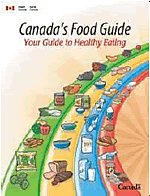 After over 3 years of "research", this coming Monday morning the wraps will be taken off the new Food Guide.
Given the incredibly large number of deficiencies in the draft Food Guide circulated in April 2006, I have to admit, I would be gob-smacked if the new Guide truly reflected medicine's understanding of the relationship of diet to chronic disease prevention and fully expect it to instead reflect the relationship of government to the food industry.
That said, if the new Guide's great, I will stand up and loudly applaud and am quite prepared to eat humble pie all over this blog.
Stay tuned, I'll post updates as soon as I've got them.
Ignorance
It has been described as bliss.
At times it feeds and fuels hatred.
Today it makes Funny Friday.
Only problem is, it might be more sad than funny - and don't kid yourself for a moment thinking that interviews like this could only happen in America, ignorance is unfortunately a global phenomenon.
Here are some prime examples of the demographic that Aquamantra is going after with their water.
Have a great weekend!
Thursday, February 01, 2007
A Terrifically Bad Snack
 McDonald's has just launched a new "Snack" food.
Called the Snack Wrap and specifically designed to be eaten with one hand while gripping the steering wheel with the other, this Franken-Snack contains 330 calories and includes 4.5grams of saturated fat, 1gram of trans-fat and a staggering 780mg of sodium (more than 30% of daily recommended values).
Again, I never knock corporations for giving consumers what they want because that's their job, but I do find it remarkable that only one day after McDonald's announced that it was replacing it's frying oils with trans-fat free versions, that they release a product containing trans-fat.
To read more about McDonald's and it's corporate drive, read this great article in business week on how McDonald's has managed to continue it's incredible market growth.
A great quote in the article comes from James Skinner, McDonald's CEO,
"We've learned. We've evolved. We believe we've cracked the code in the United States. It's a simple secret, actually: Americans like to eat all day long."A very simple secret indeed.

