
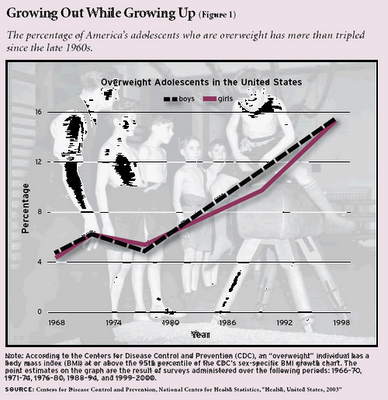
 That's the title from a great article from John Cawley and colleagues out of the Hoover Institution and Education Next.
Not that anyone's going to listen to what they have to say.
You see they're saying things that most people don't want to hear.
They're saying that PE in schools is not going to be the magic bullet to our childhood obesity problem.
According to the article, adding an additional 200 minutes of PE time into a week led high school boys to report being active only an additional 7.6 minutes more per week!.
Perhaps the failure here has to do more with genetics and less with motivation.
A fascinating piece was published recently in the International Journal of Obesity. In it Dr. TJ Wilkin and colleagues proposed the existence of an "activitystat" in children whereby by means not yet elucidated (they propose neuro-hormonal regulation) somehow children are programmed to trend towards a specific amount of activity, and then not do more.
The study used uniaxial accelerometers (for objectifying the children's levels of activity) and then compared total daily activities in children with widely varied access to PE.
They included children from a school where they were receiving 9 hours of PE per week (of course a private prep school) to one where they were receiving 2.2 hours per week (a public school with an "Activemark Gold" award for their devotion to PE) to one where they were receiving 1.8 hours per week (an inner city school with no special provisions or facilities for exercise).
What was remarkable was that after all was said and done, all the kids were equally active (or equally inactive depending on how you choose to spin the article).
The kids who exercised more at school, exercised less at home and vice-versa.
To put this all into a different perspective. To burn off one Slammer, a kid would need to be vigourously active for over 30 minutes.
According to Dr. Cawley, assuming a kid only drinks one of these weekly, we'll have to add 10 hours of PE just to burn it off.
Too bad about those vending machines....you think maybe if we got rid of them altogether, or stocked them solely with water, zero-calorie beverages and skim milk (plain old skim milk), that we'd have more success than trying to make kids move?
Such a shame that politically, that'll be more of a challenge.
Monday, October 09, 2006
"Not Your Father's PE"


Sunday, October 08, 2006
We live in a very strange world
Not only because this event actually took place, not only because someone televised it, but mainly because of the use of the term, "athlete", by the commentators and the fact that one can make a living as a "professional eater".
Friday, October 06, 2006
Like-a-Bike
 It's not a bike, but it's like-a-bike.
My wife wouldn't let me buy one, she said it was too expensive.
Basically picture a small, toddler friendly bicycle with no pedals. By using their feet, children are able to propel themselves forward and by lifting their feet up, they're able to start to learn how to balance.
Apparently kids who use these basically graduate to two-wheelers and skip the training wheels.
On the website there's a great video of a kid tooling around on one.
I may have to buy one without my wife's permission.
Quobesity
 Went down to the House of Commons again yesterday to watch the Standing Committee on Health's continued focus on Childhood Obesity.
What was striking was how little some of the "experts" knew about the subject at hand.
A number of the experts were economists and indeed, when it came to their opinions on the effects of "fat taxes", I would not question their knowledge bases. It's when they strayed from their subject at hand when the quobesity flowed thick.
One gentleman concluded that the reason for childhood obesity had nothing to do with eating and everything to do with a lack of exercise.
He surmised that he already knows what's healthy, that he can "just ask his butcher just to cut some of the fat off of his steaks", but that it's lack of exercise that has led the World to gain weight.
He continued to wax philosophic on this culminating with today's quobesity installment.
"Why can't they just make a healthier chip? You know, I bet there already are healthy chips, I bet they sell them in health food stores."
Thursday, October 05, 2006
The Wee-Ride
 As the newspapers will tell you virtually daily, childhood obesity rates are growing rapidly. Parents will often call me to ask me what they should do about their overweight kids and generally my answer's always the same - treat your lifestyles.
Kids are not going to live lives different from their parents. Live the life you want your child to live, and that includes healthy regular eating with no meal skipping or snack skipping, calorie awareness and exercise.
Perhaps the easiest way to exercise is to focus on what I often call "Functional Exercise" rather than gyms, and perhaps one of the best functional exercises is going out for family walks or bike rides.
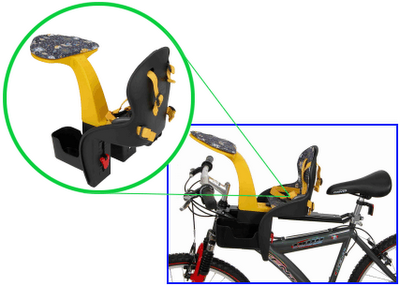
The Wee-Ride looks like a great option in place of one of those rear baby carriage thing. With the Wee-Ride you can talk easily with your child while riding and not have to worry about what's going on behind you. You can also buy an additional mounting bar so the Wee-Ride can be swapped between parental bikes.
Remember of course, once your child is old enough to ride, a better option would be their own bike.
Tomorrow I'll post on a great bike related product for toddlers.
Wednesday, October 04, 2006
Quobesity
 A new periodic feature on Weighty Matters will be Quobesity - quotes that in one way or another embody what's wrong and hopefully, occasionally, what's right with relation to our attitudes and knowledge about weight and weight related matters.
This quote comes from this past Sunday's Run for the Cure (for breast cancer research) where I'm proud to say that BMI won the Corporate Spirit Award by raising more money than any other team in Ottawa (not bad for a "corporation" with 5 full time employees) - we raised over $30,000!
As we were leaving the event some young teenagers working for McCain's were distributing their latest product - Smooth-EEZ, basically a just add milk and stir smoothie.
We asked them how many calories were in the servings and their response is today's Quobesity
"Oh not many! There's no sugar added - it's sweetened with honey!"For the record, more calories drop per drop than Coca Cola.
Tuesday, October 03, 2006
Geek-a-Cycle
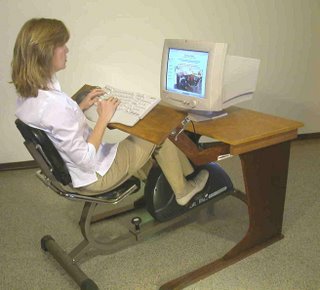 Hot on the heels of bookofjoe's treadmill desk comes the self-proclaimed "Geek-a-Cycle".
Touted as a means to pedal your way to a healthier you.
May not cause dramatic weight loss, but certainly ala Dr. Levine's NEAT hypothesis of weight management, it certainly can't hurt.
Yours for just $349.95, computer equipment not included.
Monday, October 02, 2006
Slammers - Coming soon to a school near you
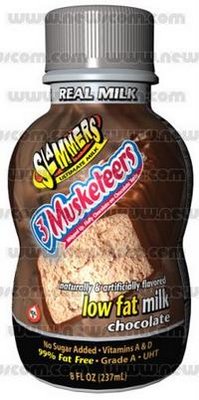 Horrifying. Here's an example of Big Food gone bad.
The press release touts their 99% fat-free-ness and their smaller 8oz serving sizes. It also brags how they meet the newer American Beverage Associate guidelines.
Here's their quote, "We saw an opportunity to create 'kid friendly', 99% reduced fat milk that is not only delicious to students, but also makes parents happy from a health and nutrition standpoint. We moved quickly to design a new package, and are proud to be the first company to provide vendable milk that meets the guidelines."
Wanna know what's in 'em?
According to the nutritional information (that took way too many clicks to get to) drinking just one of these will give your child 340 calories, more than DOUBLE the calories in a can of Coca Cola and almost 10 teaspoons of sugar.
I think that the parents that are being made "happy from a health and nutrition standpoint" better learn how to read nutrition facts labels. Might be good for them to know too that if their child's a 6 year old girl, that one drink likely accounts for 25% of the total number of calories she needs in a daytime!
Shame on Coca Cola for trying to market something so unreasonably unhealthy as a nutritious choice for children.
Friday, September 29, 2006
Food Industry Spin Doctors
 Yesterday I was given the honour of speaking in front of the Canadian House of Commons Standing Committee on Health on the subject of childhood obesity.
The panel I was on included one other clinician (a dietitian from London), an indigenous person's nutritional advocate, and then 3 corporate spokespersons representing a diverse range of companies from the restaurants, to Coca Cola, to Kentucky Fried Chicken.
Amazingly, but entirely not surprisingly, the industry spokespeople did their best to spin things in their favour.
The party line of course is that because obesity is so complex and multifactorial, to pick on any one thing as a cause would be inappropriate. I actually agree with that statement to a degree, but have a difficult time with the conclusion of all of these industry reps that therefore we should not pick on any of the various and multiple factors.
The Restaurant Industry's spokesperson tried to explain how mandatory labeling on menus of calories would be impossible due to supply chain variety. Amazingly she did that in the same breath that she mentioned the 42% of restaurant chains who voluntarily carry nutrition information in brochure form. I highly doubt that these brochures change with the supply chain.
She also questioned the value of putting calories on menus and stated that there has never been any evidence to suggest that calories on labels help. In fact that's not true. In a study available online, a high school, without providing any extra classes on the subject, simply posted calories on their cafeteria's menuboard. Immediately they noticed students choosing lower calorie options.
Certainly it would not take a degree in dietetics to know that the 2900 calorie Aussie Fries appetizer at the Outback steakhouse might be a poor choice.
Next was the beverage industry where there was much bragging about how they voluntarily took pop out of schools and replaced it with fruit drinks, juice and sports drinks. The spokesperson even bragged about the size of their containers: 250ml (8oz) containers for elementary schools, 300ml (10oz) for middle schools and 355ml (12oz) for high schools.
I of course had to point out that the expert advisory panel for the American Academy of Pediatrics with representatives from the Canadian Pediatric Society recommend that for children between 1-6 years old juice intake should be limited to 125-175mls (4-6oz) and from 7-18 years old limited to 250-355mls) and therefore every child through grade 9, with a single serving from the vending machine, actually exceeds daily recommended intake of juice. I would also like to note here that the daily recommended intake of fruit "drinks" and sports drinks is 0ml.
Remember drop per drop there are more calories in orange juice than Coke.
Now I don't blame the industry at all. They're doing their job. It's just a shame that more often than not, there's not someone there to unspin them.
Monday, September 25, 2006
Are you Giving your Kids Chocolate Bars for Breakfast?
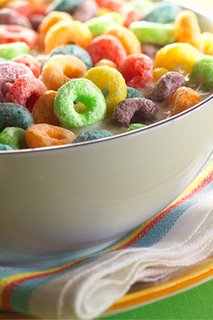 Would you feed your children chocolate bars for breakfast?
If you answered, "of course not" but give your children sugary cereals, you'd better get ready to revise your answer.
If you read food labels regularly, this might not be news, but if your child is eating a sugary cereal for breakfast, they're probably having as much or more sugar than they would if they ate a chocolate bar.
Some equivalents (based on a 50gm or 1.75oz serving):
Kellogg's Fruit Loops = 5.6 teaspoons sugar = Dark Chocolate Kit Kat Bar
Nestle Nesquick = 5.8 teaspoons sugar = Twix Bar
Post Sugar Crisps = 6.6 teaspoons sugar = Snickers Bar
Remember too that many kids will have more than one bowl.
So what should you do?
Try to give your kids cereals with 6-7 grams of fibre per serving, and unfortunately you have to be a bit cautious with the lower sugar cereals as well as often they may compensate with more carbohydrates and more calories.
Is it time yet to cut the sugary cereal out of the pantry?
Saturday, September 23, 2006
French Women DO get fat!
 You may have seen this book on the bookshelves. It's been a national best seller all over the world. Unfortunately it seems, the french women, aren't reading the book (or perhaps, like 98-99% of diet books, it fails in the most important part of weight management - sustainability).
A national survey conducted annually in France show that in fact overweight and obesity rates are rising rapidly. Currently 42% of France's population over the age of 15 is either overweight or obese.
It should be pretty telling to consumers. As of today, there are over 178,285 different diet books for sale on Amazon.com. If any single one of them was dramatically better than another, doctors offices worldwide would be prescribing it. In fact in the history of medicine, there has yet to be a study the definitively proves one diet is better than another for weight loss.
In my office at the Bariatric Medical Institute, there are no prescribed diets. Every person is an individual, with different cultural backgrounds and different dietary likes and dislikes.
Here are the only two criteria that matter for diet and weightloss:
1. You eat less calories than you burn (that will help you lose the weight)
2. You like what you're eating (that will help you keep it off)
Tuesday, September 19, 2006
Quiznos Calories
 Many times I've heard patients complain that they can't find any calories for Quiznos Subs. It's the subject of many angry rant blogs. I agree it's ridiculous that Quiznos USA refuses to release their nutritional information but the same cannot be said about Quiznos Australia. Over there their nutritional information is posted.
Now it's true not all the subs are the same as in the States, but given the nature of franchises I would imagine the numbers may well be comparable.
Only problem is their calories are listed in kilojoules.
To convert Kilojoules to Calories simply divide the number of kilojoules by 1000 and multiply by 239.
If you're worried about Calories, don't order the large white bread classic italian. It'll cost you 6755 kilojoules or 1614 calories, more than many of us burn in a daytime.
Thursday, September 14, 2006
McDonald's donates $2 million for obesity research
 Today McDonald's, in reference to the problem of childhood obesity reported that they "felt we needed to get greater education in this area" and therefore decided to donate $2 million in obesity research funding to the Scripps Institute.
Now by no means am I bashing McDonald's for funding research, nor am I bashing them for wanting to know more about childhood obesity, or even for the way they make their money.
I am however shocked that they feel the need to donate $2 million to help them to understand how they might play a greater role in the prevention of childhood obesity.
Without even wading into the debate about marketing food to children, how about they simply start dramatically reducing the portion sizes and calories counts of their children specific foods?
Hey, McDonald's, if you'd like to pay me even just $200,000 I'll help you out...anyone over there reading this? Anyone?
Friday, August 25, 2006
Star*!%*&ucks!
 Ok, I admit I took some blogger license with the post title. I've got nothing against Starbucks and in fact enjoy their coffee very much.
I am however going to use them to illustrate why the visible posting of calories on food items would be helpful.
Let's take a hypothetical 45 year old 150lb woman who like most North Americans, is inactive. According to the metabolism calculator I've referred to in a prior post, she likely burns 1800 calories daily.
Like most days, she decides she's going to hit Starbucks for coffee and breakfast. Having read about the health benefits of whole grain oats she chooses the Island Oat Bar and a Caramel Frappucino (hold the whip cream).
The Island Oat Bar has 760 calories including a heart busting 8 grams of saturated fat while her frappucino has 390 calories for a grand total of 1150 calories (more calories than 2 Big Macs or 4 McDonald's Cheeseburgers) or 65% of her total daily burned calories. Small wonder she's gaining weight and small wonder when she goes to her doctor to complain, she reports, "But I really don't eat very much". The fact is, not very much of high calorie food can still lead people to high calorie intakes.
As far as I'm concerned, it's only a matter of time until there is legislation to have calories on menuboards. Until that time, the onus is on each of us to find the calories ourselves.
A great website to look up calories is www.calorieking.com.
Remember you can gain weight on an all-salad diet if you eat enough salad and you can lose weight on an all ice-cream diet so long as you don't eat too much.
At the end of the day, it's the calories that count.
Wednesday, August 23, 2006
NEWSFLASH: Being overweight isn't good for you!
 In what I'm sure will be a disappointment to those individuals who still persist in denying that there is medical risk associated with obesity a landmark study was published in today's New England Journal of Medicine.
527,265 people were followed for over a decade in determining the risk of weight on life expectancy. The study was controlled for ethnicity, smoking status, education, physical activity and alcohol consumption.
During the 10 years of follow up 42,173 men and 19,144 women died. The death curves were U shaped with dramatic increases in risk as weight climbed.
These data also included 186,000 non-smokers. In that group the risk of death from obesity and overweight was substantially strengthened.
When restricting their observations to those who were free of preexisting diseases again there was a strengthening of the relationship between weight and death.
The bottom line's not really news - being overweight or obese is bad for your health.
Friday, August 18, 2006
The Fat Clock
 You know those clocks that count? The ones that post a real-time count of things like a country's accumulating national debt, number of people on earth, people dying of various diseases?
Well there's a new clock on the block - the Fat Clock. Using a fairly sophisticated home-made algorithm the Diet Detective website has a clock posting the running tally of the weight of all Americans. It takes into account birth rate, death rate, population age and other variables.
According to the clock, Americans are currently gaining 1,267 pounds per minute!
Tuesday, August 08, 2006
Walk away (briskly) from depression
 A great deal of well designed research has been published demonstrating that exercise is just as good, if not better, than antidepressants for mild to moderate depression.
One of the best papers on the matter was published in 2000 in the journal Psychosomatic Medicine. In it Michael Babyak and his co-authors randomly assigned 156 depressed adults to one of three groups: Zoloft, Exercise, or Zoloft plus exercise. They then looked at depression after 4 months and again after 10 months utilizing the fairly standard Hamilton Rating Scale for Depression.
Exercise involved 10 minutes of warmup followed by 30 minutes of moderate intensity cycling, jogging or brisk walking and finally by 5 minutes of cool down. This was performed 3 times per week.
The results were impressive. After 16 weeks of treatment all groups showed significant reductions in their depressive symptoms. Medication worked faster, but by week 16 exercise had caught up. What was more impressive were the results at 10 months - those exercising had lower remission rates than those on Zoloft or a combination of Zoloft and exercise.
The authors summarized their results with the following statement, "Each 50-minute increment in exercise per week was associated with a 50% decrease in the odds of being classified as depressed"
Bottom line: Don't throw out your pills, but slowly, along with your doctor, it may be reasonable to try to trade your drugs for some great shoes and a minor committment to exercise.
Wednesday, August 02, 2006
That's one scary cookie jar!
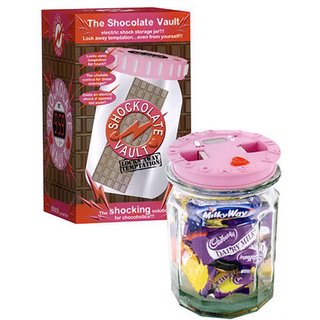 Here's a cookie jar you don't want to get your hands stuck in - the Shockolate Vault designed to keep you away from your goodies.
Not recommended by me as a diet aid, definitely recommended by me as a gag gift, the Shockolate Vault, can be set to "protect" your valuables or goodies for a given period of time. Try to get to them before the time is up and "there will be shocking consequences".
Would make for some interesting, amateur science experiements.
Tuesday, July 11, 2006
Are you ready for the McGym?
 So on July 7th in Whittier California, McDonald's opened up the "R Gym"
"Equipped with stationary bicycles attached to video games, dance pads, basketball hoops, monkey bars, an obstacle course, and a host of other games, the R Gym is intended to provide a fun, easy and convenient way for children to increase their physical activity."
Well at least they're not trying to suggest that it will help combat childhood obesity, though they do state,
"McDonald's is committed to educating its customers about balancing food consumption and physical activity."
I wonder then if they'll educate customers that in order to "balance" that Happy Meal at the R Gym, they'd better budget at least 75 minutes of time for their children to pedal furiously because the 600 average Happy Meal calories will take over an hour of vigorous activity to burn off.
Somehow, I doubt they'll tell their patrons that.
Monday, July 10, 2006
Dying, literally, for a Big Mac
 Much to my amazement, there exists a group of individuals who vehemently deny that obesity is medically risky. They're organized, write books and blogs, and often appear on national news shows claiming that it's all a big myth perpetuated through a combination of bias and capitalism. Should any of them read this blog, I would love their viewpoint on yet another in a never-ending line of well designed medical studies that clearly demonstrate the risks of obesity.
In this weeks Journal of the American Medical Association, Kathleen McTigue et al. looked at death rates and heart disease in 90,185 women following across 40 States for an average of 7 years.
Her results were not in the least bit surprising: The heavier the patient, the higher the death rate. For those with body mass indices between 30-35 death rates increased by 18%; for those with body mass indices between 35-40 death rates increased by 49%; and for those with body mass indices greater than 40 death rates rose by more than 100%.
An easier and far less scientific experiment is for you to think to yourself how many people dramatically overweight people you know who have made it past the age of 75. Speaking for myself and including the literally thousands of patients I used to have when I was working as a GP, along with the thousand or so I saw in stroke rehab, along with my friends and family, I can only think of around 30 over-75-year olds who had BMIs greater than 40, and none of them were living easy, carefree, healthy lives - they all had significant weight related co-morbidities that made their lives very difficult.
I'm all for beating down bias against obesity, and there's no doubt that some folks with significant amounts of weight to lose will lead long healthy lives unaffected by their weights. That being said, some smokers don't die from lung cancer, but of course that doesn't make smoking any healthier.

